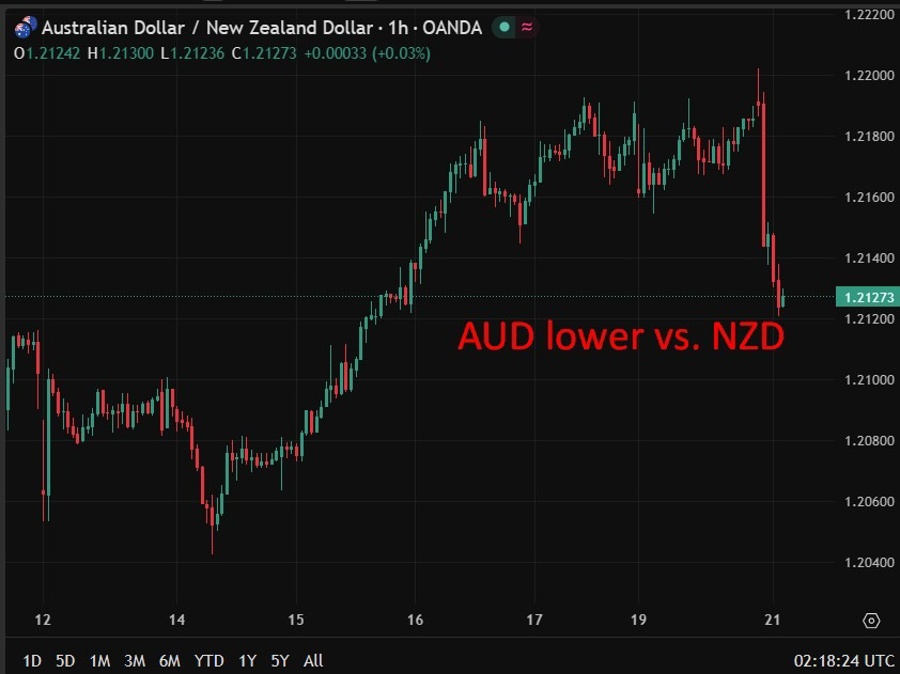
NZD rose after a stronger CPI print lifted expectations for a May RBNZ hike, while bond yields jumped and business confidence weakened, highlighting a growing tension between inflation pressures and slowing growth.
Summary:
- NZD rises after stronger-than-expected CPI
- Q1 inflation beats, annual CPI holds above target
- Markets price ~45% chance of May RBNZ hike
- Bond yields jump as policy outlook shifts
- Business confidence drops sharply
- AUD/NZD falls as rate differentials shift
The New Zealand dollar strengthened after a stronger-than-expected inflation print prompted markets to reassess the outlook for near-term monetary policy, with investors increasingly pricing in the risk of a rate hike as soon as May.
Data showed consumer prices rose 0.9% in the March quarter, exceeding expectations and leaving annual inflation at 3.1% — above the Reserve Bank of New Zealand’s 1–3% target range for a second consecutive quarter. While the release only partially reflects the inflationary impact of the Middle East conflict, it was sufficient to shift market expectations materially.
Interest rate markets moved quickly, lifting the implied probability of a May hike to around 45%, up sharply from roughly 25–30% previously. Expectations for the broader tightening cycle were also revised higher, with cumulative hikes now seen exceeding prior projections.
The shift in policy expectations drove moves across markets. The New Zealand dollar advanced, recovering from recent lows, while government bond yields rose sharply, reversing a multi-day decline as investors adjusted to a more hawkish policy outlook.
However, the inflation surprise comes against a backdrop of deteriorating business sentiment. A separate survey showed confidence dropped sharply in the first quarter, with firms increasingly cautious as geopolitical tensions and higher energy costs weigh on the outlook. The divergence between firm inflation and weakening confidence highlights the challenge facing policymakers.
Across the Tasman, the Australian dollar was little changed, though it lost ground against the kiwi as rate differentials moved in New Zealand’s favour. The cross retreated from recent multi-year highs, reflecting the shift in relative monetary policy expectations.
Markets now face a complex mix of rising inflation pressures and softening growth signals, with developments in the Middle East, particularly around the ceasefire deadline, likely to play a key role in shaping both central bank decisions and broader risk sentiment.