ANZ's call for a hike framed around risk management rather than a strong economic signal suggests the bank sees limited room for the RBNZ to sit still even with headline inflation pressures easing. The emphasis on a soft New Zealand dollar as an underappreciated inflation risk points to FX markets as a key channel to watch, since a further currency slide could reinforce the case for tightening independent of oil. ANZ's preferred scenario, a hike paired with noncommittal forward guidance, would likely produce a more muted market reaction than either a hawkish hold or a hawkish hike, both of which the bank sees carrying greater risk of volatility or an eventual loss of credibility should incoming data disappoint.
ANZ expects the RBNZ to raise the OCR 25bp to 2.50% next Wednesday despite the sharp fall in oil prices, arguing a neutral-to-dovish hike offers the most comfortable footing given persistent inflation risk and a softer NZD.
Earlier:
- RBNZ set to hike rates to 2.50% on July 8 as inflation persists, poll shows
- Preview: RBNZ tipped to hike 25bp in July as oil slide clouds tightening outlook
- RBNZ preview: Westpac see July 8 rate hold. Tightening cycle still in effect, pared back
Summary:
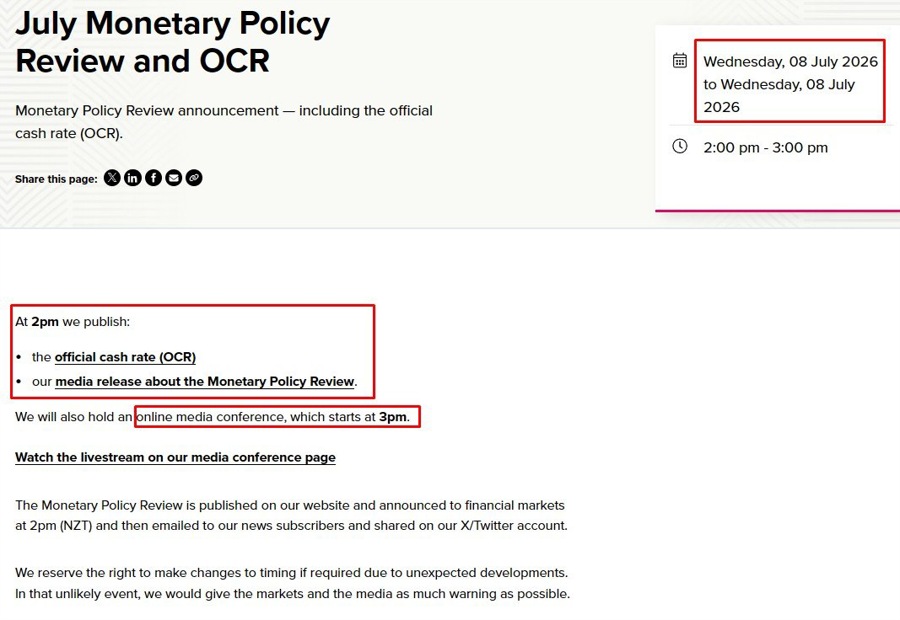
- ANZ expects the RBNZ to raise the OCR by 25 basis points to 2.50% at Wednesday's Monetary Policy Review
- The bank argues a hike is warranted despite the sharp fall in oil prices, citing an OCR still 75bp below neutral, a softer than assumed NZD, and inflation set to sit above the target band for a period
- Market odds on a hike were sitting at about 75% at the time of writing, with ANZ favouring a "neutral-to-dovish" hike paired with an open-minded statement as the strategy most likely to limit market volatility
- An inertial Taylor Rule using non-tradable inflation suggests the RBNZ probably should have already hiked in May
- ANZ forecasts Q3 GDP growth of 0.5% quarter-on-quarter, above the RBNZ's own 0.2% forecast, while noting wage-setting intentions retreated rapidly after the oil price shock but remain elevated
- The RBNZ's May Summary Record showed committee members split between those wanting to wait for more data and those pushing for earlier hikes to limit the overall size of future increases
ANZ Research expects the Reserve Bank of New Zealand to raise the Official Cash Rate by 25 basis points to 2.50% at Wednesday's (8 Jult) Monetary Policy Review, arguing the move is justified on risk management grounds even as oil prices have fallen sharply back toward pre-shock levels.
In a preview note, ANZ said the starting point for the OCR matters more than any single data point, arguing that 2.25% is too low to balance the risks around medium-term inflation given the RBNZ's own central estimate for neutral sits at roughly 3%. The bank noted the committee was already planning to lift the OCR back toward neutral before the oil price spike, meaning much of the recent debate has been about timing rather than direction. With the OCR still an estimated 75 basis points below neutral, growth conditions holding up better than expected, the New Zealand dollar softer than the RBNZ's own assumptions, and inflation still set to run above the target band for a period, ANZ argues it makes sense to lock in a hike now despite the recent oil price retreat.
Strategically, ANZ sees a "neutral-to-dovish" hike, in which the committee raises rates but sounds deliberately noncommittal about what follows, as the option that would generate the smallest market reaction and leave the committee in the most comfortable position. The bank contrasts this with a "hawkish hold," which it says would likely trigger a bigger and more disruptive shift in swap rates and the currency, and a "hawkish hike," which risks looking overconfident if incoming data proves as volatile as ANZ expects over the coming weeks. An inertial Taylor Rule using non-tradable inflation, built from one-year-ahead inflation expectations and the RBNZ's own estimate of the output gap, suggests the central bank arguably should have already raised rates back in May.
On growth, ANZ said recent data suggests New Zealand's economic recovery was a little more established than initially thought, with revised first-quarter GDP coming in stronger than the RBNZ's May forecast. The bank's own nowcast has lifted its second-quarter GDP estimate from a contraction to flat, in line with the RBNZ's forecast, and it expects a bounce-back of 0.5% growth in the third quarter, above the RBNZ's 0.2% projection. On inflation, ANZ pointed to wage-setting intentions as the more reliable medium-term signal compared with near-term cost and pricing indicators, noting that wage intentions retreated quickly after the oil shock but remain meaningfully elevated and warrant close watching as confidence in the recovery builds.
The bank also flagged that the RBNZ's May Summary Record of Meeting showed a split committee, with some members emphasising contained core inflation and deteriorating activity as reasons to wait, and others warning that broader-based price increases and rising two-year inflation expectations argued for moving earlier to limit the eventual size of the tightening cycle. All members agreed further OCR increases were likely to be necessary over coming meetings, leaving the pace, rather than the direction, of tightening as the key open question heading into next week's decision.