The USDCHF is pushing to fresh session lows in early North American trading and is now trading at its lowest level since March 11. The latest leg lower has taken the pair beneath the 61.8% retracement of the 2026 trading range at 0.7771, while also breaking below a key swing area between 0.7771 and 0.7782. The low price has reached 0.7768 so far, keeping the sellers firmly in short-term control.
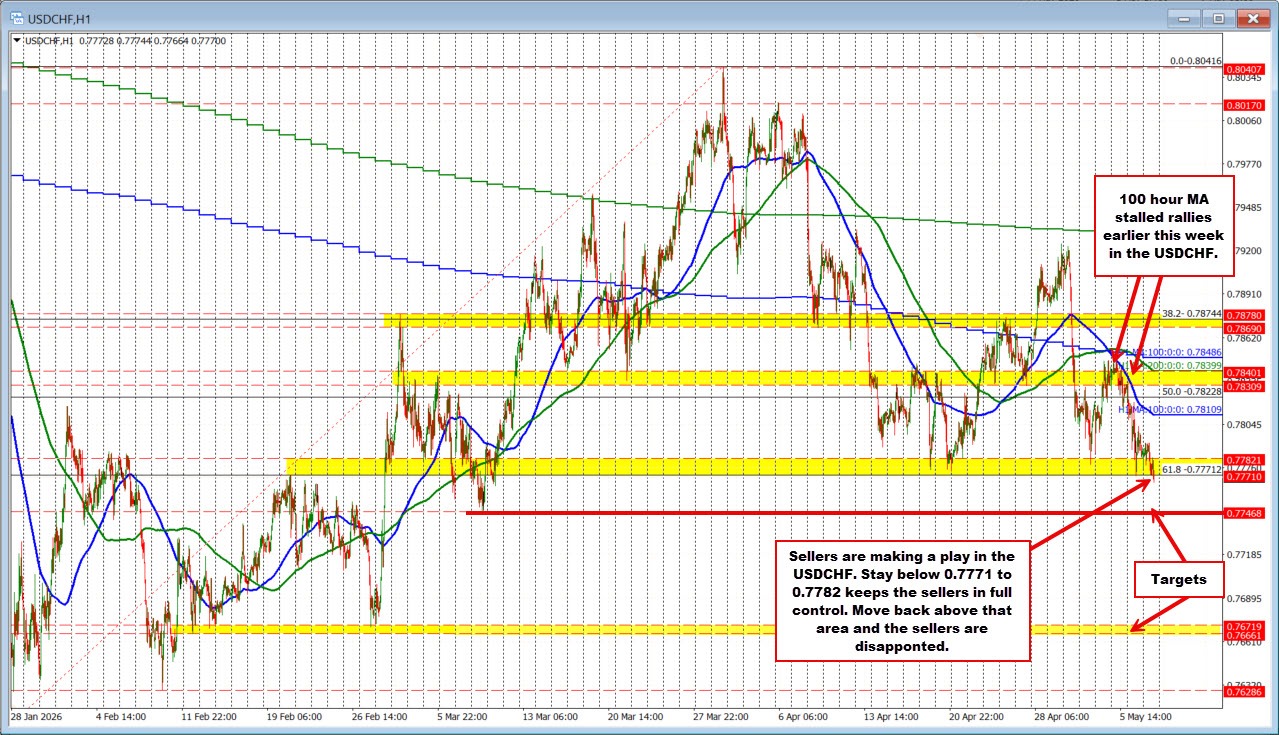
With the break below that support zone, the 0.7782 level now becomes the key near-term risk-defining level for sellers. As long as the price remains below that ceiling, traders will continue to favor further downside momentum.
Recall that earlier this week the pair attempted to rebound, but buyers repeatedly ran into sellers leaning against the falling 100-hour moving average — first on Tuesday and again at the start of trading on Wednesday. The inability to break and stay above that moving average reinforced the bearish technical bias and gave sellers a low-risk opportunity to lean against the level with clearly defined risk.
So what comes next?
If the price can stay below 0.7782, sellers will target the March 10 swing low at 0.77468. A break below that level would open the door for a deeper move toward the broader swing area from February 11 through February 27 between 0.7666 and 0.7672.
Below that zone, traders would begin targeting the 2026 lows at 0.7628 and ultimately 0.7604.
Conversely, if the current breakdown fails and the price rotates back above 0.7782, it would likely disappoint sellers and trigger short-covering back toward the falling 100-hour moving average, currently at 0.78109. Buyers would need to regain and hold above that moving average to shift confidence back in their favor after repeated failures there earlier this week.
Arguing against further CHF buying is the threat from intervention. Amid the Middle East conflict, the SNB signaled a greater willingness to intervene in currency markets to prevent excessive Swiss franc appreciation and protect price stability. This was reiterated in a late April speech by SNB Governor Schlegel, who said the SNB's willingness to intervene in the foreign exchange market has increased, and that it can counter a rapid and excessive appreciation of the Swiss franc, as such appreciation would jeopardize price stability in Switzerland.
However, analysts believe outright systematic intervention is constrained — the SNB is unlikely to engage in systematic intervention to weaken the Swiss franc in coming months, with the fear of being perceived as a currency manipulator by the US administration likely influencing this decision.