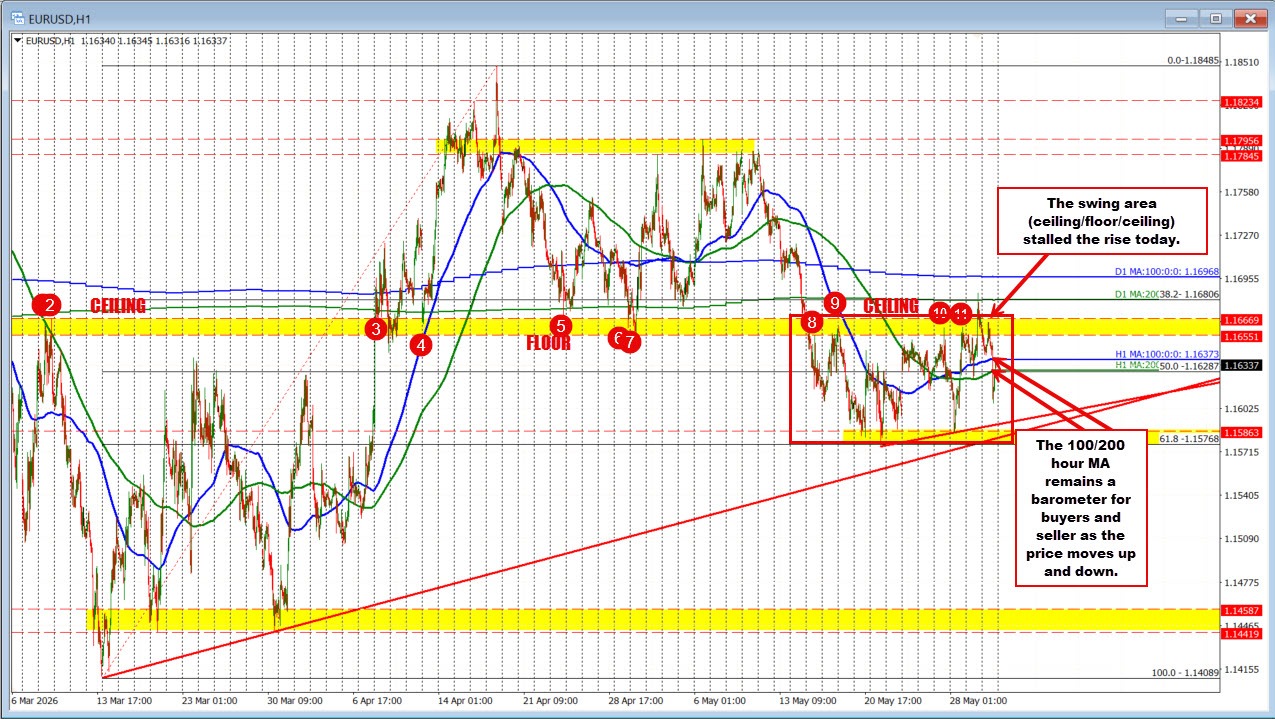
For the last 12 days, the EURUSD has been trapped in a relatively tight range between 1.1576 and 1.1669. While buyers managed to push the pair above the topside boundary on Friday, reaching 1.1685, the breakout quickly failed. The price reversed lower into the close and finished back below the 1.1669 resistance level, reinforcing the importance of that ceiling.
In the middle of the range sit the key hourly moving averages that have helped define the near-term battle between buyers and sellers. The 100-hour moving average at 1.1637 and the 200-hour moving average at 1.1629 are clustered with the 50% midpoint of the rally from the March low, making this area an important barometer for short-term direction. However, while the moving averages help gauge intraday bias, traders are likely more focused on the outer edges of the range, where a break could trigger a stronger directional move.
A move below 1.1576 would represent a downside breakout, taking the pair to its lowest level since April 7 and pushing it below the 61.8% retracement of the rally from the March low. If sellers gain that control, there is relatively little technical support until the 1.1505 area, giving the downside room to extend.
On the topside, resistance is more clearly defined. The 200-day moving average at 1.1681 and the 100-day moving average at 1.1697 sit just above the recent highs. Those longer-term moving averages tend to attract attention from risk-focused traders, and a sustained move above them would strengthen the bullish case and signal that buyers are regaining control.
For now, the EURUSD remains near the middle of its recent range, with the battle centered around the hourly moving averages. However, with the pair still trading below both the 200-day and 100-day moving averages and below the recent swing-high area, sellers maintain a slight technical advantage. Buyers can begin to chip away at that edge by keeping the price above the 100-hour moving average at 1.1637 and then challenging the key resistance levels overhead.