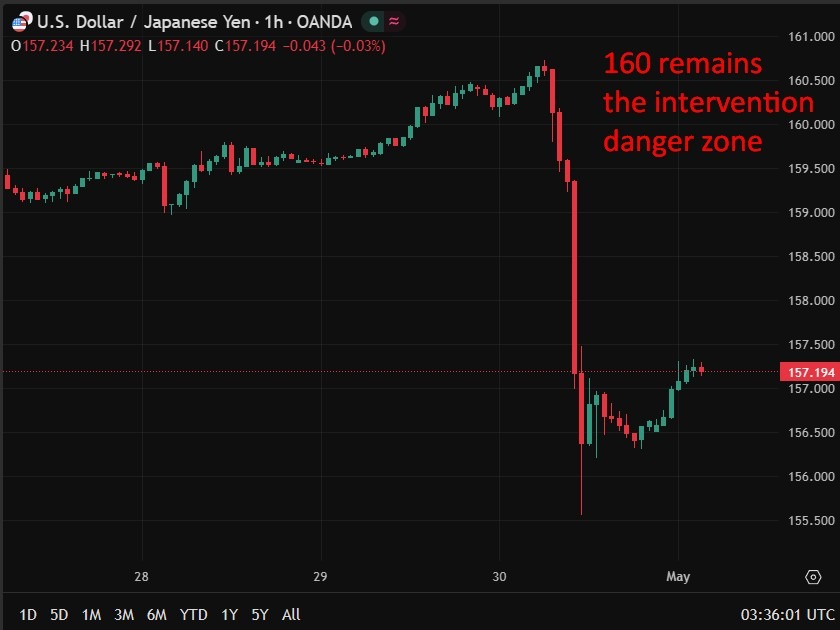
- Japan intervenes to defend yen and warns of further action over Golden Week
- Axios:Trump received briefing on plans for possible military action against Iran
- ASEAN ministers warn Middle East war threatens energy security and regional growth
- May meeting, RBA set for third straight hike as Hormuz closure drives inflation surge
- Japan manufacturing PMI hits 4-year high but Middle East stockpiling masks fragile demand
- Japan head intervention official won't comment on FX or oil futures intervention
- Tokyo CPI misses forecast sharply, giving BoJ room to hold despite June hike signals
- Gold could nearly double, $8K, as emerging market central banks ditch the USD for bullion
- Japan: Tokyo area April CPI headline 1.5% y/y (expected 1.7%, prior 1.4%)
- Australian factory input costs hit four-year high as Middle East supply disruption bites
- S&P 500 considers fast-track entry rules as SpaceX, OpenAI and Anthropic eye IPOs
- NZ consumer confidence hits three-year low as Middle East oil shock bites
- ECB June hike near-certain as Middle East energy shock forces policymakers' hand
- Deutsche Bank sees ECB leaving door open to hike in June as inflation expectations surge
- Morgan Stanley delays Fed cut call to 2027 (more info). Middle East risk drives dollar
- S&P and NASDAQ indices close at record levels
- Apple authorises $100 billion buyback. Quarterly profits top Wall Street estimates
At a glance:
- Asia-Pacific markets subdued with Singapore, Hong Kong and mainland China on holiday; Japanese markets will be closed Monday to Wednesday next week for Golden Week
- USD/JPY edged back above 157.00 as Mimura declined to officially confirm Thursday's intervention but warned speculators that Golden Week has just started and his view on speculative market moves is unchanged
- Tokyo April CPI missed across all three measures: headline 1.5% vs 1.6% expected; core ex-food 1.5% vs 1.8% expected, slowest since March 2022; core-core ex-food and energy 1.9% vs 2.3% expected
- Core Tokyo inflation below the BoJ's 2% target for a third consecutive month, giving the bank cover to delay a June hike despite hawkish April meeting signals; yen-negative
- Australia and Japan manufacturing PMIs both posted strong headlines that masked significant underlying weakness in output, orders and supply chains
The Asia-Pacific timezone was a little subdued today with market holidays in major centres Singapore, Hong Kong and also mainland China. Note that Japanese markets will be closed Monday through Wednesday, inclusive, next week.
Atsushi Mimura, the Ministry of Finance's most senior official on international financial affairs, declined to confirm JPY intervention directly but delivered a pointed warning to speculators, noting that Japan's Golden Week holidays have just started and that there is no change to his view that market moves remain speculative in nature. USD/JPY ticked a little higher in a retrace move today, taking the pair back above 157.00.
In data today from Japan we had the Tokyo area CPI for April. Tokyo area inflation data leads the national data by about three weeks. Tokyo headline CPI came in at 1.5% year-on-year in April, below the 1.6% forecast and up from 1.4% in March. Core CPI excluding fresh food rose 1.5% year-on-year, its slowest pace since March 2022, missing the 1.8% forecast and slowing from 1.7% in March. Core-core CPI excluding fresh food and energy rose 1.9% year-on-year, well below the 2.3% forecast and the 2.3% prior reading, marking a significant deceleration in the measure most closely watched by the BoJ as a gauge of trend inflation. Tokyo core inflation has now remained below the BoJ's 2% target for a third consecutive month, with fuel subsidies cited as a key factor suppressing readings despite rising raw material costs linked to the Middle East conflict. The continued drift lower is significant enough to give the BoJ genuine cover to delay a June hike despite the hawkish signals delivered at the April meeting. This, of course, is yen-negative.
We had mixed manufacturing PMI data from Australia and Japan. Both delivered strong headline results that masked significant areas of weakness.