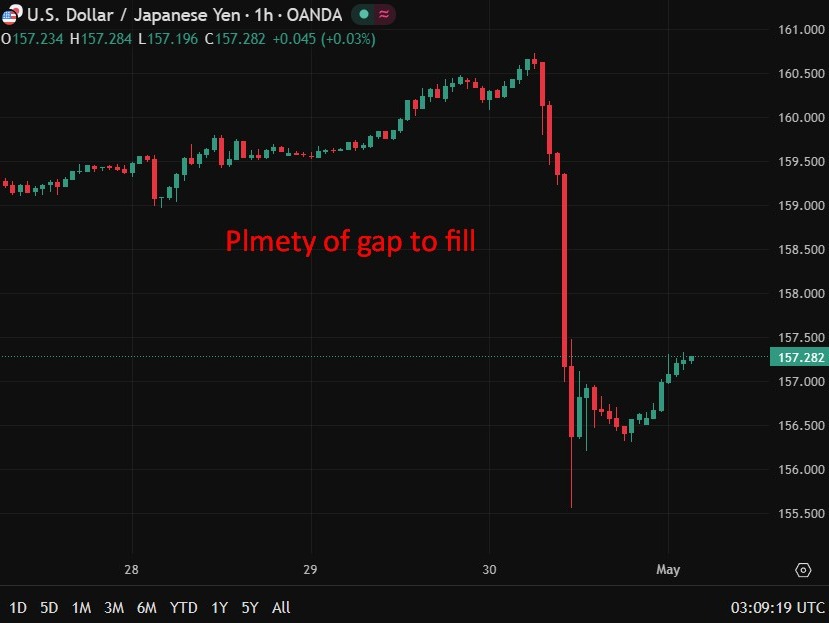
Japan basically confirmed FX intervention for first time in nearly two years after yen breached 160/USD, sending it 3% higher to 155.5. Mimura warns further action possible during Golden Week. US and Japan in extremely close contact on markets.
Summary:
- As flagged in our earlier coverage, Japan has now all but confirmed it intervened in the foreign exchange market on Thursday, its first such action in nearly two years, after the yen breached the 160 per dollar level widely seen as authorities' line in the sand
- The intervention sent the yen surging by as much as 3%, reaching 155.5 per dollar before trimming gains to stand at 156.99, still well clear of the 160 level that triggered the response
- Atsushi Mimura, the Ministry of Finance's most senior official on international financial affairs, declined to confirm the intervention directly but delivered a pointed warning to speculators, noting that Japan's Golden Week holidays have just started and that there is no change to his view that market moves remain speculative in nature
- Finance Minister Satsuki Katayama had telegraphed the action on Thursday, warning of decisive action and notably urging reporters to keep their smartphones on hand throughout the holiday period, an explicit signal of readiness to move again
- Mimura confirmed Japan is in extremely close contact with the US on currency markets, and that both countries agree action may be needed depending on market developments, a co-ordination signal that meaningfully raises the deterrent effect of any further intervention
- Japan's previous intervention was in July 2024, when the yen hit a 38-year low of 161.96 per dollar
- Japanese markets will be closed Monday through Wednesday for Golden Week, a period of sharply reduced liquidity that analysts warn could invite aggressive speculative attacks on the yen
- The structural drivers of yen weakness remain in place: the BoJ is raising rates slowly, the Fed is not cutting given persistent inflationary pressure, and oil prices above $100 continue to compound Japan's import cost burden
- Mimura also reiterated that Japan has conditions in place and stands ready to act in crude oil futures markets if volatility there spills over into yen moves, a tool he had flagged in earlier remarks
Japan has followed through on the warnings delivered earlier on Friday, stepping into the foreign exchange market to buy yen for the first time in nearly two years after the currency breached the 160 per dollar threshold that authorities had effectively declared their line in the sand. The intervention, confirmed to Reuters by two sources familiar with the matter, sent the yen surging by as much as 3% to 155.5 before it trimmed gains to sit at 156.99 as of Friday afternoon.
As covered in our earlier report on Atsushi Mimura's initial remarks, the Ministry of Finance's most senior international finance official had carefully avoided confirming or denying intervention while leaving no ambiguity about Tokyo's readiness to act. That posture hardened on Friday. When asked whether Japan could intervene during the Golden Week holiday period, Mimura told reporters he would not comment on future action before adding pointedly that Japan's Golden Week holidays have just started, a formulation that left little room for doubt about the implied message.
The groundwork had been laid the day before. Finance Minister Satsuki Katayama issued a warning on Thursday that decisive action was approaching and, in an unusually direct signal of intent, urged reporters to keep their smartphones nearby throughout the holiday period. Hours later, Tokyo moved.
The co-ordination dimension of Friday's remarks adds a layer of significance beyond the intervention itself. Mimura confirmed that Japan and the United States are in extremely close contact on currency markets and that both sides agree further action may be warranted depending on how conditions develop. That bilateral alignment, if sustained, substantially increases the deterrent effect of any future intervention. Unilateral action can be faded by determined speculative flows; action perceived to carry US endorsement is considerably harder to bet against.
The structural backdrop that has driven the yen to these levels has not changed. The BoJ's cautious approach to rate normalisation, reaffirmed by Governor Kazuo Ueda's measured tone at this week's press conference despite three board members dissenting in favour of an immediate hike, continues to leave a wide and persistent interest rate gap with the United States. The Fed, facing its own inflation pressures, is not moving toward cuts. Oil above $100 a barrel is simultaneously worsening Japan's current account through higher import costs and generating the inflationary pressure that keeps the Fed on hold. The yen remains caught in that crossfire.
Golden Week now presents the immediate tactical risk. With Japanese markets closed Monday through Wednesday, liquidity will thin sharply, historically a condition that amplifies currency moves in both directions. Mimura's public warnings are designed to raise the cost of testing those thin markets, but the structural case for yen weakness means speculators have strong incentives to probe the intervention level regardless.

---
As noted in our earlier coverage of Mimura's initial remarks, the intervention risk was clearly flagged before Tokyo acted. The execution has moved the yen from above 160 to around 157, but the structural drivers of yen weakness remain entirely intact: the BoJ is hiking slowly, the Fed is not cutting, oil above $100 is compounding Japan's terms-of-trade problem, and Golden Week liquidity is about to thin dramatically. That combination means the intervention buys time rather than resolves the underlying pressure.
The co-ordination signal with Washington is the most significant new element. Mimura's statement that Japan and the US are in extremely close contact and that both agree action may be needed is a meaningful escalation from unilateral jawboning, suggesting any further intervention could carry implicit US endorsement, which would substantially increase its deterrent effect on speculators.