Trump said he brokered a halt to Israel-Hezbollah fire and expects an Iran deal to reopen the Strait of Hormuz within a week, though markets remain deeply sceptical of his conflict timeline.
Summary: Source: Donald Trump via Truth Social and ABC News
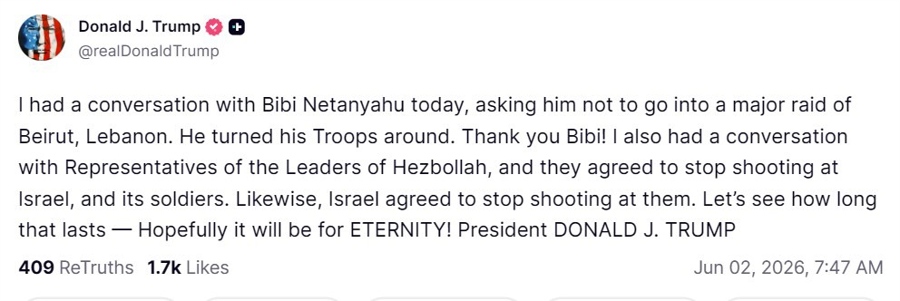
- Trump said he called Netanyahu and asked him not to proceed with a major raid on Beirut, and that Israeli troops were turned around
- Trump said he spoke with representatives of Hezbollah leadership, who agreed to stop shooting at Israel; Israel reciprocally agreed to halt fire
- Speaking to ABC News, Trump said he expects an agreement with Iran to extend the ceasefire and reopen the Strait of Hormuz within the next week
- Trump described the Israel-Lebanon flare-up as a "little glitch" and said the Iran deal was "looking good"
President Donald Trump claimed on Monday that he had personally brokered a halt to hostilities between Israel and Hezbollah, saying he called Israeli Prime Minister Benjamin Netanyahu to stop a planned major military raid on Beirut and separately secured a commitment from Hezbollah representatives to cease fire, with Israel agreeing to do likewise.
Trump made the claims via Truth Social and in remarks to ABC News, where he added that he expected to have a deal with Iran to extend the ceasefire and reopen the Strait of Hormuz within the next week. He described the situation as "looking good," and characterised the recent flare-up in Lebanon as a "little glitch" in what he portrayed as a broader diplomatic process moving toward resolution.
The remarks follow a well-established pattern. Trump has expressed confidence in a swift end to the conflict repeatedly since its escalation began, and those assurances have consistently failed to translate into the verified, durable outcomes markets would need to reprice risk meaningfully lower. The Strait of Hormuz remains effectively closed, Iranian mine-laying activity was reported as recently as last week, and oil prices, while volatile around Trump's statements, have not priced in anything close to a genuine resolution.
What the statements do reliably produce is a short-term mechanical bid in equities and a brief compression of oil risk premia. That dynamic has become a recognised feature of the trade, with participants buying the headline while positioning for the follow-through to disappoint. Trump, aware of the market sensitivity, has shown little reluctance to supply optimistic framing at regular intervals.
The credibility gap is the central problem. A ceasefire along the Israel-Lebanon front, even if it holds, does not by itself address the Hormuz closure, the core supply disruption driving oil prices. Until verified progress on that specific point emerges, the market's sceptical read of Trump's timeline is likely to persist.
---
Markets have learned to trade Trump's optimism on the conflict as a short-term signal rather than a reliable forward indicator, buying the headline and fading the follow-through. The pattern has repeated since the earliest days of the war, with Trump repeatedly framing resolution as imminent while the Strait of Hormuz has remained effectively closed. The exploitation of market dynamics, where positive statements mechanically lift equities and compress oil risk premia, has become a feature of the trade, with participants increasingly aware they are being managed as much as informed.