Tesla posted $1.44bn Q1 free cash flow vs expected burn but flagged a sharp rise in capex to ~$25bn in 2026. The company expects negative free cash flow ahead as it ramps investment in AI, robotaxis and robotics, shifting focus to long-term growth.
Summary:
- Q1 free cash flow: $1.44bn vs -$1.43bn expected → major upside surprise
- Capex guide raised to ~$25bn for 2026 (vs $9bn in 2025)
- Company expects negative free cash flow for remainder of 2026
- Spending tied to AI, robotaxis, and robotics expansion
Tesla signalled a major step-up in investment following its latest earnings, indicating that a new capital-intensive phase is underway as the company doubles down on artificial intelligence, autonomy and robotics.
The update came after a stronger-than-expected first-quarter performance, where the company delivered positive free cash flow of $1.44 billion, a sharp contrast to expectations for a $1.43 billion cash burn. The result suggested tighter cost control and operational resilience in a challenging global environment, even as revenue of $22.39 billion came in slightly below consensus estimates.
However, the near-term strength was overshadowed by a significant shift in forward guidance. Management indicated that capital expenditures will rise substantially, with the full-year outlook lifted to around $25 billion for 2026, up sharply from $9 billion in 2025 and above earlier expectations for just over $20 billion. The increase reflects a strategic pivot toward large-scale investment in next-generation technologies.
Executives signalled that the company is entering a multi-year heavy investment cycle, with spending focused on building out AI-driven capabilities, including autonomous vehicles and humanoid robotics. This transition is expected to weigh on cash generation, with negative free cash flow anticipated for the remainder of 2026 despite the strong start to the year.
Much of Tesla’s valuation is increasingly tied to these future initiatives rather than its core automotive business. The company is advancing plans to scale production of fully autonomous vehicles, including a dedicated robotaxi platform, while also expanding its presence in robotics. Early rollout of robotaxi services is already underway in select US cities, with further expansion planned.
At the same time, the core electric vehicle segment faces ongoing pressure. Competition is intensifying globally, particularly from lower-cost rivals, while the removal of certain policy incentives has added to demand headwinds. Although there are signs of stabilisation in some regions, overall delivery growth expectations remain modest.
Tesla is also exploring new vehicle offerings, including a smaller, lower-cost model, though this remains in early development and is unlikely to contribute meaningfully in the near term.
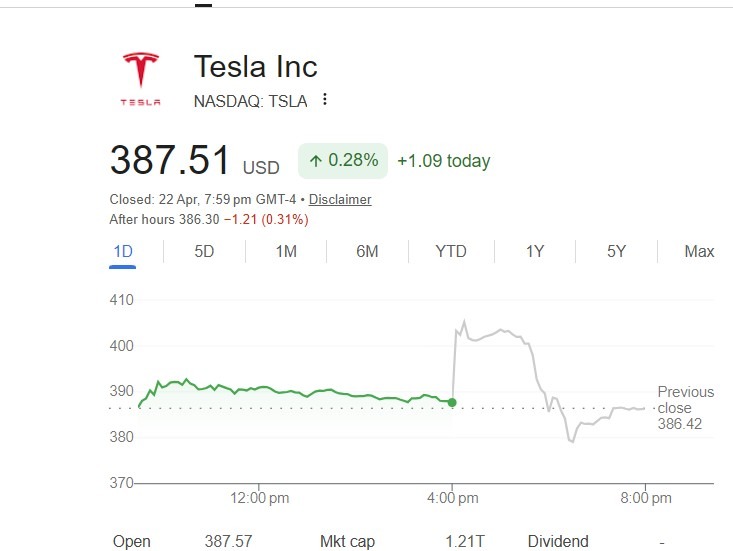
The combination of rising investment and uncertain near-term returns appears to have unsettled investors. Shares initially moved higher following the earnings release but reversed course during the conference call as the scale of future spending became clearer.
Overall, the results highlight a company transitioning away from near-term profitability metrics toward a longer-term, capital-intensive strategy centred on AI and automation.