Shares of Microsoft are trading up nearly $10 or 2.43% at $419.37, bucking the bias in the market which has a second exit down -1.26% in the S&P index down -0.8%.
Although higher on the day, the price of Microsoft has been a big underperformer for the year. The stock is still down -13.21% after closing the year at $483.62.
The rise today comes after Billionaire investor Bill Ackman revealed that Pershing Square has built a new core position in Microsoft, arguing the recent selloff has created an attractive long-term opportunity. Microsoft shares are down more than 13% this year as investors worry about slowing cloud growth, rising AI spending, and the company’s evolving relationship with OpenAI. Ackman believes those concerns are overdone and says the market is underestimating the durability of Microsoft’s enterprise software business.
Ackman highlighted Microsoft’s Azure cloud platform and Microsoft 365 ecosystem — including Copilot AI — as key long-term strengths. He defended the company’s aggressive AI spending plans, saying the investments are necessary to support future growth. He also argued Microsoft’s shift toward a more open AI model strategy should be viewed as a positive, not a weakness, and estimated Microsoft’s economic interest in OpenAI could be worth roughly $200 billion.
The investment continues Pershing Square’s recent strategy of buying major technology companies during periods of investor skepticism. Ackman noted the firm previously made similar bets on Alphabet, Amazon, and Meta Platforms when markets became overly focused on near-term risks tied to AI competition and spending.
Technically, the stock is once again testing — and trading above — its 100-day moving average at $419.15 (see blue line on the chart below). That moving average has become an important battleground between buyers and sellers over the last few months. Back on April 22, the price pushed above the level but quickly reversed lower before the close. Similar upside attempts on April 28 and again on May 7 also failed to generate sustained momentum. Those repeated failures have reinforced the importance of the 100-day moving average as a key barometer for the market’s bias.
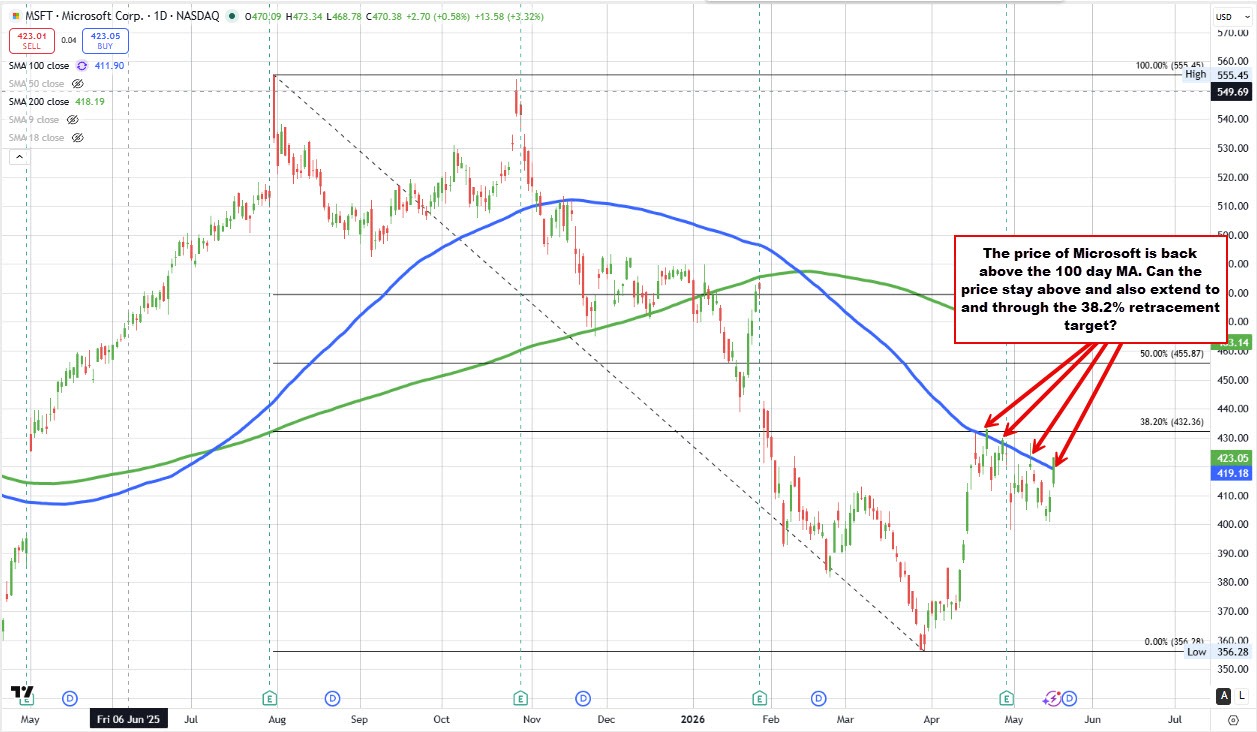
For buyers, getting and staying above the 100-day moving average is an important first step in signaling that the worst of the recent selling pressure may be behind the stock. Holding above the level would help shift the short-term technical bias more to the upside and could encourage additional momentum buying. However, simply moving above the moving average is not enough on its own. Buyers still need to prove they can maintain control after multiple failed breakout attempts over the past several weeks.
Looking higher, the next major technical hurdle comes at the 38.2% retracement of the decline from the all-time high reached at the end of July 2025. That retracement level comes in at $432.36 and has already proven to be a difficult ceiling. The corrective rally high on April 17 reached $431.58 before stalling, while the April 22 rally extended to $433.70 before reversing lower once again. Those prior failures near the retracement level underscore its importance as a key resistance target.
Another key target would be the 200 day moving average which is all way up at $463.13.
If buyers can break and sustain momentum above the 100 day MA and then the 38.2% retracement (and prior corrective highs) at the $432 area, it would go a long way toward improving the broader technical outlook and increasing confidence that a more meaningful recovery is underway. Until then, the stock remains in a rebuilding phase after a sharp decline. Even with the recent bounce, shares are still down roughly 24% from the all-time high reached in July 2025.