The NASDAQ led the selloff on Friday, tumbling 4.18%, with losses reaching nearly 4.5% at the session lows. The S&P 500 declined 2.65%, after being down as much as 3.0%, while the Dow Jones Industrial Average fell 1.35%.
The catalyst was a sharp rise in Treasury yields following a stronger-than-expected U.S. employment report. Nonfarm payrolls increased by 172,000 in May, well above the 85,000 estimate, while revisions added a net 93,000 jobs to prior months. The stronger labor market data reinforced concerns that the Federal Reserve may have less urgency to cut interest rates, sending the 2-year Treasury yield up 11.3 basis points and the 10-year yield up 6.7 basis points.
Stocks never found their footing following the jobs report and instead spent the day grinding steadily lower. Selling pressure intensified later in the session after reports surfaced that Meta was considering an equity offering to help finance its massive AI infrastructure buildout. The news followed Alphabet's $85 billion equity raise earlier this week, raising concerns that technology giants are increasingly turning to stock issuance rather than relying solely on cash flow or debt financing to fund their AI ambitions.
The market was arguably vulnerable to a pullback. Prior to this week's decline, the S&P 500 had rallied for nine consecutive weeks, while the NASDAQ had posted only one negative week during that stretch, slipping a mere 0.08%. From its March low to its recent record high, the S&P 500 surged 20.64%, while the NASDAQ advanced an impressive 31.42%.
Even after this week's declines of 2.65% for the S&P 500 and 4.18% for the NASDAQ, many of the market's biggest winners remain up dramatically in 2026. The AI and semiconductor sectors, in particular, have produced extraordinary gains. While several high-flying stocks fell more than 10% on Friday alone, many remain up more than 117% year-to-date, with SanDisk still ahead by an eye-popping 556.42%.
Those types of gains have all the hallmarks of a speculative boom. As a result, Friday's sharp reversal may reflect more than just concerns over higher interest rates—it may also signal that investors are beginning to lock in profits after one of the strongest runs seen in years.
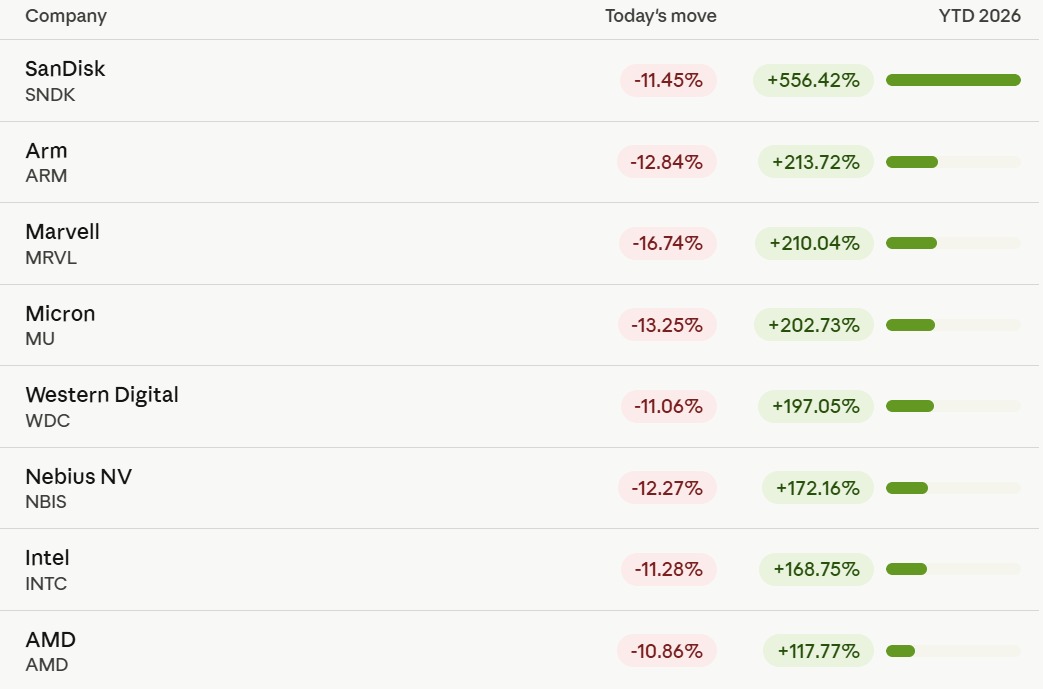
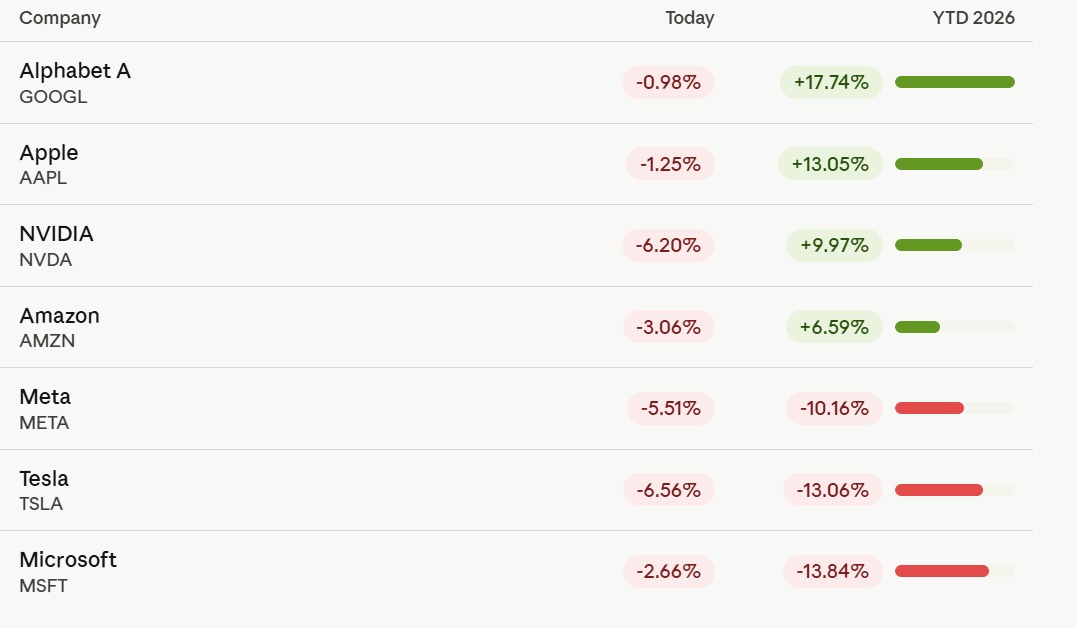
Comparing those stocks to the Magnificent 7, the run-up is even more pronounced, with four of the magnificent 7 stocks higher on the year (with Alphabet leading at 17.74%). Shares of Microsoft are down -13.84%, Tesla is down 13.06%, and Meta is down -10.16%. That does not compare to the three digit gains seen in the stocks above.
Things are starting to feel a bit out of balance, and today's sharp decline in stocks reflects that growing unease. The war in the Middle East continues, oil prices remain elevated even after today's pullback, inflation pressures are proving stubborn, and a stronger-than-expected economy is pushing Treasury yields higher. Against that backdrop, a stock market that had become increasingly stretched after months of gains was vulnerable to a correction.
The political backdrop adds another layer of complexity. President Trump has made it clear that he does not like falling stock prices, nor does he welcome higher gasoline and energy costs. With the midterm elections approaching in November, economic and market performance will remain under intense scrutiny.
The challenge for policymakers is that their options are becoming more constrained. Inflation expectations are beginning to creep higher, making it more difficult to pursue aggressively stimulative policies without risking another inflation wave. During Trump's first term, the COVID crisis ultimately opened the door to unprecedented fiscal and monetary support. Today, the environment is very different. Economic growth remains solid, employment is healthy, and inflation risks have not fully disappeared. As a result, the policy playbook is much narrower, leaving Washington with fewer easy solutions if growth begins to slow while inflation remains elevated.
President Trump can point to the repair and refilling of the Reflecting Pool, the restoration of Washington's iconic fountains, the new ballroom project, and even the planned MMA stadium as visible accomplishments -for some. But for many Americans, the stock market has been the most tangible measure of economic success and you can only tout those things for so long. They are nice but not everyone vacations in Washington DC (although it is nice), and tourism from overseas is also down.
Until recently, soaring equity prices gave the White House something to celebrate. However, if the market's cracks today begin to widen into a more sustained correction, that source of confidence could quickly disappear. Rising interest rates, elevated energy prices, and growing concerns about inflation are already creating headwinds. If stocks continue to unravel, the mood in Washington could shift from confidence to intense concern in a hurry.
For an administration that has often pointed to market gains as evidence that its policies are working, a prolonged downturn would remove one of its strongest talking points and raise pressure on policymakers to find answers in an increasingly challenging economic environment.