- Prior month 92.8 revised higher to 93.8
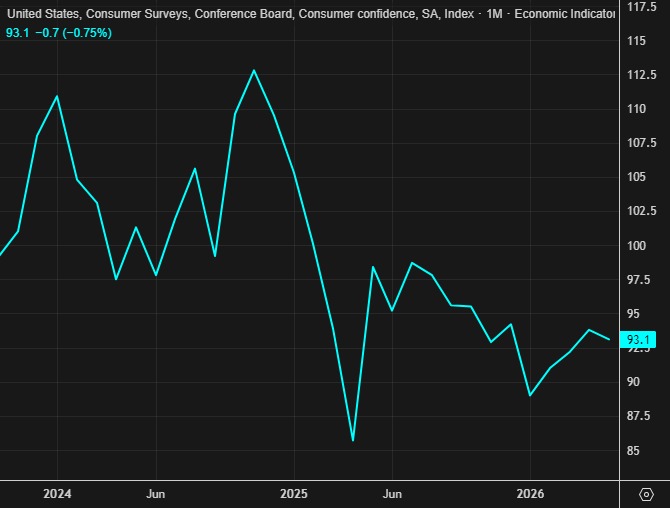
- Consumer confidence 93.1 vs 92 estimate
Details from the Conference Board.
- The Conference Board Consumer Confidence Index slipped 0.7 points to 93.1 in May from a revised 93.8 in April.
- The Present Situation Index fell 3.2 points to 121.2, reflecting softer views on current business and labor market conditions.
- The Expectations Index rose 1.0 point to 74.4, showing modest improvement in the outlook for business and labor market conditions over the next six months.
The survey period ran from May 1–19 and included the impact of the ongoing Middle East war and rising global price pressures.
- Consumers were less positive about current economic and labor market conditions compared to April.
- Expectations for future business conditions and employment improved modestly.
- Income expectations weakened, with more consumers expecting lower income ahead.
- The Expectations Index remained below 80, a level often associated with elevated recession concerns.
Comments from Dana Peterson:
- Said consumer confidence edged lower as the inflationary effects from the Middle East conflict intensified.
- Noted consumers were less upbeat on current business and labor market conditions.
- Said modest improvements in future expectations partly offset weaker current assessments.
- Highlighted softer income expectations as more consumers anticipated lower income going forward.
The recent high has been near 94 and 88.5 on the downside. With the index at 93.1 it is near the recent highs.
The Dow is coming off highs, while the Nasdaq is stretching to new highs.. The S&P is also stretching higher.
- Dow up 0.08%
- S&P up 0.78%
- Nasdaq up 1.30%
The Conference Board Consumer Confidence Index is a monthly survey that measures how optimistic or pessimistic U.S. consumers are about current and future economic conditions. The survey looks at consumers’ views on business conditions, the labor market, and income expectations over the next six months. A higher reading signals stronger consumer confidence and can point to increased consumer spending and economic growth, while a lower reading may reflect concerns about the economy, jobs, inflation, or personal finances. Because consumer spending makes up a large portion of the U.S. economy, traders and economists closely watch the report as a gauge of economic momentum and potential direction for Fed policy.