- Prior was 1.502m (revised to 1.507m)
- Building permits 1.442m vs 1.385m expected
- Prior 1.363m (revised to
Privately-owned housing starts in April were at a seasonally adjusted annual rate of 1,465,000. This is 2.8 percent (±11.0 percent) below the revised March estimate of 1,507,000, but is 4.6 percent (±13.9 percent) above the April 2025 rate of 1,400,000. Single-family housing starts in April were at a rate of 930,000; this is 9.0 percent (±7.5 percent) below the revised March figure of 1,022,000. The April rate for units in buildings with five units or more was 529,000.
Privately-owned housing units authorized by building permits in April were at a seasonally adjusted annual rate of 1,442,000. This is 5.8 percent above the revised March rate of 1,363,000, but is 0.2 percent below the April 2025 rate of 1,445,000. Singlefamily authorizations in April were at a rate of 872,000; this is 2.6 percent below the revised March figure of 895,000. Authorizations of units in buildings with five units or more were at a rate of 514,000 in April.
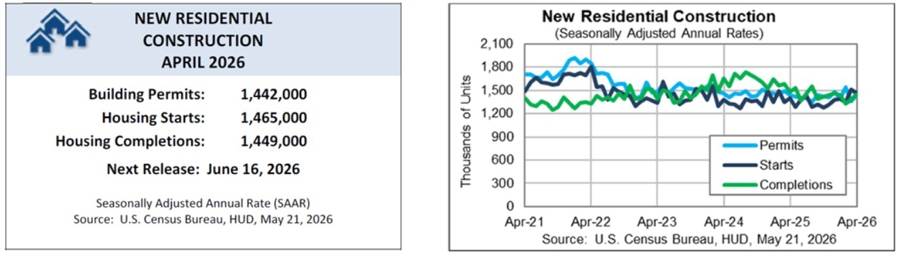
For background, the New Residential Construction report, published jointly by the U.S. Census Bureau and the Department of Housing and Urban Development, is the most widely watched gauge of U.S. homebuilding activity. Released monthly at 8:30 a.m. ET (typically around the 17th business day of the month, with a roughly six-week lag), it covers three series: building permits, housing starts, and housing completions. A "start" is recorded when excavation begins for a building's footings or foundation. Markets focus particularly on the seasonally adjusted annual rate (SAAR) of total starts and the single-family component, with multifamily (five-plus units) tracked separately given its higher volatility. Permits are treated as a leading indicator of future starts, while completions feed into housing supply estimates. The data are reported with notably wide confidence intervals, often ±10–15 percentage points on monthly changes, so analysts focus on trends rather than single readings, and on the regional breakdown across the four Census regions.