
The BOJ passage is the most market-sensitive element of this document. The draft's explicit call for the central bank to align monetary policy decisions with the government's growth agenda, citing legal coordination provisions, sets up a direct tension with a BOJ that has been gradually normalising rates and whose independence the market has been pricing as intact. Any signal that Takaichi's administration intends to lean on the BOJ through the policy framework rather than through informal pressure will be read as a constraint on the hiking path, and is yen-negative at the margin.
The nominal growth target of above 3% is itself inflationary in framing, which creates an internal contradiction: achieving it likely requires the BOJ to allow inflation to run, yet the draft simultaneously wants rates kept low. The $2.29 trillion combined public and private investment target through fiscal 2040 is the structural demand signal for Japanese industrials, infrastructure and strategic sector capex. Private capex alone is targeted at 230 trillion yen annually, a figure that, if approached, would represent a fundamental break from Japan's decades-long underinvestment pattern and carry material implications for domestic construction, energy and technology supply chains.
---
Japan's draft economic blueprint targets real growth above 1% and nominal growth above 3%, with $2.29 trillion in investment through 2040, while urging the BOJ to keep policy aligned with the government's growth drive.
Summary:
- Japan's government draft economic blueprint targets annual real GDP growth of more than 1%, more than double the 0.4% average of the past five years, to be achieved "as early as possible"
- Nominal growth is targeted above 3%, reflecting Prime Minister Sanae Takaichi's reflation agenda
- Combined public and private investment is projected to exceed 370 trillion yen ($2.29 trillion) through fiscal 2040, with annual private-sector capital expenditure targeted at around 230 trillion yen
- GDP is targeted to grow to nearly 1,100 trillion yen by fiscal 2040
- The draft commits to fiscal sustainability, pledging to reduce the debt-to-GDP ratio while managing the primary balance over multiple years consistent with debt reduction
- The document urges the BOJ to align monetary policy with the government's growth agenda, citing legal coordination provisions, and describes appropriate monetary policy as "extremely important" for achieving a strong economy
- The government is expected to finalise the policy framework shortly; the Cabinet Office did not immediately respond to a request for comment
Japan's government has circulated a draft long-term economic blueprint that sets a target of more than 1% annual real GDP growth, a goal that would more than double the country's average pace of expansion over the past five years and represents one of the most ambitious economic targets Tokyo has articulated in decades.
Reuters reviewed the draft of the basic policy framework for economic and fiscal management, which also sets a nominal growth target of above 3% and outlines combined public and private investment of more than 370 trillion yen, equivalent to $2.29 trillion, through fiscal 2040. Annual private-sector capital expenditure is targeted at around 230 trillion yen by the same year, while GDP is projected to reach nearly 1,100 trillion yen, marking a deliberate break from the underinvestment pattern that has constrained Japanese growth for a generation.
The blueprint reflects Prime Minister Sanae Takaichi's drive to reflate the economy through strategic public-private collaboration, channelling resources into industries the government identifies as critical to Japan's long-term competitiveness. On fiscal policy, the draft reiterates a commitment to reducing the debt-to-GDP ratio over time, framing the primary balance as an indicator to be managed across multiple years in a manner consistent with debt reduction rather than as a hard annual constraint.
The most pointed passage concerns the Bank of Japan. The draft urges the central bank to align its monetary policy decisions with the government's growth agenda, citing legal provisions requiring coordination between the two institutions, and describes appropriate monetary policy management as extremely important for achieving a strong economy. The language signals a clear government preference for keeping borrowing costs low, and establishes a framework for potential policy tension with a BOJ that has been carefully navigating its exit from ultra-loose settings.
The government is expected to finalise the framework shortly.
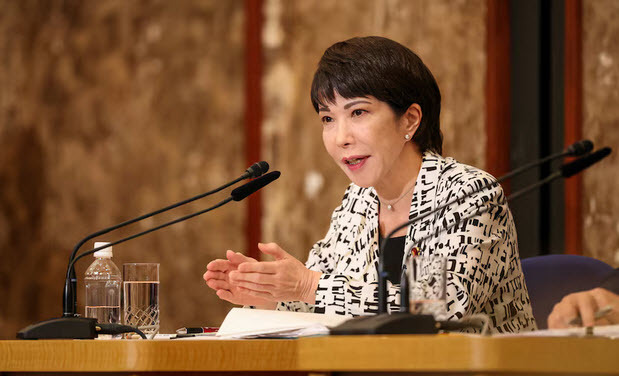
Prime Minister Sanae Takaichi