- Gold retests the 38.2% retracement and swing area
- McDonald's is now worth 160x rival Wendy's
- Crude oil futures settled below the 200 day moving average
- US treasury so $69 billion of two-year notes at a high yield of 4.189%
- U.S. Secretary of State Rubio: We're going to deal directly with the Lebanese government
- BOC's Macklem: So far we are not seeing much spreading of higher oil prices
- ECB's Vujcic: We do not want to give forward guidance, every meeting is live
- US Richmond Fed composite index +4 vs +13 prior
- US June S&P Global flash services PMI 51.3 vs 51.0
- Bank of Canada's Macklem: We need to create more places for savings to go beyond the USA
- BOE's Taylor: An extended hold at this level is appropriate policy
- Memory stocks have had one of the all-time great runs. Why this could be the end
- Has the hype around SpaceX faded?
- Trump: I agreed to allow the Hormuz Strait to remain OPEN, with no further Naval Blockade
- investingLive European FX news wrap: Eurozone PMIs stabilise, UK data disappoints
- Intervention risks weigh on momentum as USD/JPY approaches the highest level since 1986
The early focus was on the sharp decline in U.S. equity futures, particularly the NASDAQ, which was down as much as 800 points in premarket trading. The selling pressure eased somewhat after the 9:30 a.m. ET open, but the damage was still significant. The NASDAQ fell to an intraday low of -653.34 points and closed down -579.56 points, or -2.21%. The index never traded in positive territory, with its best level of the day still lower by 284 points. The S&P 500 and Russell 2000 also ended the session in the red, falling -1.44% and -0.96%, respectively, while the Dow Jones Industrial Average was little changed, slipping just -0.09%.
The decline in equities helped fuel a flight-to-safety bid for the U.S. dollar. The Dollar Index rose 0.37% on the day, with the biggest gains coming against the commodity currencies. The AUDUSD fell 1.23%, while the NZDUSD declined 0.86%, making them the largest movers among the major currency pairs.
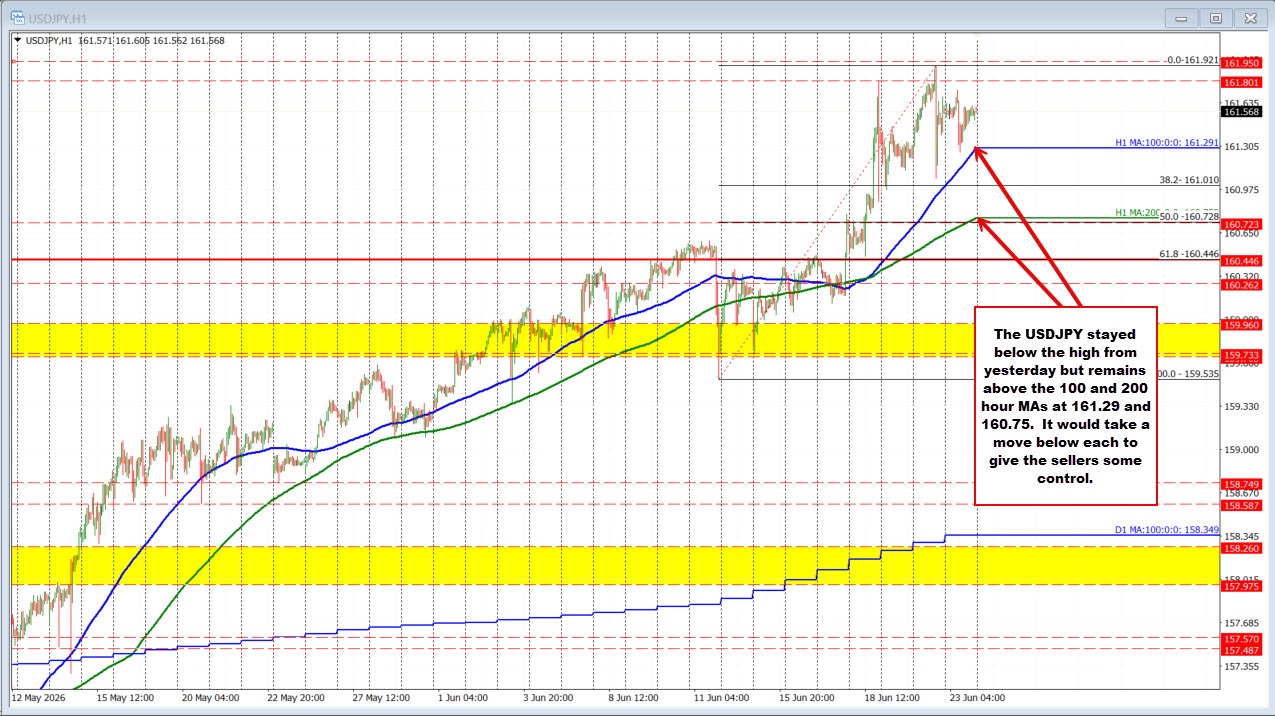
The USDJPY was the least affected, with the pair rising just 0.02% as traders remained wary of potential intervention from Japanese authorities. Yesterday, the pair nearly tested the 2024 high at 161.95, reaching 161.918, a level that represents the highest price since 1986. Although the pair is little changed today, it remains comfortably above its rising 100-hour moving average at 161.39 and its rising 200-hour moving average at 160.759. It would take a move below both of those levels to shift the short-term bias back to the downside. Until then, the buyers remain firmly in control.
The USD was higher vs all the major currencies:
- EUR +0.42%
- GBP +0.37%
- CHF +0.11%
- CAD +0.38%
- AUD +1.23%
- NZD +0.82%
On the economic front, the U.S. data was mixed. The S&P Global PMI report came in stronger than expected, with the services index rising to 51.3 versus 51.0 expected, manufacturing climbing to 55.7 versus 54.8 expected, and the composite index improving to 52.2 from 51.7 previously. The data suggested that economic activity continues to expand, but the details were less robust, with overall growth remaining modest, employment declining for a second consecutive month, and price pressures showing further signs of cooling.
In contrast, the Richmond Fed survey painted a softer picture of the economy. The composite index fell to +4 from +13 previously, the services index dropped to -1 from +14, manufacturing shipments slowed to +3 from +16, and employment slipped to -1 from +3. While new orders and shipments remained in positive territory, the report marked a notable loss of momentum following recent strength.
Meanwhile, Federal Reserve officials have remained notably quiet following last week's rate decision. New Fed Chair Kevin Warsh has expressed a preference for less frequent public commentary from policymakers, and the lack of Fed chatter since the meeting suggests that approach is already influencing communications.
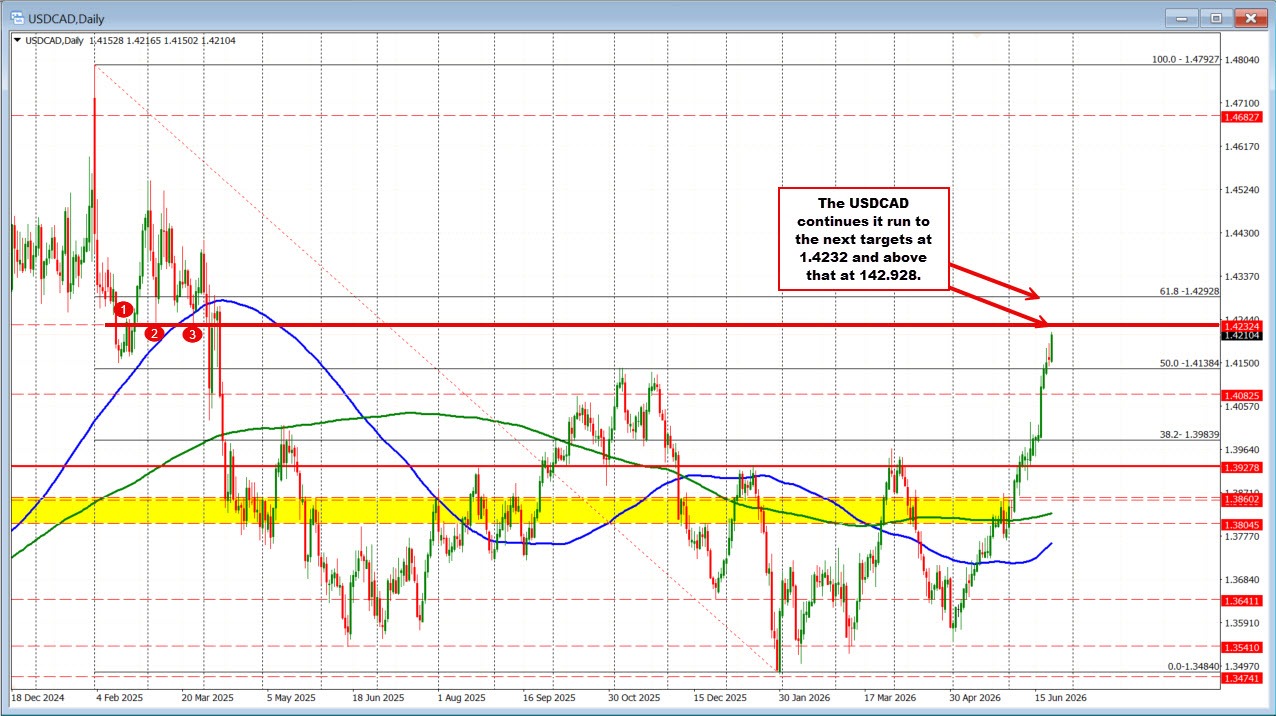
Outside the U.S., Bank of Canada Governor Tiff Macklem spoke as the USDCAD continued its powerful uptrend. The pair has rallied from an early May low of 1.3549 to a new yearly high of 1.42165, a move of nearly 668 pips, or 4.9%, in less than two months. Macklem did not address monetary policy directly, but instead highlighted growing global financial imbalances, noting that the United States continues to attract the largest share of global capital flows. He added that the enduring appeal of the U.S. dollar may have allowed these imbalances to persist longer than they otherwise would have, a reminder of the strong underlying demand supporting the greenback.
To build a more balanced and resilient global financial system, policymakers need to create additional destinations for global savings beyond the U.S. At the same time, even as the U.S. has stepped back from free and open trade, other countries should seek to deepen their trade and investment relationships.
He also addressed concern that increased leverage among hedge funds and non-financial firms may be making the financial system more fragile and susceptible to shocks.
The remarks did not include any new signals on monetary policy or the economic outlook, but they underscored the continued strength of the U.S. dollar, with the USDCAD trading at the highest level since April 2025. The comments did not lead to any change in that trend with the price ending the day within 6 pips of the high for the day.
In the US debt market, the yield curve steepened with the 2 year down -2.7 basis points to 4.202%, the 10 year down -0.6 basis points at 4.500%, but the 30 year up 0.4 basis points.
Crude oil settled below the 200 day MA at $73.68 for the first time since the end of January. The price is trading at $73.23.
Gold fell -$80 to $4109. Support is at $4000 to $4006. Silver fell -$3.51 or -$5.39% to $61.53. The low took out the low from June 11 and trades at the lowest level since March.