- Downside risks for the euro mount ahead of next week's ECB meeting
- The ECB meet next week - to consider a temporary increase in regular bond purchases
- Japan PM Kishida says must be mindful of downside risks to the economy
- Here is what’s on the economic calendar in the US on Friday - CPI for November the focus
- PBOC sets USD/ CNY reference rate for today at 6.3702 (vs. estimate at 6.3499)
- More on Chinese property developer Evergrande's USD debt default
- Japan finance minister Suzuki says important to follow up on higher wages
- An official from the BOJ says Japanese steelmakers worried over Omicron uncertainy
- Fitch downgrades Chinese property firms Evergrande and Kaisa to 'restricted default'
- Japan data - November PPI +0.6% m/m (vs. expected 0.3%) & +9.0% y/y (expected 8.5%)
- FOMC meet next week - analyst say hawkishness is already priced in!
- US Senate votes 59-34 to framework to raise the debt ceiling next week
- Beer is being rationed in Australia due to supply chain disruption
- Toyota has shut down production lines at two assembly plants due to supply chain problems
- Biden said the US is preparing "additional measures" against Iran as nuclear talks falter
- Trade ideas thread - Friday 10 December 2021
- NZ retail card spending for November +9.6% m/m (prior +10.1%)
- More on Morgan Stanley projecting 5 Federal Reserve interest rate hikes
- New Zealand - BusinessNZ manufacturing PMI for November 50.6 (vs. prior 54.3)
News and data flow was light during the session here in Asia to round out the week with little net change for most major currencies.
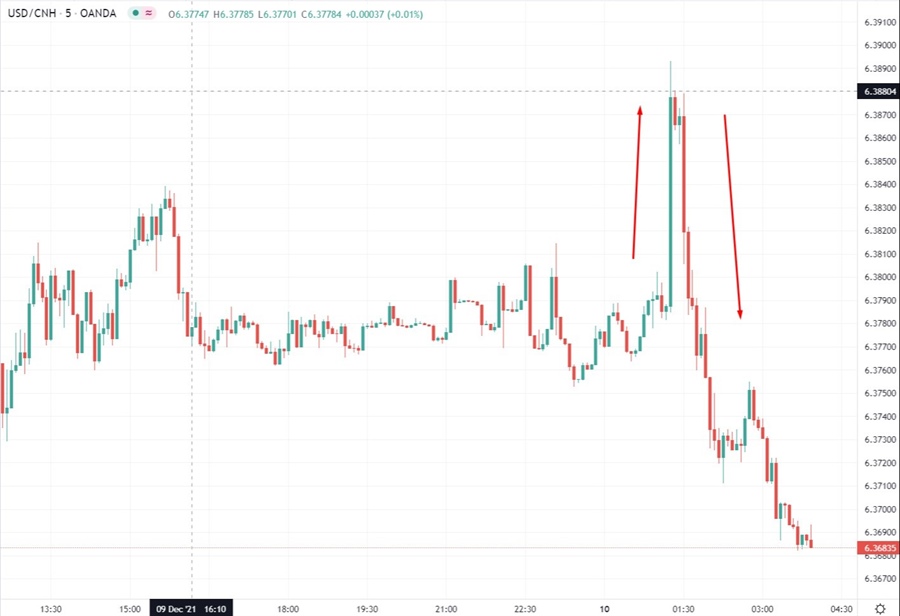
The Chinese yuan was a stand-out exception though. The People’s Bank of China weakened the onshore yuan at its daily reference setting. USD/CNY was set at a mid-rate of 6.3702 against a survey estimate of 6.3499. Whenever there is a significant difference between the survey expectation and the actual reference rate that is set that is seen as a signal from China’s central bank of what it wants. In this case the PBOC is clearly signalling it does not want the yuan to strengthen from here, or at the very least to do so at a much slower pace.
The movement in the offshore yuan, USD/CNH initially reflected this desire from the Bank for a weaker yuan (arrow on the left, taking CNH to its weakest since November 29 ) but that did not last with the CNH soon stacking on gains again to recover by the middle of the day in China (arrow on the right of chart below).