- The employment change -17.7 K revised to xxK
- Employment change change 87.8K vs 10.0K estimate
- Unemployment rate 6.6% versus 6.9% estimate . Prior month 6.9%.
- Full-time employment change 154.0K versus -46.7L ;ast month.
- Part-time employment change -66.2Kvs. 29.0 K last month
- average hourly wages or permanent employees 3.2% vs 4.8% last month
- Employment rose among employees in both the private sector (+56,000; +0.4%) and the public sector (+20,000; +0.4%) in May. The number of self-employed workers was little changed.
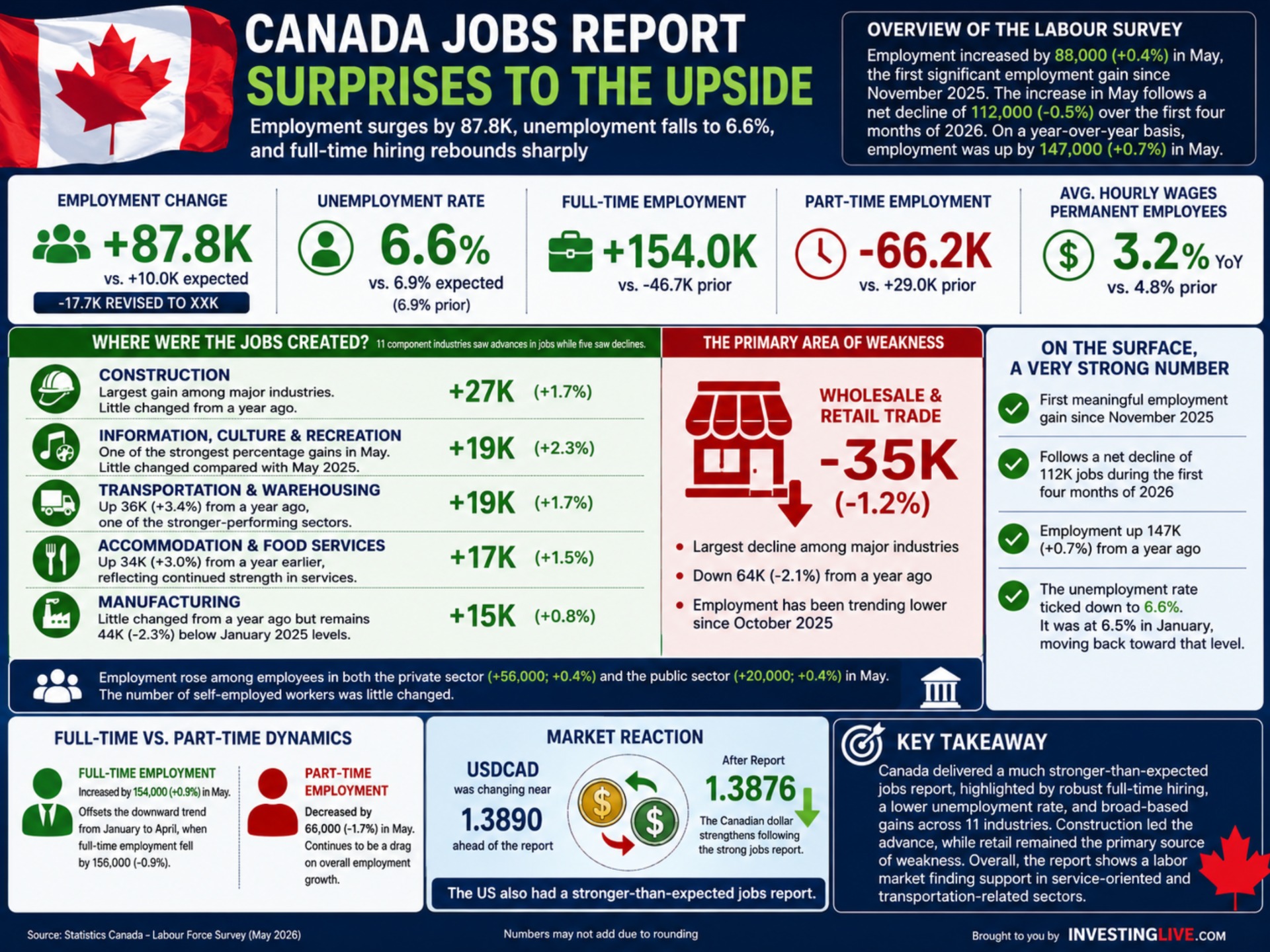
On the surface a very strong number. The US had a stronger than expected jobs report as well. The USDCAD is trading at 1.3876 down from 1.3890 prior to the report.
Details from Statistics Canada
- Employment increased by 88,000 (+0.4%) in May, the first significant employment gain since November 2025. The increase in May follows a net decline of 112,000 (-0.5%) over the first four months of 2026. On a year-over-year basis, employment was up by 147,000 (+0.7%) in May.
- The number of people working full-time rose by 154,000 (+0.9%) in May. The increase in the month offsets a downward trend observed from January to April, in which the number of full-time workers fell by 156,000 (-0.9%). In May, part-time employment decreased by 66,000 (-1.7%).
- The unemployment rate ticked down to 6.6%. The unemployment rate was at 6.5% in January so the price is moving back down toward that level
Where were the jobs created:
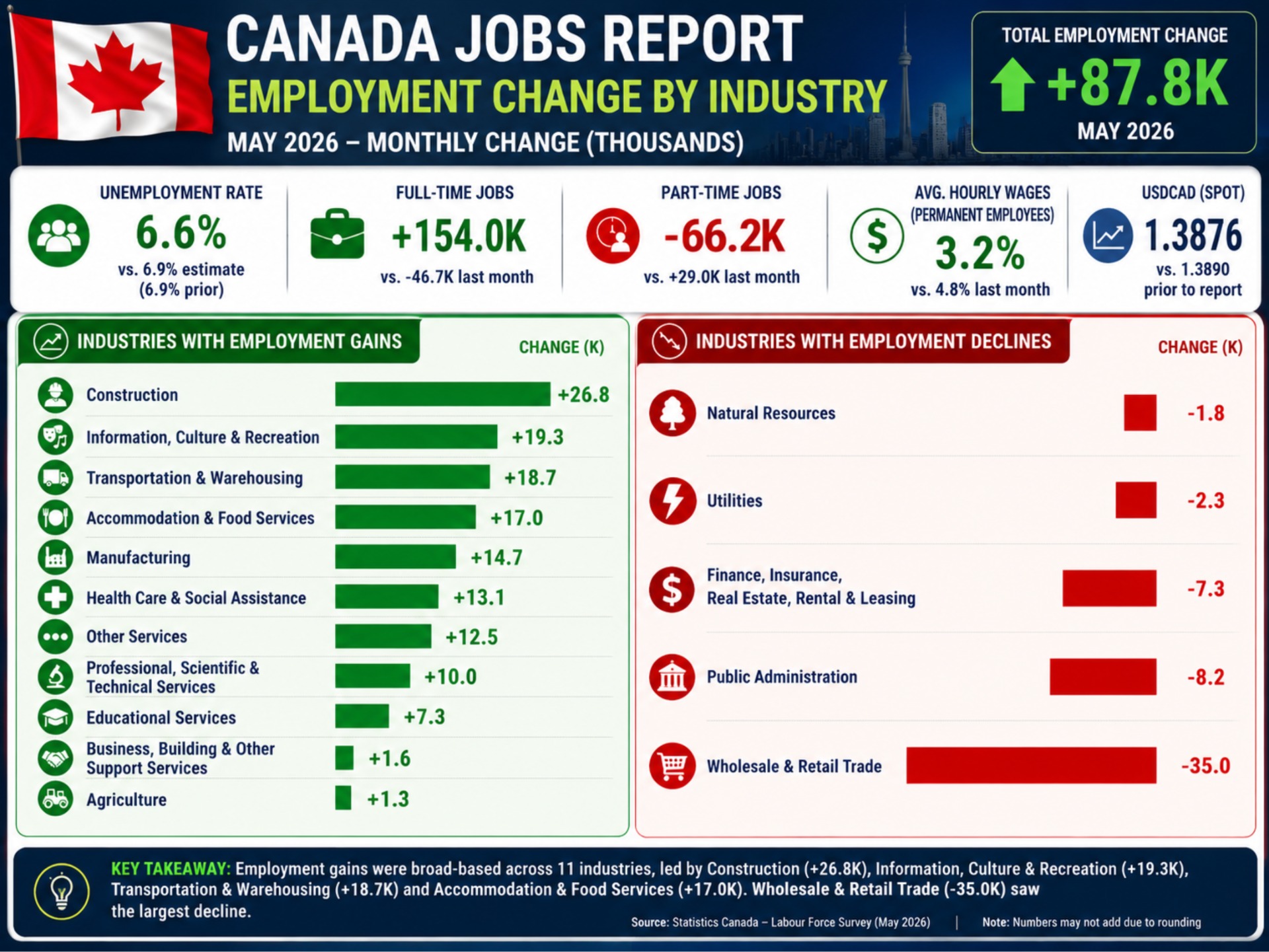
Looking at the components of the job creation, construction was the strongest while wholesale and retail trade was the weakest. 11 component industries saw advances in jobs while five saw declines:
- Construction: Employment increased by 27,000 (+1.7%), the largest gain among major industries. Despite the monthly increase, employment was little changed from a year ago.
- Information, Culture and Recreation: Employment rose by 19,000 (+2.3%), one of the strongest percentage gains in May. Employment was little changed compared with May 2025.
- Transportation and Warehousing: Employment increased by 19,000 (+1.7%). Compared with a year ago, employment was up 36,000 (+3.4%), making it one of the stronger-performing sectors over the past 12 months.
- Accommodation and Food Services: Employment climbed by 17,000 (+1.5%). Employment was up 34,000 (+3.0%) from a year earlier, reflecting continued strength in consumer-facing services.
- Manufacturing: Employment increased by 15,000 (+0.8%). Employment was little changed from a year ago but remained 44,000 (-2.3%) below January 2025 levels. The sector continues to face uncertainty related to U.S. tariff policies and broader economic concerns.
- Wholesale and Retail Trade: Employment fell by 35,000 (-1.2%), the largest decline among major industries. Employment has been trending lower since October 2025 and was down 64,000 (-2.1%) compared with a year ago.
Key Takeaway
- Employment gains were broad-based across several industries, led by construction, transportation and warehousing, accommodation and food services, information, culture and recreation, and manufacturing.
- The primary area of weakness remained wholesale and retail trade, which continued its downward trend.
- Overall, the report points to a labor market that is finding support in service-oriented and transportation-related sectors, while retail employment remains under pressure.
The USDCAD was trading near 1.3890 ahead of the report. It is trading modestly lower to 1.3875 off of the initial move.
Overview of the Labour Survey:
For background, the Labour Force Survey, published monthly by Statistics Canada, provides comprehensive data on employment, unemployment, and labour force participation across Canada. Released on the first or second Friday of each month at 8:30 a.m. ET, the report surveys approximately 56,000 households and tracks employment changes by industry, province, full-time versus part-time status, and demographic characteristics. The survey measures not only net job creation but also unemployment rates, wage growth, and labour force participation, offering insights into the health of Canada's economy. The data is closely monitored by the Bank of Canada when setting monetary policy and by economists assessing economic conditions. At the moment, there are no further cuts priced in for the Bank of Canada.
Below is a summary of the recent Bank of Canada expectations:
Here's a summary of the Bank of Canada's current policy stance and outlook based on recent official communications:
Current Rate: 2.25% — On Hold
The Bank held its policy rate at 2.25% at its April 29 meeting. The labour market remains soft, with the unemployment rate in the 6.5%–7% range, and while consumer and government spending are supporting the economy, tariffs and trade uncertainty are weighing on exports and business investment.
The Rate Path — Neutral Bias, But Two-Sided Risks
Governor Macklem stated that "a policy rate close to current settings looks appropriate" to support economic adjustment and return inflation to target — assuming oil prices come down and US tariffs remain at current levels.
Macklem said current rates "look appropriate," but warned that if oil prices keep rising and remain elevated for an extended period, "there may be a need for consecutive increases in the policy rate."
The Middle East War & Inflation
The BoC expects inflation to peak around 3% in April and ease back to the 2% target by early next year. Governing Council agreed to "look through" the war's immediate impact on inflation — but drew a clear line: "if energy prices stay high, we will not let their effects become persistent inflation."
Growth Outlook
The Bank's April forecast projects GDP growth of 1.2% in 2026, rising to 1.6% in 2027 and 1.7% in 2028 as exports and business investment gradually recover. The war in Iran may alter the composition of growth, but since Canada is a large net exporter of oil, higher oil prices increase national income even as they squeeze consumers.
Structural Concerns
Macklem signalled a somewhat hawkish lean in a February speech, warning that "monetary policy should not try to compensate for lost supply," and reinforcing market expectations that the central bank will remain on hold through 2026. He noted that "the path for potential output is lower because of increased trade friction and slower population growth," adding long-term unpredictability to how fast the economy can grow without generating inflation.
Key Upcoming Date
The next rate announcement is scheduled for June 10, 2026, with the next Monetary Policy Report to follow on July 15. Bank of Canada
In short, the BoC is firmly on hold, leaning neutral-to-hawkish due to energy-driven inflation risks, while keeping the door open to cuts only if trade headwinds worsen significantly and energy prices retreat as expected.