January CPI is set to show electricity-driven headline strength and still-firm core inflation, keeping a May RBA hike in play.
Summary:
Headline CPI seen at 0.4% m/m (seasonally adjusted) in January
Annual inflation forecast at 3.6–3.7% y/y
Electricity prices a key upside driver; fuel partly offsets
Trimmed mean seen at 0.3% m/m, annual pace steady at 3.3%
RBA still expected to hike in May despite slight core moderation
Australia’s January CPI, due from the Australian Bureau of Statistics on Wednesday at 11:30am Sydney time (1930 US Eastern time), is expected to show firm underlying inflation even as seasonal factors temper headline momentum.
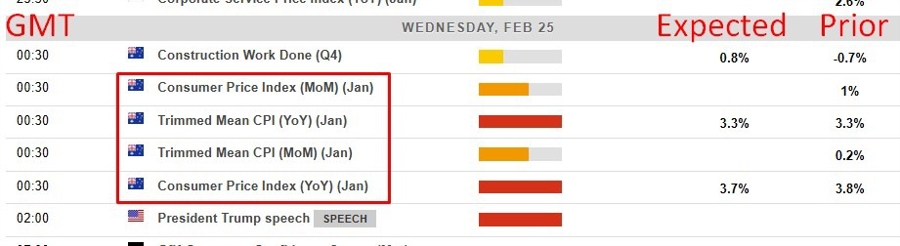
Both Commonwealth Bank of Australia and Westpac expect headline inflation to rise by 0.4% month-on-month on a seasonally adjusted basis. On a non-seasonally adjusted measure, CBA looks for a 0.2% monthly gain, while Westpac’s 0.1% estimate translates to the same 0.4% seasonally adjusted outcome.
The annual inflation rate is forecast to print between 3.6% and 3.7%, easing slightly from December’s pace but remaining well above the midpoint of the Reserve Bank of Australia’s 2–3% target band.
Electricity prices are expected to be the standout contributor in January as cost-of-living rebates fade and bills revert toward underlying pricing. Food inflation, particularly fresh fruit and vegetables and non-alcoholic beverages, is also seen adding upward pressure. Health costs are another modest contributor.
These gains should be partly offset by declines in automotive fuel, holiday travel and accommodation, garments and communications. Lower fuel prices in particular are expected to cushion the electricity-driven lift in headline CPI.
The key focus will be underlying measures. Both banks estimate the trimmed mean rose 0.3% in January, leaving the annual pace steady at 3.3% y/y. Westpac notes the six-month annualised rate may ease to 3.4% from 3.7%, hinting at gradual moderation in momentum.
CBA’s alternative three-month-on-three-month trimmed mean measure is expected to soften slightly to 0.8% from 0.9%, broadly consistent with a quarterly trimmed mean of 0.8% in Q1 2026. That would be marginally below the RBA’s central forecast of 0.9%, though still indicative of persistent underlying price pressures.
From a policy perspective, CBA continues to expect the Reserve Bank of Australia to raise the cash rate in May. Even if quarterly trimmed mean inflation undershoots the RBA’s forecast slightly, the bank argues that would likely be insufficient to deter further tightening given the Board’s recent signalling and upward revisions to the output gap and neutral rate.
With electricity volatility complicating the headline read, markets are likely to focus squarely on the trimmed mean as the cleaner gauge of inflation persistence.