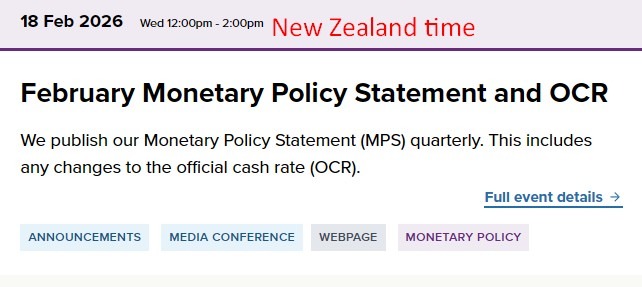
The RBNZ is expected to hold rates steady, but a recent lift in food price inflation adds nuance. Markets will focus on the tone of the statement, with the NZD at risk if policymakers sound more relaxed about inflation.
Summary
Reserve Bank of New Zealand meets Wednesday, 18 February 2026; policy widely expected to remain on hold.
statement due 2pm New Zealand time (0100 GMT / 2000 US Eastern time on Tuesday 17 February)
Recent inflation data showed some renewed firmness, with food prices posting a noticeable jump.
Headline pressures are not yet viewed as enough to force immediate tightening.
Statement tone will be closely watched for hints on persistence in domestic inflation.
NZD vulnerable to downside if the Bank leans dovish or emphasises growth risks.
The Reserve Bank of New Zealand is set to deliver its latest policy decision on Wednesday, 18 February, with markets widely expecting the Official Cash Rate to remain unchanged.
Recent inflation data have added a layer of interest to the meeting. While overall price growth remains broadly consistent with a gradual disinflation trend, the latest figures showed a renewed lift in food price inflation.
New Zealand Food Prices in January +2.5% m/m
- prior 0.3%
- +4.6% y/y (prior +4%)
- Food prices make up nearly 19 percent of the consumer price index.
The move was not extreme, but it was noticeable enough to remind markets that price pressures have not fully disappeared. Food costs can be volatile, yet sustained strength in this component has the potential to influence inflation expectations if it persists.
Despite this, the broader picture does not yet appear strong enough to compel the RBNZ into a rate increase. Economic momentum has been uneven, and policymakers are likely to balance signs of lingering inflation against ongoing risks to household demand and business confidence.
The key for markets may lie less in the decision itself and more in the accompanying statement. If the Bank highlights upside risks from domestic price pressures, including food and services inflation, expectations for future tightening could firm modestly. However, if policymakers lean into concerns about growth or signal confidence that inflation will continue to ease over time, rate expectations may soften.
Currency markets are sensitive to tone shifts. With positioning already cautious, a statement that fails to reinforce a tightening bias could leave the New Zealand dollar vulnerable to a modest pullback. Conversely, any suggestion that inflation risks remain skewed to the upside may help stabilise the currency.
For now, the baseline remains a steady hand, watchful, data-dependent and alert to both inflation persistence and downside growth risks.