Goldman Sachs has pushed its Federal Reserve rate cut forecast back to December 2026, citing sticky inflation near 3% and a resilient jobs market, with its terminal rate view held at 3% to 3.25%.
Summary:
- Goldman Sachs shifted its forecast for the next Fed rate cut to December 2026, pushed back one quarter from its prior call of September
- The revision followed a stronger-than-expected April jobs report, the second consecutive month of above-forecast hiring
- Goldman expects PCE inflation to remain near 3% through 2026, well above the Fed's 2% target, with energy costs feeding into broader prices
- The bank's terminal rate forecast was left unchanged at around 3% to 3.25%, implying a slower and shallower easing path than markets had anticipated
- Goldman also lowered its estimate for the probability of a US recession over the next 12 months alongside the rate call revision
Goldman Sachs has pushed back its forecast for the next Federal Reserve rate cut to December 2026, a one-quarter delay from its prior call, after a second consecutive month of stronger-than-expected US jobs growth reinforced the case for the central bank to keep policy on hold.
The revision, led by Goldman's economics team under Jan Hatzius, centres on inflation that continues to run well above the Fed's 2% target. The bank expects PCE inflation to hover near 3% through 2026, driven in significant part by energy costs that have surged since the escalation of the Iran conflict. Brent crude has risen from the low $70s per barrel before the war to close to $100 in recent trading, a move of between 35% and 45%, and Goldman's economists argue that energy prices feeding into broader price measures have not yet given the Fed sufficient grounds to ease.
The March PCE data illustrate the difficulty. Headline PCE rose 3.5% on a year-on-year basis, up sharply from earlier in the year, while core PCE, stripping out food and energy, climbed 3.2% annually. Personal spending rose 0.9% in March, pointing to a consumer that is still absorbing higher prices without meaningfully pulling back, a combination that makes near-term rate cuts difficult to justify. Fed Chair Jerome Powell acknowledged at the most recent FOMC meeting, held on 28 and 29 April, that inflation has moved higher, attributing part of the increase to elevated global energy prices. The Fed held rates unchanged at 3.50% to 3.75% at that meeting.
Goldman's terminal rate forecast remains unchanged at around 3% to 3.25%, a signal that while cuts will eventually come, the path there will be slower and shallower than many in the market had expected. Alongside the rate call revision, Goldman also trimmed its estimate for the probability of a US recession over the next 12 months, suggesting the delay to easing reflects economic resilience rather than deterioration.

---
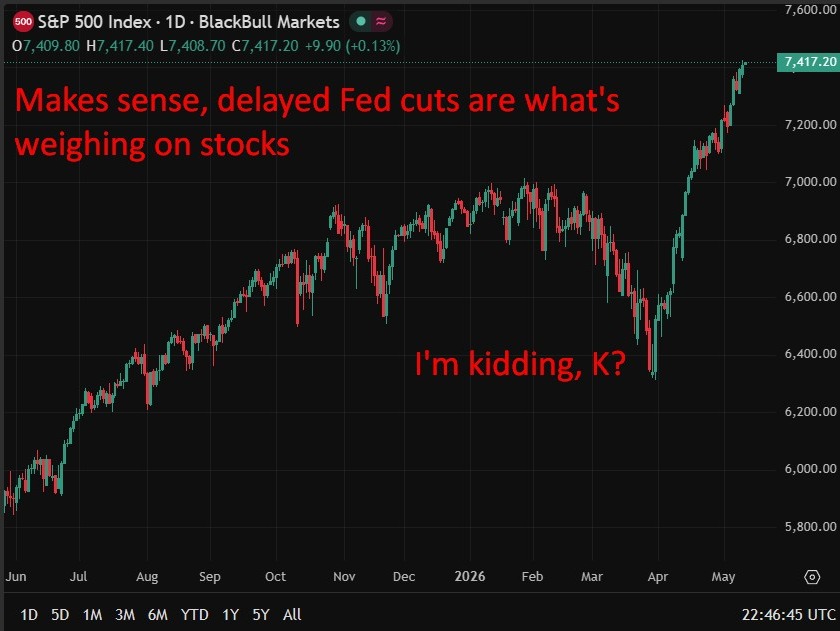
Goldman's delay to December 2026 adds institutional weight to a rates market already repricing for a prolonged Fed hold, keeping upward pressure on Treasury yields across the curve. A terminal rate anchored at 3% to 3.25% signals that the easing cycle will be shallower than many equity and credit markets have priced in, which could weigh on rate-sensitive sectors and corporate borrowing costs. For energy markets, the persistence of oil-driven inflation as the key variable in Goldman's framework means any further escalation in Hormuz disruptions directly lengthens the timeline before financial conditions begin to ease.