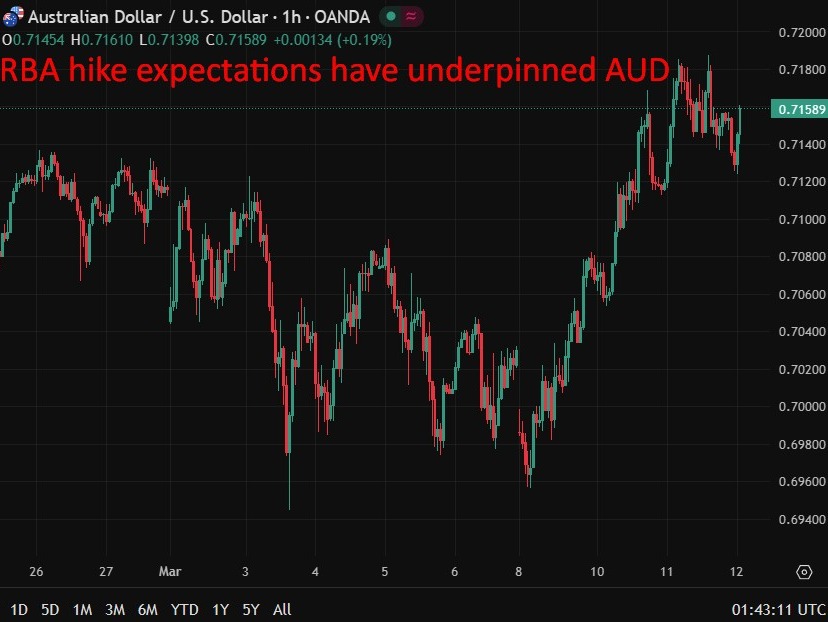
Commonwealth Bank expects the RBA to raise rates in March and May as rising energy prices and strong domestic data keep inflation risks elevated.
Earlier:
- ANZ joins banks expecting March 17 RBA rate hike as oil shock lifts inflation risks
- Westpac lifts RBA peak rate forecast to 4.35%, sees RBA hiking rates in March and May
- Australian bank analysts are piling on to forecast an RBA rate hike next week
Summary:
CBA expects the RBA to raise the cash rate in March and May, taking the rate to 4.35%.
The outlook has shifted due to higher oil prices linked to the Middle East conflict.
Inflation is already above target and expected to rise further due to energy costs.
The Australian economy is running above capacity, with GDP growth around 2.6%.
The unemployment rate remains low at 4.1%, indicating a tight labour market.
CBA expects trimmed-mean inflation around 0.9% in Q1 and 0.8% in Q2.
Some domestic data have softened, including household spending and card activity.
Despite the uncertainties, the bank believes the inflation outlook will drive the RBA to tighten policy.
Commonwealth Bank of Australia (CBA) expects the Reserve Bank of Australia to raise the cash rate at both its March and May policy meetings as policymakers respond to mounting inflation risks and a domestic economy operating above capacity.
In a research note, CBA economists said the policy outlook has shifted significantly in recent weeks, largely due to the inflationary implications of the escalating conflict in the Middle East. Rising energy prices linked to the war have introduced a new layer of uncertainty for the global economy while increasing the risk that inflation could move further away from the RBA’s target range.
The March policy meeting now takes place in a very different environment than was expected only a few weeks ago, according to the bank. While geopolitical developments have complicated the outlook for global growth, they have simultaneously strengthened the near-term inflation pressures facing Australia.
CBA argues that domestic economic conditions already point toward the need for tighter monetary policy. Inflation remains above target, the labour market continues to operate at historically tight levels, and the broader economy appears to be running beyond its sustainable capacity.
Recent economic data have reinforced that assessment. Annual GDP growth of 2.6% remains above the RBA’s estimated long-term “speed limit” of roughly 2.1%, indicating demand is still exceeding the economy’s productive capacity. At the same time, the unemployment rate has held at 4.1% for two consecutive months, remaining below estimates of the non-accelerating inflation rate of unemployment (NAIRU).
Price pressures also remain persistent. January inflation data pointed to ongoing underlying inflation momentum, and CBA’s modelling suggests trimmed-mean inflation could reach around 0.9% in the first quarter and 0.8% in the second quarter — consistent with the RBA’s latest forecasts and above the bank’s previous expectations.
Against this backdrop, CBA said recent commentary from RBA officials has reinforced the central bank’s hawkish stance. Both Governor Michele Bullock and Deputy Governor Andrew Hauser have emphasised the importance of preventing inflation expectations from becoming entrenched after the sharp rise in prices in recent years.
Still, the bank acknowledges that the decision facing policymakers at the March meeting is finely balanced. Global uncertainty tied to the Middle East conflict presents downside risks to growth, and some domestic indicators have softened. Household spending was weaker than expected in late 2025, and CBA’s own card spending data showed a pullback in February before a modest recovery in March.
Unit labour costs have also moderated somewhat and wage growth has not shown signs of reaccelerating.
Nevertheless, CBA believes the balance of risks now favours action. With inflation already elevated, energy prices rising and inflation expectations showing signs of drifting higher, the bank expects the RBA to lift the cash rate by 25 basis points in both March and May, taking the policy rate to 4.35%.