The disclosure adds a political risk dimension to pending US crypto legislation, with ethics provisions barring officials from profiting off regulation they oversee now a harder sticking point for Senate negotiators needing 60 votes to advance the bill. Broader sentiment toward Trump-linked tokens could stay weak given roughly two-thirds of memecoin holders and 85% of World Liberty Financial's WLFI buyers are currently underwater, according to Nansen data. The episode lands against a backdrop of an already volatile crypto market, with Trump's flagship memecoin down 97% from its peak. Any delay to regulatory clarity from a stalled bill could weigh further on sentiment across the sector.
---
Trump earned $1.4bn from crypto ventures last year even as most retail holders of his memecoins remain underwater, a disclosure shows, complicating regulation talks in Congress.
Summary:
- President Trump earned $1.4 billion from crypto ventures last year, including $800 million from World Liberty Financial, according to a financial disclosure
- Roughly two-thirds of investors in Trump's memecoin are currently underwater, based on Nansen data covering 1.48 million wallets since its January 2025 launch
- Around 85% of World Liberty Financial's WLFI token buyers in the secondary market are also sitting at a loss
- Trump's memecoin peaked near a $15 billion market cap before falling 97% to about $400 million
- World Liberty Financial launched a dollar-pegged stablecoin shortly before Trump signed the Genius Act, which established a regulatory framework for such tokens
- The disclosure could complicate Senate negotiations over crypto legislation, with ethics provisions barring official profit from crypto activity a key sticking point
- The bill has passed the House but needs Democratic support to reach 60 votes in the Senate
President Trump earned $1.4 billion from crypto ventures last year, according to a financial disclosure reported by the Wall Street Journal (gated), even as most retail investors who bought into his family's digital tokens are sitting on losses. The single largest contributor was World Liberty Financial, the family's flagship crypto venture, which alone generated $800 million for the president.
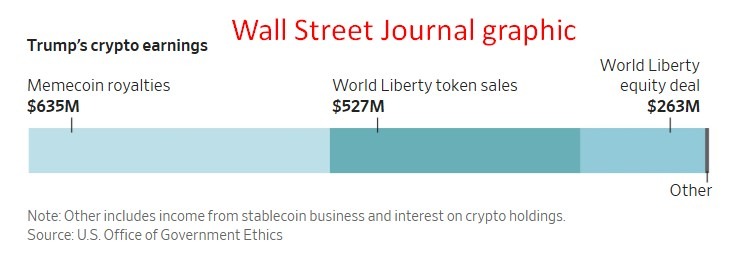
The scale of the earnings underscores a gap between Trump's financial position and that of many investors who followed him into crypto. Data provider Nansen, which tracked 1.48 million wallets that bought Trump's memecoin since its January 2025 launch, found roughly two-thirds of those holders are currently underwater. A separate Nansen analysis of secondary market buyers found 85% of World Liberty's WLFI token holders are also in the red.
Trump's memecoin, launched just before his inauguration, reached a peak market capitalisation near $15 billion before collapsing 97% to around $400 million today. World Liberty Financial, launched by Trump and his sons in September 2024, later released a dollar-pegged stablecoin shortly before Trump signed the Genius Act into law, which established a regulatory framework for such tokens.
The White House has rejected suggestions of any conflict of interest, with spokeswoman Anna Kelly saying the president and his family act in the best interest of the American people. Trump himself attributed the earnings to broader stock market gains when questioned by reporters this week.
The disclosure lands at a sensitive moment for crypto regulation efforts in Congress. Legislation establishing rules for digital assets has passed the House but requires Democratic support to clear the 60 vote threshold in the Senate. Ethics provisions that would bar the president and other officials from profiting off crypto activity they help regulate have become a central sticking point in negotiations, one that Senator Cynthia Lummis, a bill sponsor, said needs to be resolved with strong language. Some Democrats have said their support hinges on that provision being included, with the disclosure likely to sharpen those demands.
Beyond crypto, the president's overall financial disclosure also showed rising income from the family's hotel and golf businesses, along with growing stock holdings in companies including Nvidia and Meta.