The war market is unwinding as the hopes for the Strait of Hormuz opening and hopes for denuclearization propelling the moves. The price of oil is down -17%. The 10 year yield is down -10.7 basis points to 4.235%, the US stock indices are sharply higher with Dow up 1310 points , the Nasdaq is up 862 points and the S&P is up 190 points. The USD is lower.
IN the video above, I take a technical look at the EURUSD, USDJPY and GBPUSD from a technical perspective. The bias in the major pair has shifted to the upside in the EURUSD and the GBPUSD and more to the downside in the USDJPY, but we have to also remember, the USD has been higher in 2026, so the declines are still retracing and moving toward key longer term targets.
I outline those targets as well as redefine close risk for traders looking to benefit from more dollar selling. So watch the video and better understand the roadmap going forward for the major currency pairs.
As a review of the overnight headline news, of course President Trump struck an upbeat and forward-looking tone, declaring it could be “a big day for world peace,” with Iran signaling willingness to move ahead and the U.S. assisting in stabilizing shipping through the Strait of Hormuz. He pointed to the potential for significant economic activity and reconstruction, saying the U.S. would help supply materials and support rebuilding efforts, framing it as a possible “Golden Age” moment for the Middle East. At the same time, he outlined a firmer policy framework, stating the U.S. will work closely with Iran following what he described as a “productive regime change,” with a strict requirement of no uranium enrichment. He added that nuclear capabilities would be dismantled and closely monitored, while also indicating that tariff and sanctions relief are on the table, with many elements of a broader agreement already in place. Overall, Trump’s message combined optimism on peace and economic upside with clear red lines on nuclear policy and enforcement.
Vice President Vance described the situation as showing constructive progress but still fragile, noting that Iran has agreed to reopen the Strait of Hormuz and that a pause in hostilities forms the basis of a tentative truce. He said some factions within Iran are engaging positively, but others are not, underscoring uncertainty around follow-through. Vance added that President Trump is impatient to secure a deal, stressing the importance of good-faith negotiations, while warning that failure by Iran to cooperate could lead to consequences, reinforcing a cautious but firm U.S. stance.
There have been reports of Iranian missile attacks on Kuwait and UAE in response to violations of the ceasefire. Israel is also bombing in southern Lebanon. Of course Israel may be a wild card in the process.
IN other news, the RBNZ held its OCR at 2.25% as expected, signaling a cautious stance as near-term inflation is projected to rise while economic growth is expected to weaken. The Committee emphasized its commitment to returning inflation to the 2% midpoint over the medium term, noting that this will require contained core inflation, moderate wage growth, and stable inflation expectations. While the current hold balances inflation risks against the risk of unnecessarily slowing the economy, policymakers made clear they are prepared to act decisively with rate hikes if inflation pressures broaden or expectations become unanchored. The Minutes highlighted a split in views, with some members favoring earlier tightening, while others stressed downside risks to growth and the need for more data. Overall, the outlook reflects rising short-term inflation pressures—driven in part by supply disruptions and geopolitical risks—alongside a softer growth backdrop, leaving the policy path data-dependent but tilted toward tightening if inflation persists.
RBNZ Governor Breman said the decision to hold rates was unanimous and, while rate hikes were discussed, policymakers were not close to tightening and there was no strong support for a hike at this meeting. He noted that falling oil prices could push inflation forecasts higher, while tighter financial conditions are expected to modestly weigh on growth. Looking ahead, he kept optionality open, indicating that future rate hikes could come at every meeting or every second meeting, depending on how the data evolves, reinforcing a flexible, data-dependent policy path.
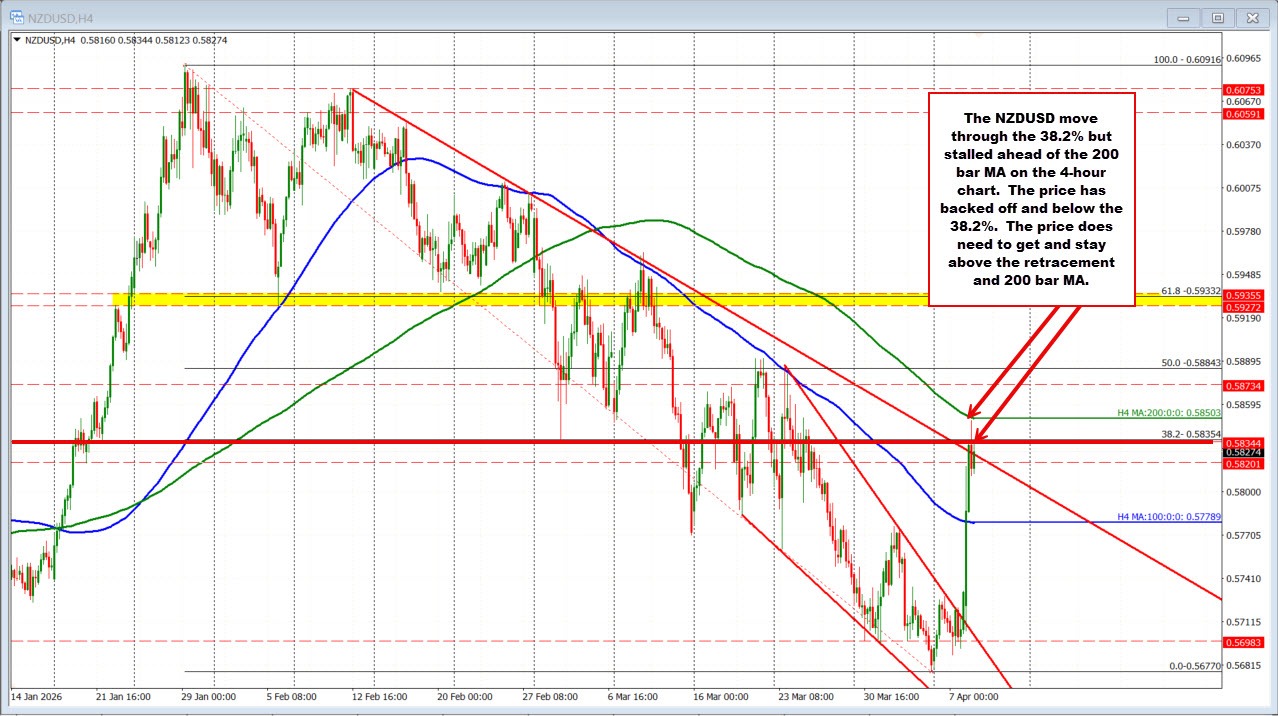
The NZDUSD is sharply higher mostly in reaction to the ceasefire in Iran. The move to the upside has taken the NZDUSD above the 38.2% of the move down from the 2026 high at 0.5835, but fell short of the 200 bar MA on the 4-hour chart at 0.58503. The price is back below the 38.2% after the failed run to the upside. The price does not need to get and stay above those levels to increase the bullish bias.