Markets appear to be disconnecting from some of the traditional risk drivers today. Both the NASDAQ and S&P 500 have surrendered earlier gains and slipped into negative territory, even as Treasury yields remain little changed and crude oil prices continue to move lower.
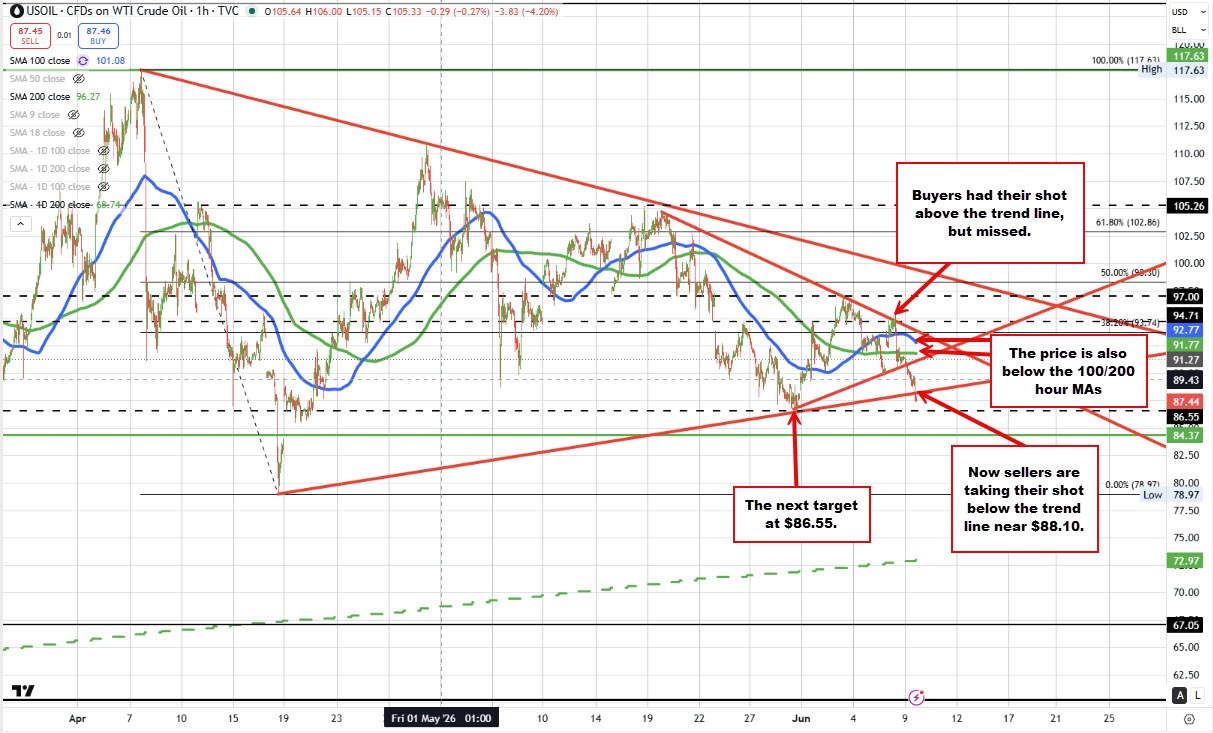
WTI crude oil is down roughly $3.50 to $87.70, its lowest level since May 29, reflecting a significant unwinding of the geopolitical premium that had built into the market. From a technical standpoint, the bearish turn began on Monday when the price broke below both its 200-hour moving average at $91.77 and 100-hour moving average at $92.77. That breakdown shifted the short-term bias firmly in favor of the sellers.
The downside momentum accelerated today as WTI fell below an upward-sloping trend line on the hourly chart near $88.10. As long as the price remains below that trend line, sellers maintain the technical advantage. The session low has reached $87.37, with the next key downside target coming in at the May 29 low of $86.55.
On the fundamental side, U.S. Energy Secretary Chris Wright noted that a return to normal energy flows could take many months, but also emphasized that shipping traffic through the Strait of Hormuz is increasing meaningfully. At the same time, Israel's top military commander said recent operations in Iran were preparation for a potentially heavier blow. Despite those comments, traders appear to be focusing more on the gradual restoration of supply flows than on the risk of future disruptions tied to the conflict.
The result has been a sharp pullback in crude prices. Since reaching a high near $97.00 on June 3, WTI has fallen nearly 10%, underscoring the market's growing belief that supply concerns may prove less severe than initially feared. From a technical perspective, the path of least resistance remains lower while the price stays below the broken moving averages and trend-line resistance.
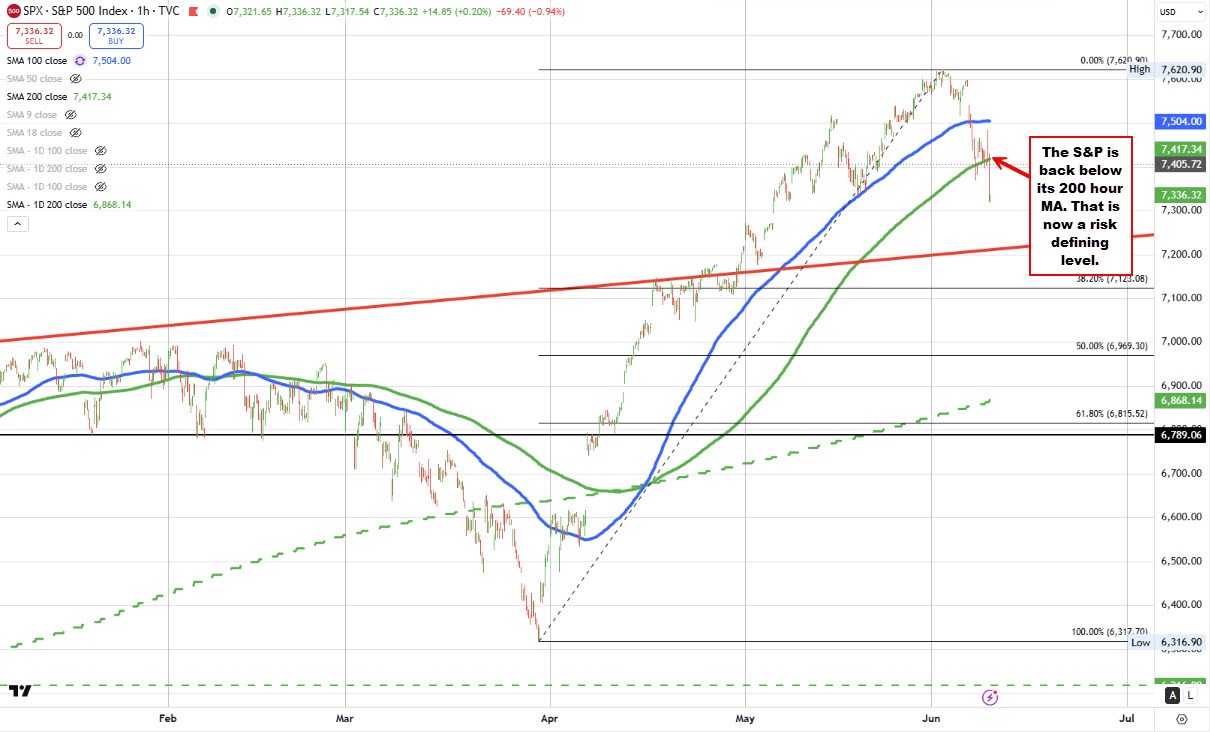
Stocks have moved to new lows with the Dow, S&P and the Nasdaq now all in negative territory. The Nasdaq is leading the way with a decline of -1.88% and trading to the lowest level since May 5th. The S&P index is now back below its 200 hour moving average at 7417.28. The price is currently trading at 7323-82 points or -1.11%.
Traders are contributing they decline to report that data center developer Crusoe has pause development on a Wyoming site.
Here's a full breakdown of what's going on with Crusoe's Wyoming project:
What it is — Project Jade Laramie County commissioners unanimously voted to move forward with construction of a 1.8 gigawatt data center campus near Cheyenne — designed to eventually scale up to 10 gigawatts, which would make it the largest single AI campus in the US. The facility is officially called Project Jade.
The partnership Crusoe partnered with Tallgrass Energy Partners, with Tallgrass building the adjacent BFC Power and Cheyenne Power Hub next door to supply electricity from on-site natural gas turbines, while also leveraging its existing CO2 sequestration hub for carbon capture and its existing natural gas and water infrastructure in Wyoming.
About Crusoe Crusoe began as Crusoe Energy Systems, a flare mitigation provider that powered onsite computing from stranded natural gas, with bitcoin mining as an early use case. It has since pivoted to AI infrastructure and GPU cloud services, and is also developing a 1.2 GW campus in Abilene, Texas — where Oracle is the direct customer and OpenAI is Oracle's customer, tied to the Stargate program.
Local controversy Despite unanimous county approval, the project drew emotional testimony from rural neighbors concerned about lost views and potential water contamination, with residents lamenting the industrialization of pasture land. Developers pledged to use deep aquifer drilling and closed-loop cooling to protect local drinking water.
Why Wyoming The state offers cheap land, cold climate for cooling efficiency, proximity to natural gas infrastructure, and a business-friendly regulatory environment. Senator Cynthia Lummis has been a vocal supporter, calling it a project that will solidify Wyoming's role as a powerhouse of high-performance computing.