Summary:
Trump signs semiconductor proclamation citing national security concerns
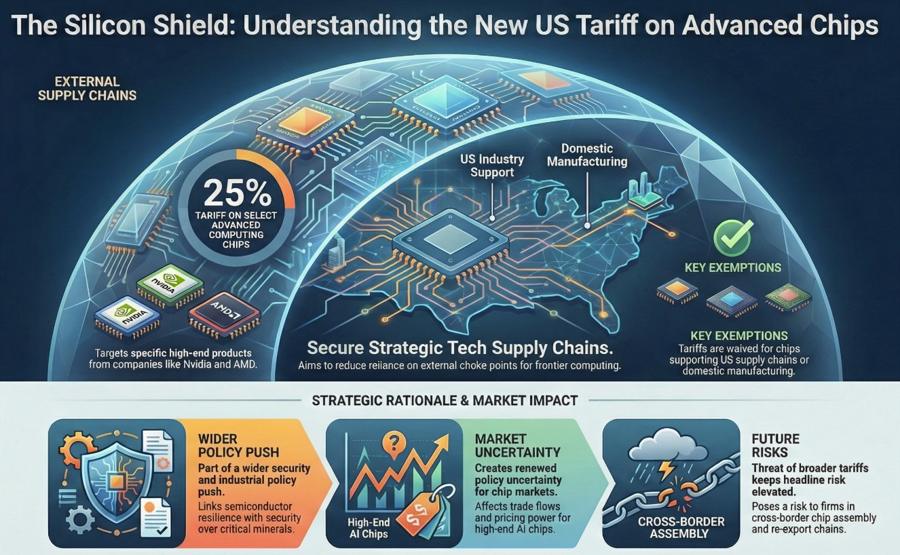
25% tariff imposed on select advanced computing chips (H200, MI325X cited)
Exemptions carved out for U.S. tech supply needs and domestic buildout-related imports
White House flags broader semiconductor and derivative-product tariffs may follow
Sits alongside the week’s critical-minerals security push and reshoring agenda
President Donald Trump signed a proclamation targeting semiconductor imports on national security grounds, imposing a 25% tariff on a narrow set of advanced computing chips, with the White House naming products such as Nvidia’s H200 and AMD’s MI325X.
The White House framed the move as an early step in a broader effort to secure strategically important technology supply chains and reduce reliance on external choke points for frontier computing. The fact sheet also flagged that broader tariffs on semiconductors and derivative products may follow in the near future, explicitly tying tariff policy to incentives for domestic manufacturing.
Two exemptions are doing a lot of work here. The administration said the 25% levy will not apply to chips imported to support the U.S. technology supply chain, and will also not apply where imports are linked to strengthening domestic manufacturing capacity for semiconductor derivatives. In effect, the policy aims to penalise “non-essential” or strategic destination flows while trying to avoid hitting inputs viewed as necessary for U.S. buildout.
Why now? This fits with a wider security-and-industrial-policy push that has been gathering pace, including the critical-minerals supply emphasis we discussed earlier in the week. Semiconductors and critical minerals are increasingly being treated as two sides of the same resilience agenda: minerals secure the upstream, chips secure the downstream.
For markets, the immediate read-through is renewed policy uncertainty around chip trade flows and pricing power at the high end of AI compute. The exemptions soften the broadest “cost shock” fears, but the White House’s reference to potential wider tariffs keeps headline risk elevated, particularly for firms and countries embedded in cross-border chip assembly and re-export chains.
---
I've added this as an explainer. Is it helpful? Let me know in the comments please.