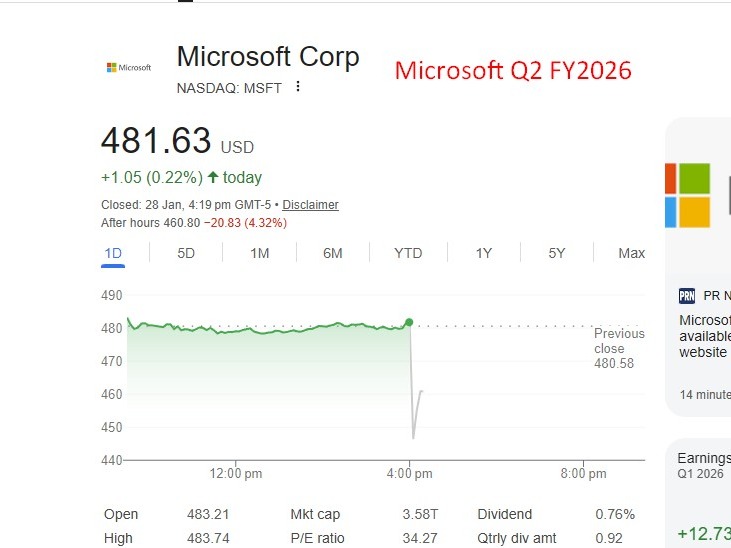
Microsoft beat Q2 expectations with Intelligent Cloud strength and a $625B commercial backlog, while Azure’s +38% ex-FX growth stayed steady and in line.
Summary:
Microsoft beat Q2 FY2026 expectations on both adjusted EPS and revenue, signalling resilient demand across its core franchise.
Adjusted EPS was $4.14 vs $3.92 expected, while revenue came in at $81.27B vs $80.31B expected.
Intelligent Cloud revenue rose to $32.91B, topping the $32.39B consensus estimate.
Azure & other cloud revenue grew +38% ex-FX, matching expectations and reinforcing steady cloud momentum.
Forward indicators stayed firm: commercial RPO was $625B, and Microsoft 365 commercial seats grew 6%.
Microsoft posted a solid Q2 FY2026 result, beating expectations on revenue and adjusted earnings while delivering steady cloud growth and firm forward-demand indicators. The quarter was marked by broad-based resilience across the company’s core commercial engine, with Intelligent Cloud outperformance and a large remaining performance obligation balance supporting the view that enterprise demand remains durable.
On the headline numbers, Microsoft reported revenue of $81.27 billion, edging above the $80.31 billion consensus estimate. Profitability also came in stronger than anticipated on an adjusted basis, with adjusted EPS of $4.14 versus $3.92 expected. The company also reported EPS of $5.16 (non-adjusted), underscoring strong underlying earnings power for the period.
The cloud segment again did much of the heavy lifting. Intelligent Cloud revenue was $32.91 billion, topping expectations of $32.39 billion, reflecting ongoing demand for cloud infrastructure and enterprise workloads. Within that, Microsoft said Azure and other cloud revenue grew 38% on a constant-currency basis, landing exactly in line with the market’s forecast. That “in-line but high” growth rate is likely to be read as a confirmation that Azure momentum remains intact even as investors continue to scrutinise the pace of cloud expansion.
Beyond the quarterly print, Microsoft’s forward-looking demand picture stayed constructive. The company reported commercial remaining performance obligation (RPO) of $625 billion, a key measure of contracted backlog that points to continued revenue visibility. Microsoft also noted Microsoft 365 commercial seats grew 6%, supporting the view that the company’s productivity suite remains sticky and continues to expand within enterprise accounts.
Overall, the quarter reinforces Microsoft’s position as a high-quality large-cap compounder, with cloud execution and commercial backlog trends likely to remain the key swing factors for near-term sentiment.