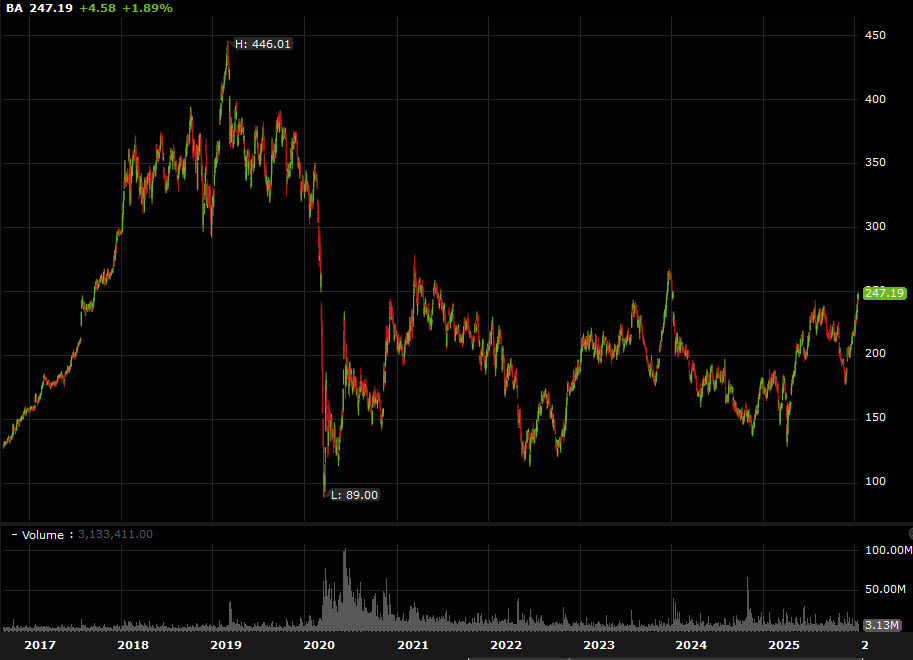
Shares of Boeing traded at a two-year high of $248.75 today as the company shows signs of getting on track after years of disappointment and executive turnover.
Bernstein today raised its Boeing target to $298 from $277. They highlighted that free cash flow will ramp up to $9-10 billion annually in the coming years against a market cap of $185 billion.
Suseuehanna has a $300 target as it values the company at 12x normalized 2027 EBITDA, arguing that the rich premium is deserved given the lack of aerospace/defense competitors and its strong customer moat in the aftermarket.
What most analysts want to see is reliable, repeatable free-cash flow generation, something that analysts see building in the coming years with the consensus at:
- 2026 $2.3 billion
- 2027 $6.8 billion
- 2028 $10.5 billion
- 2029 $14 billion
That's a compelling acceleration, though the out-year estimates are thin and obviously highly variable.
It's taken some time to get past the 737 Max disasters but Boeing is now trading at a premium to Airbus on some forward measures, despite much higher leverage (+3x EBITDA vs 1.2x for Airbus).
What has the market increasingly enthusiastic (shares up 36% in the past seven weeks) is the growing backlog. Delta this week announced 60 orders (30 firm) for 787-10 Dreamliners and the company's backlog at the end of Q3 was already $636 billion.
The company reports Jan 27 and that will likely rise further, including a separate order for 50 737 MAX jets from Aviation Capital Group.
Looking at the stock chart above, it would still need to rally 80% to get back to the 2019 highs. That's an enticing prospect but digging into the numbers, it's not a cheap stock by any metric. The bull case relies on generating sufficient margins on the big order backlog and executing on defense.
The latter is tricky as Trump said he wanted to boost the defense budget by 50%, but he also said that dividends and share buybacks would be halted until production increased. The latter would take a significant investment in capex.
Now we take everything Trump says with a grain of salt but those variables highlight how Boeing isn't exactly well-positioned in any scenario, especially with the company now looking for more in terms of cash harvesting rather than investing and growing the order book. A good portion of the free cash may also go towards bringing down leverage, rather than shareholder returns in any case.
It's been a long road back for Boeing but the market has already largely discounted it. In terms of price-to-sales, it trades at 2.26x, which is higher than 1.8x in 2018, before the big bull run started that year.
All told, there are decent reasons to buy BA stock and it has some momentum but valuation isn't one of them. Buying shares now already bakes in a turnaround, good execution and growing cash generation. As we know, a lot can go wrong.