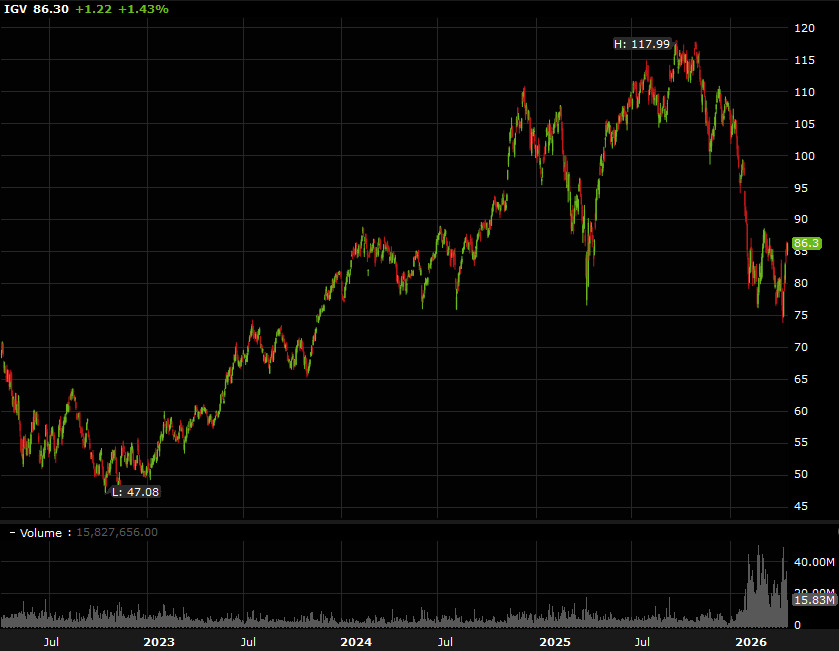
A Scotiabank research note from Monday deserves more attention than it will probably get. Patrick Colville's team spoke with the Global Head of Digital at a major biopharmaceutical company, one with over $25 billion in annual revenue. That's the kind of blue-chip, highly regulated customer that software vendors have traditionally treated as bulletproof recurring revenue and it's why they traded at 50x multiples before late 2025. What that executive described should make every long-only holder of legacy application software stocks think carefully about position sizing.
The headline number: IT spending rising to roughly $880 million in 2026, up 10% year-over-year, with every incremental dollar going to AI transformation. Microsoft is the obvious winner here, pocketing the full $30-per-user list price on a 10,000-seat M365 Copilot rollout with what the executive called "zero pricing leverage" on the customer side. That's amazing given how badly the reviews are on Copilot but it shows they're a trusted name with easy adoption. You have to imagine they will eventually get an LLM that works.
The more interesting story is what's happening to everyone else.
This pharma spends $25 million a year with Veeva — a vendor that competes with Salesforce — and the digital chief is already describing it as "just a system of record." . The ink on the contract is barely dry and the customer is publicly saying the vendor is moving too slowly on AI. Their solution? Extract the data, point Anthropic's Claude Code and Cowork at it, and build the innovation layer themselves. One mobile app for pre-call planning, built in 8-10 weeks, deployed to 150 reps.
Scotia wrote:
The fact that this massive, listed, highly regulated company is acting this way is eye popping! We in fact spoke to a giant European company last week that was thinking real-time exactly the same way – get in touch and we can talk through our latest checks. We wonder if the perceived value and pricing leverage of traditional application vendors could be at risk in 2026
The market is certainly down on software already but maybe not enough. For two decades, the application software bull case has rested on switching costs, workflow entrenchment, and the sheer difficulty of building anything custom. LLMs with agentic coding capabilities are attacking all three pillars simultaneously. When a regulated pharma giant — the most risk-averse buyer in enterprise software — is comfortable vibe-coding (and deploying) its own sales tooling on top of a vendor's data layer, the moat is narrower than the P/E multiples suggest.
Who's exposed? Start with the obvious names. Salesforce is already dealing with a Veeva split and now has to watch Veeva itself get disintermediated as an innovation layer. Adobe, Workday, ServiceNow, Atlassian — anyone whose pricing power depends on being the only reasonable way to get a feature shipped — should be rerated for the possibility that enterprises increasingly build rather than buy. Snowflake lost this particular $5-7 million mandate to Databricks on domain knowledge and price. That's a competitive loss, not a structural one, but it rhymes with the broader theme: customers are getting choosier and vendors are getting squeezed.
Stay skeptical about vertical SaaS multiples. The customers are telling you what's coming.