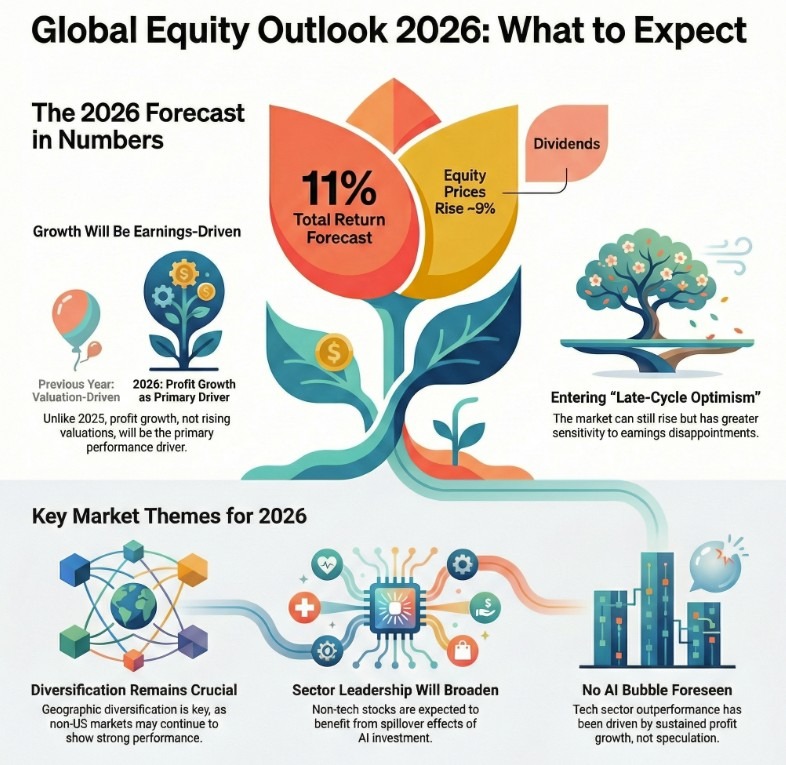
Goldman expects global equities to post solid but slower gains in 2026, led by earnings growth and a broadening market rally.
This is from earlier in January, posting ICYMI (like I did!).
Summary:
Goldman forecasts 11% global equity returns over the next 12 months.
Gains are expected to be earnings-driven rather than valuation-led.
Global growth and modest Fed easing support the outlook.
Diversification across regions, styles and sectors remains key.
No AI bubble seen despite intense investor focus.
Global equities are expected to deliver solid, though more moderate, gains in 2026, with Goldman Sachs Research forecasting total returns of around 11% over the next 12 months, including dividends and measured in US dollars.
After a powerful rally in 2025, Goldman argues the global equity bull market remains intact, supported by continued earnings growth and steady economic expansion across regions. While last year’s advance pushed valuations to historically elevated levels, the bank does not see conditions consistent with a major equity drawdown in the absence of a recession. Goldman expects the Federal Reserve to provide modest additional easing, helping to sustain growth without reigniting inflation pressures.
Peter Oppenheimer, Goldman’s chief global equity strategist, said the current macro backdrop makes a sharp equity setback unlikely, even with valuations already stretched. He noted that equity cycles typically progress from despair to hope, then into a longer earnings-driven growth phase, before entering an optimism phase marked by rising confidence. Goldman’s analysis suggests markets are now in this late-cycle optimism phase, which can still support further upside but also introduces greater sensitivity to earnings disappointments.
Unlike 2025, when multiple expansion contributed meaningfully to returns, Goldman expects 2026 performance to be driven primarily by fundamental profit growth rather than further valuation gains. The bank’s regional forecasts imply equity prices rising roughly 9% over the next year, with dividends lifting total returns to around 11%.
Diversification is expected to remain a key theme. Geographic diversification paid off in 2025 as US equities underperformed several overseas markets for the first time in more than a decade, helped by a weaker dollar. Europe, Japan, China and broader Asian markets delivered stronger dollar-adjusted returns, supported by a mix of earnings recovery and valuation expansion.
Goldman expects this convergence in growth-adjusted valuations between US and non-US markets to continue in 2026, even as absolute US valuations remain higher. The bank also sees increased scope for stock selection as correlations fall, creating opportunities for alpha generation.
Sector leadership is expected to broaden further, with non-technology stocks benefiting from spillovers linked to artificial intelligence investment. While AI remains a dominant market theme, Goldman does not view current conditions as a speculative bubble, arguing that technology sector outperformance has been driven by sustained profit growth rather than excess valuation alone.