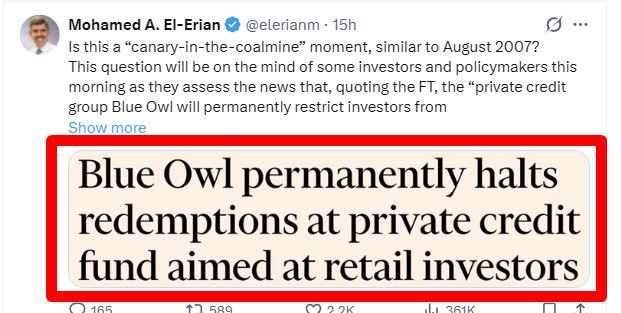
Blue Owl shares hit record lows as redemption requests surge, forcing limits on withdrawals and loan sales. The move highlights growing stress in private credit, with liquidity concerns and AI-related risks weighing on sentiment.
Summary:
- Blue Owl shares hit record lows amid sustained selling pressure
- Redemption limits imposed after surge in withdrawal requests
- Highlights liquidity mismatch risks in private credit funds
- Broader $1.8tn private credit market under scrutiny
- BDCs facing rising retail investor outflows
- AI disruption concerns weigh on software-heavy loan exposure
- Stock increasingly used as proxy short for private credit risk
- Loan sales undertaken to meet redemptions
Shares of Blue Owl Capital Inc. have fallen to fresh record lows, as intensifying concerns around the private credit sector trigger sustained selling pressure and rising investor scrutiny.
The stock closed lower again on Monday, extending a prolonged decline that has now stretched across multiple months. The latest move follows a sharp deterioration in sentiment after the firm confirmed it would impose limits on investor redemptions from two of its private credit funds, citing a surge in withdrawal requests.
The decision has heightened fears around liquidity mismatches within the private credit ecosystem, where funds often hold relatively illiquid loans while offering investors periodic redemption windows. As redemption demand rises, managers are increasingly forced to either gate withdrawals or sell assets into weaker markets.
The pressure on Blue Owl reflects broader unease across the roughly $1.8 trillion private credit market, where business development companies (BDCs), a key access point for retail investors, have seen a wave of outflows. Investors are becoming more cautious about underwriting standards, borrower quality, and exposure to sectors facing structural disruption.
In Blue Owl’s case, the concerns are amplified by its significant exposure to software and technology-linked borrowers, areas viewed as particularly vulnerable to displacement from artificial intelligence. As a result, the stock has emerged as a proxy for bearish positioning on the private credit space more broadly.
The selloff has been severe. Shares are coming off their steepest quarterly decline on record and have now posted a prolonged run of monthly losses. Short interest has also surged in recent weeks, reflecting growing conviction among bearish investors that stress within the asset class could deepen.
Fund-level pressures have also become more visible. One of the firm’s technology-focused BDCs saw redemption requests exceed 15% in the prior quarter, while plans to merge two vehicles were abandoned amid concerns over potential investor losses.
To meet withdrawal demand, Blue Owl has already taken steps to raise liquidity, including the sale of approximately $1.4 billion in loans earlier this year. Company executives have pushed back against concerns around pricing, insisting the transactions were conducted without hidden discounts.
Even so, the combination of rising redemptions, forced asset sales, and broader questions around credit quality is reinforcing a negative feedback loop—one that is increasingly weighing on both valuations and investor confidence across the private credit landscape.
----
This has been ongoing for a good few months, starting here: