Earlier today, we had Germany and France release their latest trade figures for December and in summary the whole of 2025. There were quite a few things to note but a couple of standout points were:
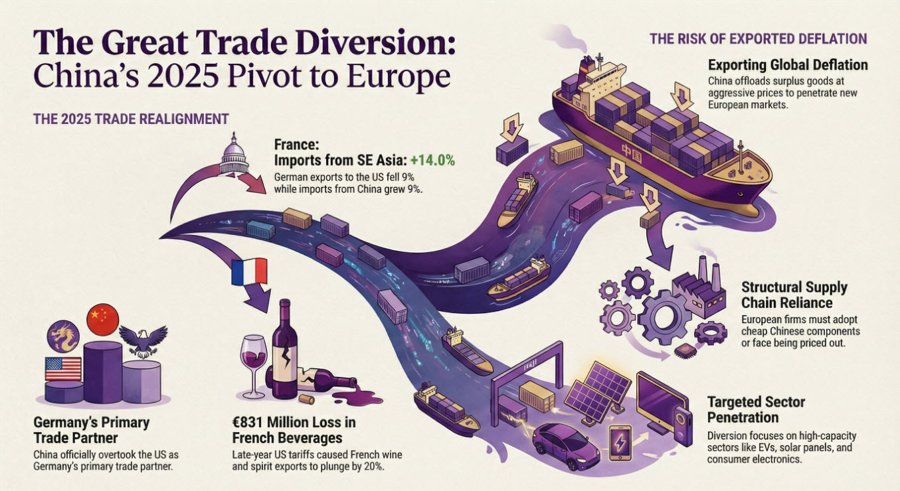
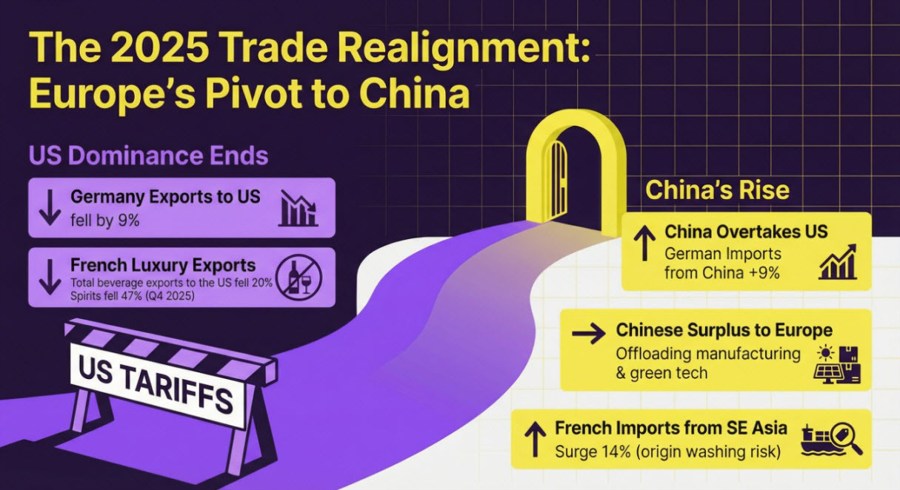
- China once again overtaking the US as being Germany's top trade partner
- German exports to the US declined by 9% for the year
- German imports from China grew by over 9% for the year
- China and the US go toe-to-toe in being France's top trade partner
- French exports to the US remain resilient, although wines and spirits saw exports plunge in Q4
- French imports from China grew by over 5% for the year, driven by pharmaceutical products, clothing, and household appliances
- French imports from South East Asian countries surged by 14% for the year; origin washing perhaps?
Taking all that into consideration, it is clear that Trump's tariffs is having a material impact on who and what European countries are choosing to trade with.
The steep decline in German exports to the US exemplifies that, with auto exports surely being hit hard. And that means Germany has to try and foster bilateral relations elsewhere to maintain their economic stature. Evidently, China is the main beneficiary from all this. And I'm not speaking about investment and trade ties in helping out Germany alone.
It is the fact that China is also able to help itself in diverting and offloading surplus goods manufactured in Chinese factories. It would be reasonable to think that these goods would be originally intended for the US market. But with Trump's aggressive tariffs eating into profit margins, Chinese firms have to do some reshuffling and instead redirect their goods and sales elsewhere instead.
It seems that Europe is one of the more popular destinations, not to mention the sudden demand surge for electric vehicles (EVs) as well helping in that regard. The green transition is a key thing to note as well, allowing for China to export things like solar panels and wind turbine components to Germany to help with the shift.
In the case of France, this year is going to be the more interesting one to take note of. French demand for Chinese goods was solid last year but it seems that exports to the US also held up well despite tariffs. So, was the impact of tariffs overblown? Not quite.
Do be reminded that the higher levies on French wines and spirits only came into effect in August last year. However, Trump was already threatening these tariffs since April. And that allowed for French bottle makers to frontrun exports to the US before the tariffs hit.
But when you look at the Q4 numbers after the tariffs came into effect, the impact is evident. French wine exports to the US dropped by over 39% in 2H 2025 and spirits were down by roughly 47% in Q4 2025. Despite the late impact, total beverage exports to the US exhibited a decline of over 20% for the year. That's roughly a a loss of €831 million.
To summarise all of that, it is clear that the nature of US tariffs is having a negative impact on the trade relationship between major European countries with the US itself. However, it is at the same time indirectly also creating an avenue for these impacted countries (China included) to seek out opportunities within themselves.
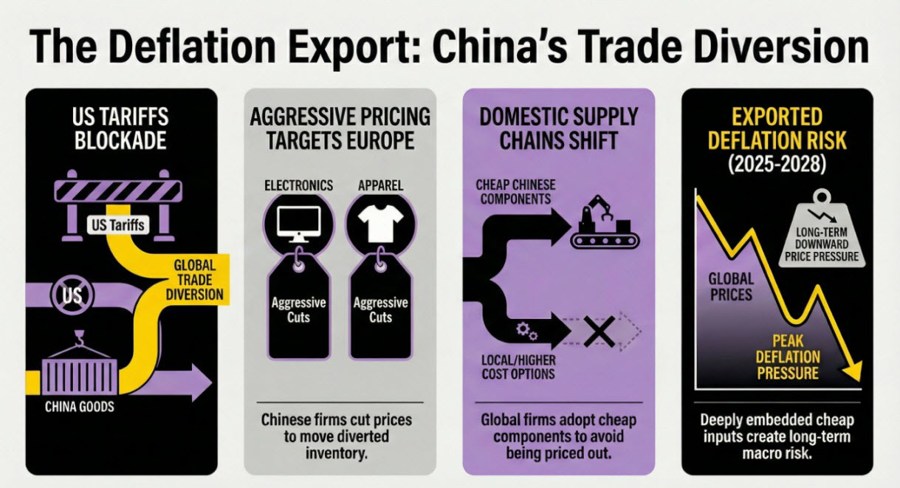
On that final point, China is obviously sneaking in to try and establish a stronger footing in the European market. And not just to help with the needs of Germany and France, but to also market their own products which were originally manufactured for the US market.
In order to be able to move this diverted goods and products, Chinese companies will tend to try and compete hard in terms of pricing and make things a lot cheaper. That includes specific sectoral products such as consumer electronics and apparel especially.
Now, this is where there might be an even bigger worry - not just to Europe but also for the rest of the world.
As China diverts their final trade products away from the US and to other countries, they are doing so for cheap in order to try and penetrate new markets. And what is not clearly evident at first glance is the structural impact this will have on domestic supply chains for these countries that are importing their goods from China.
In time, this will eventually lead to lower input costs as it would be much cheaper to source for equivalent components from China due to domestic overcapacity there. As such, domestic firms in let's say Europe will have to adjust or be priced out of the competition and that means also increasing reliance on Chinese raw materials and parts to make it cheaper to build their end product.
So, what does this all mean?
In essence, China is indirectly exporting deflation to these countries. That especially the longer it is allowed to penetrate and stay embedded into the supply chains.
And while markets are now all talking about inflation returning, this is a potential outside risk to consider as part of the macro outlook. It may not be obvious now but it could become a real issue come next year or perhaps in 2028. That especially if global trade relations with the US also fail to improve in the years ahead.