- Prior month 107.57 was revised higher to 108.00.
Looking at the data, the move lower takes the index to the lowest level since May 2021 (when it was at 107.40).
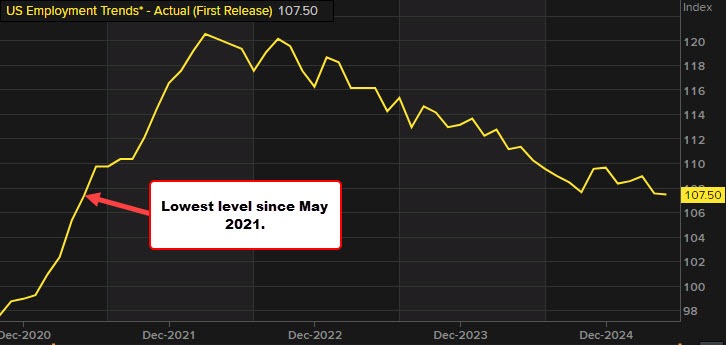
According to the Conference Board:
ETI is composed of 8 indicators:
Initial Claims for Unemployment Insurance
Rose to 235,000 in May (highest since July 2024). Weaker
Percentage of Respondents Who Say Jobs Are Hard to Get
Rose to 18.6%, matching 2024 highs. Weaker
Number of Employees Hired by the Temporary-Help Industry
Fell by 20,200 in May; down 41,600 YTD. Weaker
Part-Time Workers for Economic Reasons (Involuntary)
Declined to 17%, still above 2024 average
Job Openings
Rose in April, but expected to fall in May (per Help-Wanted-OnLine data). Stronger
Industrial Production
Not specifically mentioned for May
Real Manufacturing and Trade Sales
Not discussed in this release
Ratio of Involuntary Part-Time to All Part-Time Workers
Embedded in point 4 above
Components dragging the index lower in May:
Jobs hard to get (consumer sentiment)
Temporary-help employment
Jobless claims
Job openings
Despite those weaknesses, the overall labor market remains resilient, with high employment and strong wage growth helping cushion against emerging tariff-related headwinds
On Friday the US employment data painted a mixed yet generally stable picture for labor market conditions:
Headline data showed an increase of 139,000 nonfarm payrolls, slightly exceeding consensus forecasts and marking a modest cooling from earlier readings—Tuesday’s March and April gains were revised down by a total of 95,000 jobs. The unemployment rate remained steady at 4.2%, but this reflected a drop in labor force participation, with 625,000 individuals exiting the workforce.
Sector dynamics revealed that job creation was concentrated in health care (+62K), leisure & hospitality (+48K), and social assistance (+16K), while federal government jobs declined sharply (–22K) and industries such as manufacturing and temporary help showed little change . Meanwhile, average hourly earnings rose 0.4% m/m, translating to a 3.9% year-over-year gain, underscoring continued wage strength
