
- Business activity index 53.9 vs 59.9 prior
- Employment 45.2 vs 51.8 prior
- New orders 60.6 vs 58.6 prior-- two year high
- Prices paid 70.7 vs 63.0 prior -- highest in three-and-a-half years
- Supplier deliveries 56.2 vs 53.9 prior
- Inventories 54.8 vs 56.4 prior
- Backlog of orders 53.6 vs 55.9 prior
- New export orders 50.7 vs 57.2 prior
- Imports 55.2 vs 51.8 prior
- Inventory sentiment 54.3 vs 55.3 prior
From the chart, you can see the trajectory of this survey before the start of the war.
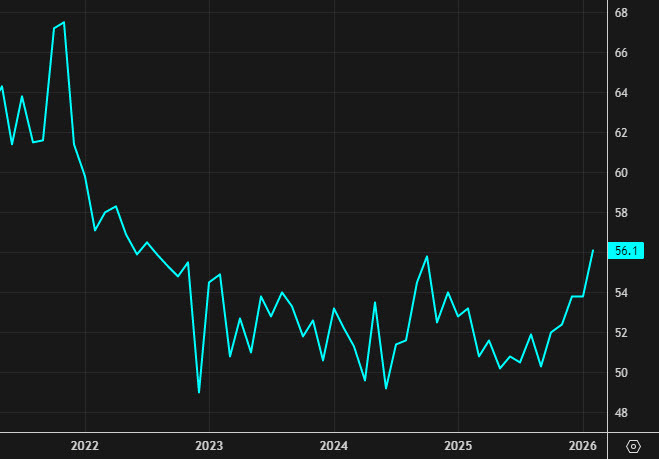
This index has been above 50 for 20 consecutive months and is one of the better-looking economic indicators in the US. Lately, it's creeped back into the pre-covid range of 55-60 as companies benefit from tax breaks, rate cuts and deregulation. The removal of tariffs could also have helped boost sentiment but those mostly applied to goods. It's not yet clear how the reversal of energy prices higher is going to impact business sentiment but this isn't a good sign.
Comments in the report:
- “Tariff rollbacks are resulting in favorable price adjustments, but the news of new implementation is driving continued uncertainty. Snowstorms last month disrupted demand and supplier operations, mostly around the availability of labor. Forecasted seasonal growth is starting to materialize due to daylight savings time and higher temperatures.” [Accommodation & Food Services]
- “Transportation disruptions in the Middle East are inhibiting both incoming and outgoing cargoes from the region. While force majeure has been received from several Middle Eastern suppliers, business operations are generally at normal levels and no interruptions, except shipping.” [Construction]
- “We are still in cost cutting and operational streamlining mode as technology continues to advance. We have seen more concessions regarding passing through tariff surcharges. We continue to closely monitor the political situation in the Middle East and how ramifications could impact our supply chain and overall costs.” [Finance & Insurance]
- “As we close out the first quarter, demand for AI computer infrastructure remains incredibly resilient. Customers have opened their 2026 capital budgets, leading to a strong refresh in new order intake. Operationally, our focus has shifted toward efficiency and margin protection.” [Information]
- “Political uncertainty with Iran conflict has resulted in less international business. Domestic business remains consistent with January and February levels.” [Mining]
- “We’re seeing some expansion across the services economy with stronger business activity and new orders. Clients remain active on regulatory, tax planning, and risk management initiatives, though persistent pricing pressures and evolving economic conditions continue to shape project prioritization and budgeting.” [Professional, Scientific & Technical Services]
- “The war in Iran has added an additional layer of uncertainty on top of an already shaky macroeconomic climate. A spike in inflation due to higher oil prices will reduce purchasing power, affecting every industry.” [Real Estate, Rental & Leasing]
- “Recent increases in fuel prices are having a substantial impact on the airline industry, resulting in significantly higher operational costs compared to pricing from just one month ago.” [Transportation & Warehousing]
- “Continued volatility in copper, aluminum and steel markets — driven by supply chain constraints and strong infrastructure demand — has increased costs and lead times for electric utility projects. These conditions are influencing purchasing strategies and capital planning across the industry.” [Utilities]
- “The U.S.-Israel military operations against Iran have created significant uncertainty for our Omani frankincense imports. Threats to close the Strait of Hormuz and rising war-risk surcharges are pressuring regional logistics costs, even for air freight. Combined with the Supreme Court’s emergency tariffs ruling — which replaced our 10-percent tariff with a 15-percent Section 122 tariff — landed costs have increased materially. We are monitoring regional stability closely and maintaining communication with Omani suppliers.” [Wholesale Trade]
For background, the ISM Services PMI (formerly the Non-Manufacturing ISM Report On Business) is published monthly by the Institute for Supply Management, based on surveys of purchasing and supply executives across the U.S. services sector. The panel is weighted by each industry's contribution to GDP. The headline composite is built from four equally weighted subindices—business activity, new orders, employment, and supplier deliveries—with readings above 50 indicating expansion. Given that services account for roughly three-quarters of U.S. economic output, the report is closely watched as a barometer of overall growth momentum.
The services sector ended 2025 on an accelerating note. The PMI rose for a third straight month in December to 54.4, the strongest since October 2024, with all subindices in expansion for the first time since February of that year. January 2026 held steady at 53.8, with business activity and supplier deliveries posting their highest readings since October 2024. Respondent commentary increasingly flagged tariff uncertainty and annual contract renewals as sources of concern, while price pressures edged higher with the prices paid index at 66.6.
February marked a significant acceleration. The headline PMI surged 2.3 points to 56.1, the highest since July 2022 and well above the 53.5 consensus. It was the 20th consecutive month of expansion and the 69th straight month of overall economic growth as measured by the index. Business activity jumped to 59.9, its second-highest reading since November 2022. New orders surged 5.5 points to 58.6, the sharpest pace in 17 months, while employment growth firmed to 51.8. Notably, all ten reported subindices were in expansion territory for the first time since March 2021. Backlogs of orders swung into expansion for the first time in a year. On the price side, the prices paid index actually eased 3.6 points to 63.0, though it remained above 60 for a fifteenth consecutive month.


