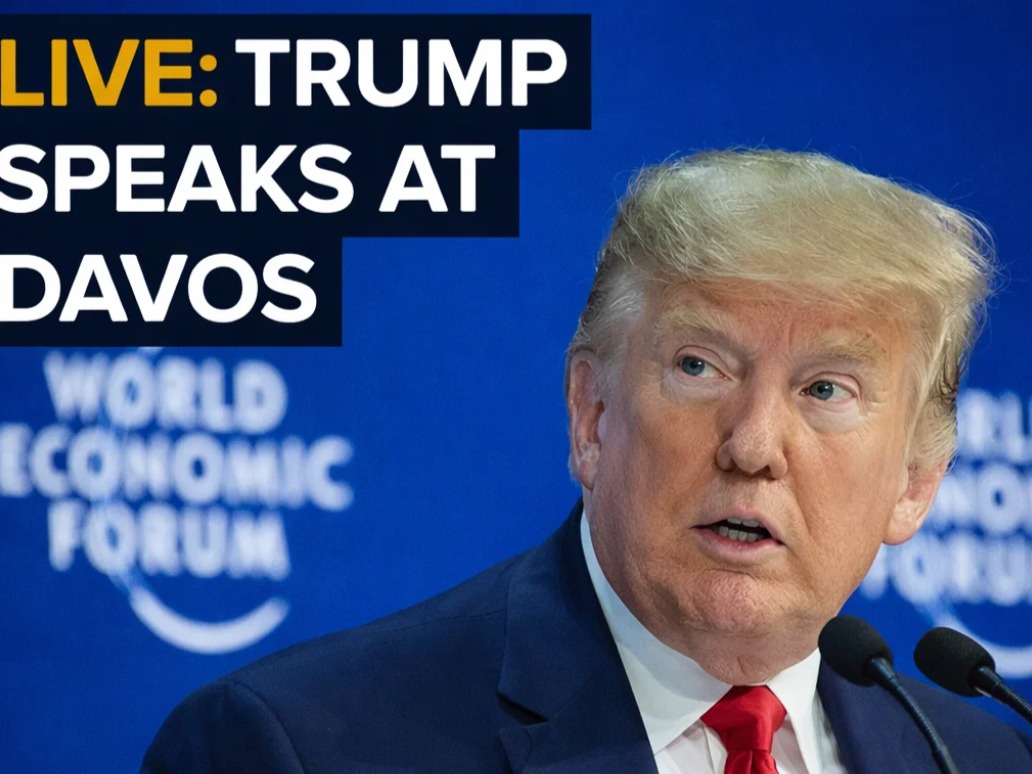
Trump at Davos: Greenland, Growth, and AI Set the Tone for Markets
Trump used his Davos speech to send three signals markets care about:
Greenland: He doubled down on its strategic importance but explicitly ruled out the use of force, reducing near-term geopolitical tail risk while keeping negotiations in play.
Markets and rates: He criticized the idea that strong growth should hurt stocks, reinforcing pressure for a more growth-tolerant rate environment.
AI: He framed AI as a once-in-a-generation opportunity where the US must lead, with innovation prioritized over regulation.
For investors and traders, the takeaway is lower immediate geopolitical risk, a pro-equity growth message, and continued support for AI, energy, and defense-related investment themes.
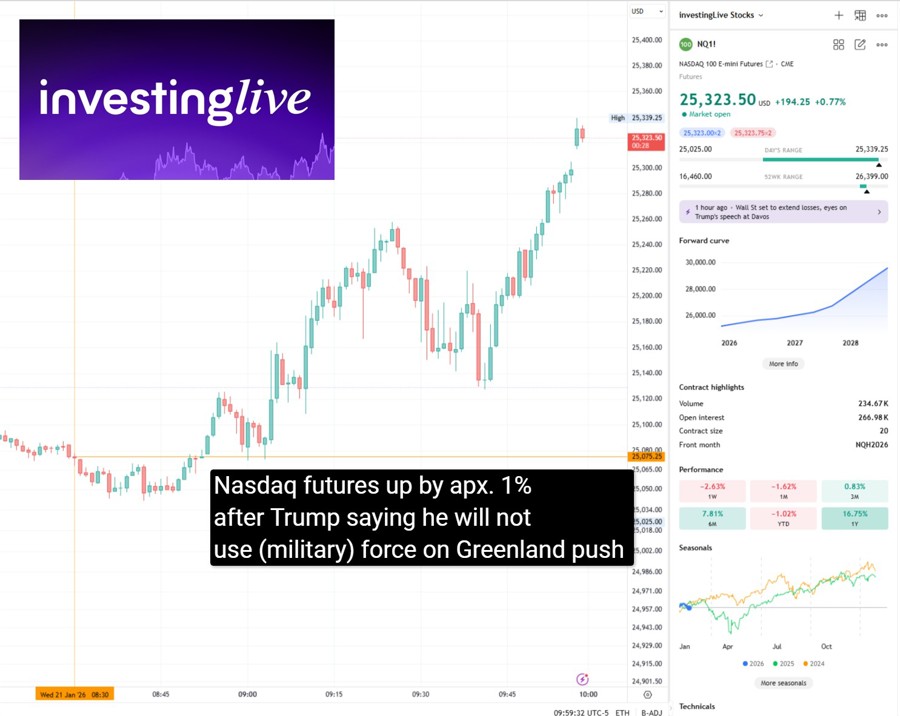
What to watch in this Trump speech at Davos Live Now
Live updates - key remarks and market context
“Our fourth quarter growth is projected to be 5.4%, far greater than anybody other than myself and a few others had predicted.”
What he said
Trump opens by framing US economic growth as significantly stronger than expectations, positioning the US economy as outperforming consensus forecasts.
What it means
This is an attempt to anchor expectations toward above-trend growth. Even if markets question the number, the message supports a strong growth narrative, which tends to lift risk assets but can also push yields higher.
What to watch
US 2Y and 10Y Treasury yields
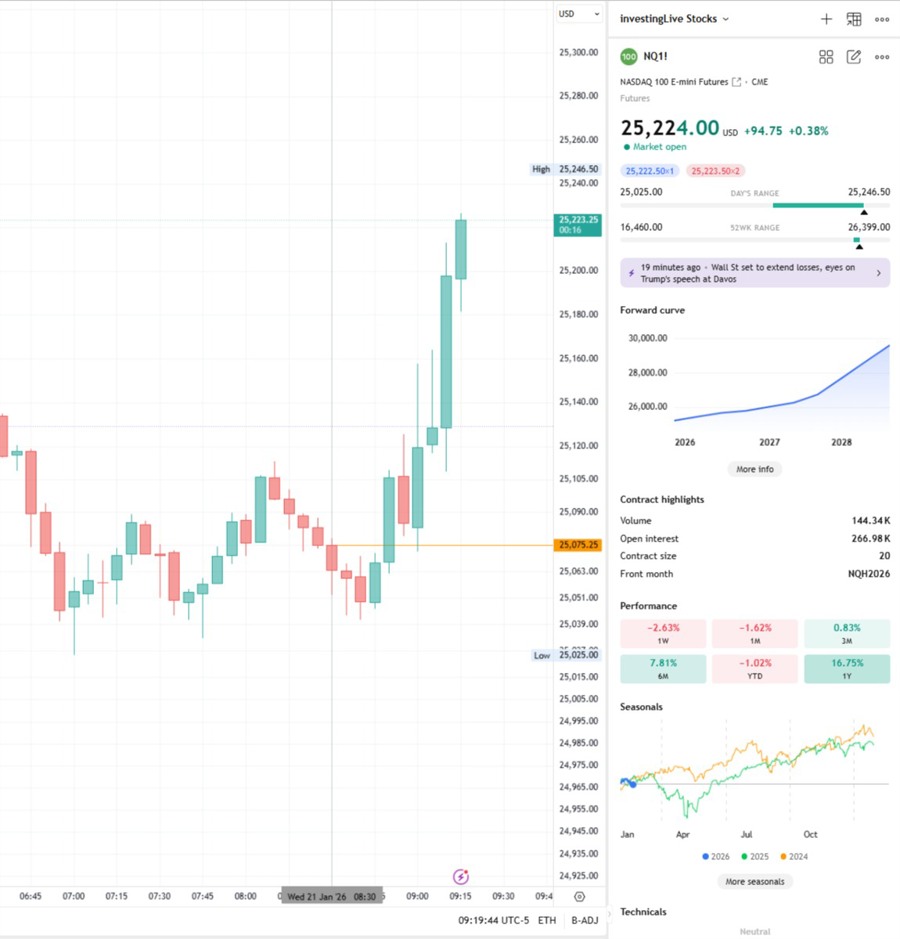
Equity index futures reaction, especially Nasdaq
Growth vs value rotation
“Since the election, the stock market has set 52 all-time high records… adding $9 trillion in value to retirement accounts, 401ks, and people's savings.”
What he said
He highlights equity market performance and the wealth effect, tying market gains directly to household financial health.
What it means
This reinforces a pro-equity, pro-wealth-effect message. Markets often interpret this as political support for policies that avoid major market drawdowns.
What to watch
S&P 500 and Nasdaq futures
VIX behavior (confidence vs complacency)
Financials and consumer discretionary stocks
“People are doing very well. They're very happy with me.”
What he said
A brief confidence and approval statement, reinforcing positive sentiment.
What it means
This keeps the tone risk-friendly and reduces perceived political uncertainty in the short term.
What to watch
Intraday volatility during the speech
Follow-through buying vs headline fade
“Since my inauguration, we've lifted more than 1.2 million people off of food stamps.”
What he said
He frames labor market and social data as evidence of economic strength.
What it means
Strong labor narratives support consumption but also keep inflation and wage pressure concerns alive.
What to watch
Inflation expectations
Rate-sensitive sectors
Fed-sensitive assets
“In four years, we've secured commitments for a record-breaking $18 trillion, and we think… closer to $20 trillion of investment.”
What he said
Trump escalates investment claims dramatically, positioning the US as the top global destination for capital.
What it means
Markets will not price the number itself, but the policy signal matters: pro-business, pro-investment, and globally competitive.
What to watch
Industrials and infrastructure-linked stocks
Capital expenditure beneficiaries
USD reaction if capital inflow narrative strengthens
“The United States economy is on pace to grow and double the rate that was projected by the IMF just last April.”
What he said
He contrasts current US growth with prior global forecasts, emphasizing relative outperformance.
What it means
This frames the US as structurally stronger than peers, which can support USD strength and US asset outperformance.
What to watch
USD vs EUR and JPY
US vs Europe equity relative performance
Global risk allocation flows
“And with my growth and tariff policies, it should be much higher.”
What he said
He explicitly links tariffs to economic growth.
What it means
This is a critical signal. Tariffs are being framed as growth-positive rather than inflationary or restrictive, increasing the risk of future trade tensions being reintroduced as a policy tool.
What to watch
Any follow-up details on tariffs
China and EU references later in the speech
FX volatility and industrial sector reaction
Live market takeaway so far
Tone: Strongly pro-growth, risk-friendly
Hidden risk: Rates and trade policy escalation
Market reaction likely to depend on specific policy details later in the speech
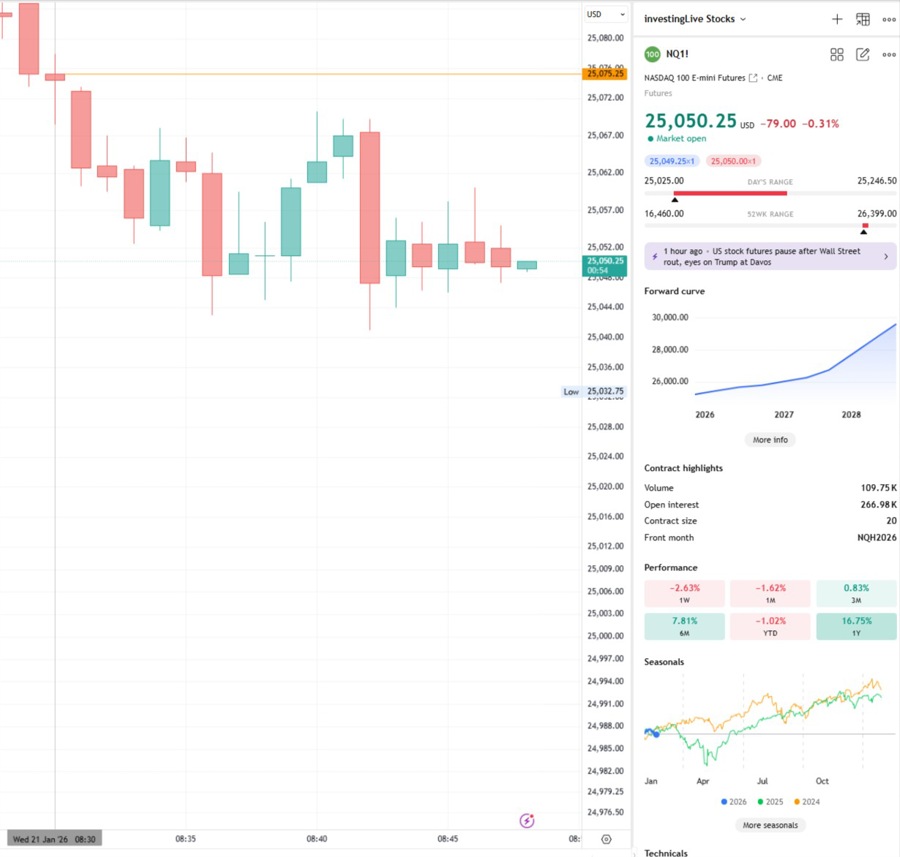
Nasdaq market in the first 12 minutes of Trump's speech - bulls not impressed so far, but no big drama yate, 1min chart
“In one year, I slashed our monthly trade deficit by a staggering 77%, and all of this with no inflation.”
What he said
Trump claims a sharp reduction in the trade deficit without triggering inflation, directly challenging a common economic assumption.
What it means
This is a core validation claim for tariffs and trade restructuring. The message to markets is that trade tightening does not have to be inflationary, which, if accepted, lowers the perceived policy risk of future tariff actions.
What to watch
Inflation expectations and breakevens
FX reaction to renewed trade confidence
Bond market response to “no inflation” claims
“American exports are now up by more than $150 billion.”
What he said
He points to a large increase in US exports as proof of improved trade competitiveness.
What it means
This supports a strong external demand narrative and reinforces the idea of the US as a growth engine rather than a drag on global trade.
What to watch
Export-heavy US companies
Transportation and logistics stocks
USD strength if export growth is believed
“Domestic steel production is up by 300,000 tons a month… It’s doubling and tripling. We have steel plants being built all over the country.”
What he said
Trump highlights a surge in domestic steel output and new industrial capacity.
What it means
This is a reshoring and industrial revival signal. Markets may see this as bullish for domestic manufacturing but potentially negative for global steel exporters.
What to watch
US steel and materials stocks
Industrial input costs
Trade-sensitive foreign producers
“Factory construction is up by 41%… and that number is really going to skyrocket right now.”
What he said
He claims strong growth in factory construction, with faster approvals accelerating the trend.
What it means
This reinforces a capex acceleration theme, suggesting multi-quarter investment momentum rather than a short-term boost.
What to watch
Capital goods and construction-related stocks
Regional manufacturing hubs
Medium-term earnings outlook for industrials
“We've made historic trade deals with partners covering 40% of all U.S. trade.”
What he said
Trump emphasizes the scale of recent trade agreements.
What it means
This shifts the narrative from confrontation to selective partnership, reducing immediate fears of blanket trade wars while keeping leverage through tariffs.
What to watch
Global risk sentiment
Countries and sectors tied to trade agreements
Relative performance of US vs global equities
“The European nations, Japan, South Korea… especially in oil and gas.”
What he said
He names major partners and highlights energy-focused trade deals.
What it means
Energy exports are positioned as a strategic and geopolitical tool, supporting both growth and trade balance improvements.
What to watch
Energy sector stocks
Oil and gas export data
Energy-linked FX flows
“These agreements raise growth and cause stock markets to boom… when the United States goes up, you follow.”
What he said
Trump frames US growth as a global market leader and catalyst.
What it means
This reinforces a US leadership and capital magnet narrative, which typically supports USD strength and US equity outperformance.
What to watch
US equity leadership vs international markets
Capital inflows into US assets
Correlation between US indices and global markets
“Under my leadership, U.S. natural gas production is at an all-time high by far.”
What he said
Trump claims that U.S. natural gas production has reached unprecedented levels under his administration.
What it means
This reinforces the theme of energy dominance. Elevated natural gas production can support domestic energy prices, export potential (LNG), and energy sector earnings. It also signals that the administration sees energy as a core economic strength.
What to watch
Natural gas prices (Henry Hub, futures)
Energy sector equities
LNG export-related stocks and infrastructure
“U.S. oil production is up by 730,000 barrels a day…”
What he said
He cites a specific increase in oil output as a sign of growth in the U.S. energy sector.
What it means
Increased oil production supports domestic energy security and can help contain energy cost inflation. For markets, higher production usually bolsters energy equities but may pressure crude prices if global demand doesn’t match supply.
What to watch
WTI and Brent crude prices
Oil producers’ stock performance
OPEC+ messaging and supply responses
“…last week we picked up 50 million barrels from Venezuela alone.”
What he said
Trump refers to acquiring a large amount of Venezuelan oil.
What it means
This signals short-term crude supply relief and geopolitical maneuvering in energy markets. It’s meant to reassure markets about supply stability and the administration’s ability to unlock resources.
What to watch
Short-term crude price volatility
Energy inventories data
Geopolitical risk premium in oil markets
“Venezuela has been an amazing place for so many years… now it's got problems, but we're helping them… they're going to be making more money than they've made in a long time.”
What he said
He frames engagement with Venezuela as both humanitarian and economic.
What it means
This is geopolitical messaging designed to soften risk perceptions. While not a direct market driver, it can influence emerging market sentiment and energy risk premia.
What to watch
Emerging markets FX and equities
Energy-linked sovereign risk premiums
Crude price reaction to geopolitical stability narratives
“Once the attack ended, the attack ended, they said, let's make a deal.”
What he said
This appears to refer to an unspecified confrontation followed by negotiation.
What it means
The ambiguity here means markets may read this differently depending on context. It could signal conflict de-escalation, which tends to be supportive for risk assets; or it could be read as diplomatic maneuvering with unclear economic impact.
What to watch
Risk-on vs risk-off indicators
Headlines clarifying what “attack” refers to
Safe-haven assets (gold, JPY, CHF)
“I've signed an order directing and approval of many new nuclear reactors. We're going heavy into nuclear.”
What he said
Trump says he has approved many new nuclear reactors and signals a major policy shift toward nuclear energy.
What it means
This is a structural energy policy signal, not a short-term headline. Nuclear is being framed as a long-term solution for baseload power, price stability, and energy security. Markets tend to read this as bullish for utilities, infrastructure, and long-duration capital investment themes.
What to watch
Nuclear and utility-related equities
Long-term power infrastructure plays
Energy policy follow-up headlines
“I was not a big fan because I didn't like the risk… but the progress they've made with nuclear is unbelievable.”
What he said
He acknowledges past concerns but emphasizes technological and safety advances.
What it means
This reframes nuclear from a political risk to a technology upgrade story, which can reduce regulatory risk premiums over time.
What to watch
Regulatory sentiment toward nuclear
Capital allocation into energy infrastructure
Utility sector valuation rerating
“We're very much into the world of nuclear energy… at good prices and very, very safe.”
What he said
Trump stresses cost competitiveness and safety.
What it means
This positions nuclear as both economically viable and scalable, supporting long-term growth narratives tied to AI, data centers, and industrial demand.
What to watch
Electricity pricing trends
Power-hungry sectors like data centers
Energy cost assumptions in equity models
“We're leading the world in AI by a lot. We're leading China by a lot.”
What he said
He asserts clear US leadership over China in AI development.
What it means
This reinforces a US tech dominance narrative, which supports large-cap technology leadership and continued capital inflows into AI-related infrastructure.
What to watch
AI and semiconductor stocks
US vs China tech sentiment
Policy rhetoric tied to technology leadership
“I've allowed these big companies… to build their own electric capacity… their own power plants.”
What he said
He says large companies are being allowed to self-build power infrastructure.
What it means
This is a quiet but critical signal. Allowing private power generation removes bottlenecks for AI, cloud, and industrial expansion. It shifts power investment from public utilities to private capital.
What to watch
Data center and hyperscaler capex
Private infrastructure investment trends
Utility vs private generation dynamics
“China's creating so much energy… but we're creating as much or more.”
What he said
He acknowledges China’s energy build-out while claiming US parity or leadership.
What it means
This frames energy production as a geopolitical competition, similar to AI and manufacturing. Markets may read this as justification for sustained, large-scale infrastructure spending.
What to watch
US-China policy headlines
Commodity demand tied to infrastructure
Long-term inflation vs productivity trade-offs
“Most ongoing that they're going oil and gas. They're even going coal in some cases.”
What he said
Trump argues that despite renewable pushes, countries and companies are reverting to oil, gas, and even coal for reliable energy.
What it means
This reinforces the message that baseload reliability beats ideology. For markets, it supports traditional energy as a long-duration theme rather than a sunset industry.
What to watch
Oil, gas, and coal equities
Energy sector capital expenditure trends
Power reliability and grid investment narratives
“The United States avoided the catastrophic energy collapse which befell every European nation that pursued the Green New Scam.”
What he said
He sharply criticizes renewable-focused energy policies and contrasts them with US outcomes.
What it means
This is a political framing, but markets focus on the implication: US energy policy is positioned as more pragmatic and growth-supportive, while Europe is framed as constrained.
What to watch
US vs European equity performance
Energy-heavy US sectors vs European utilities
Capital flows between US and Europe
“Germany now generates 22% less electricity than it did in 2017… and electricity prices are 64% higher.”
What he said
Trump cites a decline in power generation and sharply higher prices in Germany, while noting the current leadership is trying to fix the situation.
What it means
Regardless of accuracy debates, the market signal is clear: Europe is being framed as structurally disadvantaged on energy costs, which affects industrial competitiveness.
What to watch
European industrial stocks
Energy-intensive manufacturers
EUR sentiment relative to USD
“The United Kingdom produces just one-third of the total energy from all sources that it did in 1999.”
What he said
He claims a major long-term decline in energy production in United Kingdom.
What it means
This supports the narrative of energy scarcity risk in Europe, which can pressure growth, margins, and long-term investment confidence.
What to watch
UK utilities and energy imports
GBP sensitivity to growth concerns
Relative valuation gap between US and UK equities
“I haven't been able to find any wind farms in China… They make them, they sell them… but they don't use them themselves.”
What he said
Trump claims that while China manufactures and exports wind turbines, it does not rely on wind energy domestically in any meaningful way.
What it means
This is a strategic framing of renewables as an export business rather than a core domestic energy solution. For markets, the message is that energy policy should be judged by what countries actually use, not what they promote.
What to watch
Renewable energy manufacturers with China exposure
Policy risk for subsidy-driven renewables
Market sentiment toward ESG-linked investments
“China's very smart… They sell them to the stupid people that buy them.”
What he said
He argues China profits from selling renewable technology abroad while avoiding reliance on it at home.
What it means
Markets may interpret this as justification for a harder stance on green subsidies and imports, potentially increasing trade friction in clean-tech sectors.
What to watch
Trade headlines involving clean energy equipment
US and European renewable stocks
FX volatility tied to trade rhetoric
“They use a thing called coal, mostly… they go with oil and gas.”
What he said
Trump states that China relies primarily on fossil fuels for energy.
What it means
This reinforces the argument that energy reliability and scale drive real-world policy choices. For investors, it supports the idea that fossil fuels remain structurally relevant longer than consensus ESG narratives suggest.
What to watch
Coal, oil, and gas market dynamics
Energy security themes
Commodity demand linked to industrial growth
“They're starting to look at nuclear a little bit.”
What he said
He acknowledges China’s gradual move toward nuclear energy.
What it means
This aligns with earlier comments positioning nuclear as the next phase of global energy competition, especially for large-scale industrial and AI-driven power demand.
What to watch
Nuclear-related infrastructure and utilities
Long-term power generation investment themes
Energy policy convergence between major economies
“We were fighting… to save it for Denmark… but we saved Greenland and successfully prevented our enemies from gaining a foothold in our hemisphere.”
What he said
Trump frames past US actions around Greenland as a defensive move to block adversaries, while stating it was also done on behalf of Denmark and its territory, Greenland.
What it means
This reinforces the idea that territory, energy access, and defense geography are tightly linked. Markets tend to interpret this as justification for continued US strategic presence and investment in key regions, especially the Arctic.
What to watch
Defense and aerospace stocks
Arctic shipping and infrastructure themes
Geopolitical risk premium indicators
“After the war… we gave Greenland back to Denmark… but how ungrateful are they now?”
What he said
Trump criticizes post-war decisions and questions current European appreciation of US security guarantees.
What it means
This signals frustration with alliance dynamics, not an immediate policy shift, but it raises the probability of tougher negotiations with allies on defense and security responsibilities.
What to watch
NATO burden-sharing headlines
European defense spending signals
Diplomatic tone shifts affecting EUR sentiment
“Without us, right now you'd all be speaking German and little Japanese, perhaps.”
What he said
He underscores US military dominance and historical role in global security.
What it means
This is a power projection message. Markets often interpret this as support for sustained defense spending and global military presence.
What to watch
US defense budget expectations
Defense contractors and suppliers
Long-term government spending priorities
“Now our country and the world face much greater risks than it did ever before because of missiles, because of nuclear…”
What he said
Trump highlights modern security threats, including missiles and nuclear weapons.
What it means
This elevates geopolitical and security risk as a long-term macro variable. For investors, it supports themes tied to defense, cybersecurity, and strategic infrastructure, while also sustaining safe-haven demand during periods of tension.
What to watch
Defense, cybersecurity, and space-related equities
Gold and other safe-haven assets
Volatility spikes tied to geopolitical headlines
“Weapons of warfare that I can't even talk about.”
What he said
He alludes to advanced or undisclosed military capabilities.
What it means
This adds to uncertainty and reinforces the narrative of an increasingly complex and risky global environment. Markets usually respond by pricing higher risk premiums during periods of heightened rhetoric.
What to watch
Market volatility and risk-off moves
Safe-haven FX (JPY, CHF)
Defense innovation and R&D themes
“Greenland is a vast, almost entirely uninhabited and undeveloped territory, sitting undefended in a key strategic location between the United States, Russia, and China.”
What he said
Trump describes Greenland as strategically exposed and geographically positioned between major powers, including Russia and China.
What it means
This frames Greenland as a geopolitical chokepoint, not an economic asset. Markets tend to interpret this as justification for long-term defense, surveillance, and Arctic infrastructure investment.
What to watch
Defense and aerospace stocks
Arctic security and logistics themes
Geopolitical risk premiums
“It’s exactly where it is, right smack in the middle.”
What he said
He emphasizes location over resources.
What it means
The focus is on geography as strategy. This supports the idea that future competition is about positioning and control rather than near-term monetization.
What to watch
Military infrastructure spending
Satellite, radar, and space-related investments
Long-duration government contracts
“It’s not important for… the mineral… that’s not the reason we need it.”
What he said
Trump downplays minerals and rare earths as a motivation.
What it means
This removes a potential commodity speculation angle and redirects attention to security. Markets should not expect near-term resource development to drive this issue.
What to watch
Defense spending headlines rather than mining stocks
Policy clarity distinguishing security vs resource motives
“We need it for strategic national security and international security.”
What he said
He explicitly defines Greenland’s value as security-based.
What it means
This elevates the topic from diplomacy to national security doctrine. Investors often price this through higher baseline defense spending and persistent geopolitical risk.
What to watch
Defense budgets and procurement
Risk-on vs risk-off reactions to Arctic headlines
Safe-haven assets during geopolitical escalation
“This enormous unsecured island is actually part of North America.”
What he said
Trump frames Greenland as geographically tied to North America rather than Europe.
What it means
This reframing supports a US-centric security argument, increasing the likelihood of sustained US involvement rather than multilateral management.
What to watch
US-led Arctic policy moves
Transatlantic diplomatic reactions
Long-term strategic asset allocation toward defense
“Much more necessary now than it was at that time… Denmark said that they would spend over $200 million to strengthen Greenland's defenses… they spent less than 1% of that amount.”
What he said
Trump argues that Greenland’s strategic importance has increased and claims that promised defense spending by Denmark was largely not delivered.
What it means
This is a credibility challenge to allied burden-sharing. Markets may read this as a prelude to firmer US action on security responsibilities, with implications for defense spending and alliance negotiations.
What to watch
European defense budget commitments
NATO burden-sharing headlines
European bond market sensitivity to higher defense outlays
“It's the United States alone that can protect this giant mass of land… and make it so that it's good for Europe and safe for Europe and good for us.”
What he said
Trump asserts that only the United States has the capacity to secure and develop Greenland.
What it means
This frames Greenland as a US-led security project, not a multilateral one. For markets, that implies long-duration defense, infrastructure, and surveillance investment tied to US leadership.
What to watch
US defense and infrastructure contractors
Arctic logistics and monitoring themes
Government contract visibility for defense suppliers
“Develop it and improve it… good for Europe and safe for Europe and good for us.”
What he said
He links development with security and frames benefits as shared across the transatlantic alliance.
What it means
This attempts to position US involvement as stabilizing rather than extractive, potentially reducing immediate diplomatic backlash while keeping strategic control central.
What to watch
European diplomatic responses
Transatlantic trade and security coordination
EUR sentiment around geopolitical headlines
“That's the reason I'm seeking immediate negotiations to once again discuss the acquisition of Greenland by the United States.”
What he said
Trump explicitly states intent to pursue negotiations to acquire Greenland.
What it means
This is the clearest policy signal so far. Markets may not price a transaction directly, but they will price elevated geopolitical risk and defense priorities, especially in the Arctic.
What to watch
Headline-driven volatility
Defense, aerospace, and surveillance stocks
Safe-haven assets during diplomatic escalation
“Greatly enhance the security of the entire alliance, the NATO alliance.”
What he said
Trump links his Greenland proposal directly to strengthening the NATO alliance’s overall security posture.
What it means
This frames the Greenland issue as an alliance-wide security upgrade, not a bilateral move. Markets tend to interpret this as support for higher, longer-duration defense spending across NATO members.
What to watch
NATO security statements and reactions
Defense and aerospace stocks
European defense procurement headlines
“The United States is treated very unfairly by NATO… We give so much and we get so little in return.”
What he said
Trump reiterates a long-standing criticism that the US bears a disproportionate share of NATO’s burden.
What it means
This signals continued pressure on allies to increase contributions. For investors, it raises the probability of higher defense budgets in Europe and potential fiscal reprioritization.
What to watch
European defense spending commitments
Bond market sensitivity to increased military budgets
Relative performance of European vs US defense firms
“I've been a critic of NATO for many years… and yet I've done more to help NATO than any other president by far.”
What he said
He positions himself as both a critic and a reformer of NATO.
What it means
Markets may read this as pressure combined with continuity. The message is not withdrawal, but leverage to force change. That reduces tail risk of alliance collapse while sustaining reform-driven spending.
What to watch
Diplomatic tone from NATO leaders
Alliance cohesion vs tension indicators
EUR and European equity sentiment
“You wouldn't have NATO if I didn't get involved in my first term.”
What he said
Trump claims decisive intervention was necessary to preserve NATO.
What it means
This underscores a hardline negotiating stance toward allies. Markets may not price the claim itself, but they will price policy follow-through, especially around defense obligations.
What to watch
Follow-up policy actions tied to NATO funding
Defense sector order backlogs
Geopolitical risk premiums during alliance-related headlines
“You need strong borders, strong elections… and a fair media.”
What he said
Trump lists what he calls the core pillars of a stable country: border control, election integrity, and a fair press.
What it means
This is a political stability framework. Markets generally care less about rhetoric toward media and more about the implied message of control, predictability, and institutional strength, which tends to lower perceived country risk.
What to watch
Political risk sentiment
USD reaction to stability narratives
Volatility around domestic political headlines
“The media is terrible… very crooked… losing all credibility.”
What he said
He strongly criticizes the media, arguing that negative coverage undermines its credibility.
What it means
Markets usually treat this as non-economic noise, unless it escalates into regulatory or legal action. At this stage, it mainly reinforces polarization rather than driving assets.
What to watch
No immediate market impact
Watch only if rhetoric turns into policy proposals
“I inherited a terrible, terrible situation… the border was open, the inflation was raging.”
What he said
Trump describes the state of the US economy and border security when he took office.
What it means
This reinforces a crisis-to-recovery narrative, used to justify aggressive policy actions. Markets focus on whether this leads to fiscal, monetary, or regulatory shifts.
What to watch
Inflation expectations
Fiscal policy direction
Consumer and business confidence indicators
“I also inherited a mess with Ukraine and Russia… something that would have never happened.”
What he said
Trump claims the conflict between Ukraine and Russia would not have occurred under his leadership.
What it means
This introduces foreign policy credibility as part of the economic narrative. Markets may read this as a signal toward a more deal-oriented or transactional approach to geopolitics.
What to watch
Risk sentiment tied to Eastern Europe
Defense and energy market sensitivity
Safe-haven flows if rhetoric escalates
“Biden had given Ukraine and NATO $350 billion.”
What he said
Trump criticizes the scale of funding provided under Joe Biden to Ukraine and NATO.
What it means
This raises the possibility of future spending restraint or renegotiation. Markets may price this as a potential shift in defense spending allocation or foreign aid priorities.
What to watch
US defense budget expectations
European defense spending offsets
Bond market reaction to fiscal reprioritization
“I've now been working on this war for one year… during which time I settled eight other wars.”
What he said
Trump claims success in resolving multiple international conflicts, citing India-Pakistan and Armenia-Azerbaijan.
What it means
This is a deal-maker positioning. Markets tend to react favorably to de-escalation narratives, but only when backed by concrete agreements.
What to watch
Geopolitical risk premium
Energy and commodity volatility
Safe-haven assets during diplomatic headlines
“You need strong borders, strong elections… and a fair media.”
What he said
Trump lists what he calls the core pillars of a stable country: border control, election integrity, and a fair press.
What it means
This is a political stability framework. Markets generally care less about rhetoric toward media and more about the implied message of control, predictability, and institutional strength, which tends to lower perceived country risk.
What to watch
Political risk sentiment
USD reaction to stability narratives
Volatility around domestic political headlines
“The media is terrible… very crooked… losing all credibility.”
What he said
He strongly criticizes the media, arguing that negative coverage undermines its credibility.
What it means
Markets usually treat this as non-economic noise, unless it escalates into regulatory or legal action. At this stage, it mainly reinforces polarization rather than driving assets.
What to watch
No immediate market impact
Watch only if rhetoric turns into policy proposals
“I inherited a terrible, terrible situation… the border was open, the inflation was raging.”
What he said
Trump describes the state of the US economy and border security when he took office.
What it means
This reinforces a crisis-to-recovery narrative, used to justify aggressive policy actions. Markets focus on whether this leads to fiscal, monetary, or regulatory shifts.
What to watch
Inflation expectations
Fiscal policy direction
Consumer and business confidence indicators
“I also inherited a mess with Ukraine and Russia… something that would have never happened.”
What he said
Trump claims the conflict between Ukraine and Russia would not have occurred under his leadership.
What it means
This introduces foreign policy credibility as part of the economic narrative. Markets may read this as a signal toward a more deal-oriented or transactional approach to geopolitics.
What to watch
Risk sentiment tied to Eastern Europe
Defense and energy market sensitivity
Safe-haven flows if rhetoric escalates
“Biden had given Ukraine and NATO $350 billion.”
What he said
Trump criticizes the scale of funding provided under Joe Biden to Ukraine and NATO.
What it means
This raises the possibility of future spending restraint or renegotiation. Markets may price this as a potential shift in defense spending allocation or foreign aid priorities.
What to watch
US defense budget expectations
European defense spending offsets
Bond market reaction to fiscal reprioritization
“I've now been working on this war for one year… during which time I settled eight other wars.”
What he said
Trump claims success in resolving multiple international conflicts, citing India-Pakistan and Armenia-Azerbaijan.
What it means
This is a deal-maker positioning. Markets tend to react favorably to de-escalation narratives, but only when backed by concrete agreements.
What to watch
Geopolitical risk premium
Energy and commodity volatility
Safe-haven assets during diplomatic headlines
“What does the United States get out of all of this… other than death, destruction, and massive amounts of cash?”
What he said
He questions the economic and strategic return on US foreign intervention and spending.
What it means
This is a clear signal toward transactional foreign policy. Investors may interpret this as reduced willingness to fund prolonged conflicts, which can lower long-term geopolitical spending but increase short-term negotiation risk.
What to watch
Defense sector repricing
Energy markets sensitive to conflict resolution
FX volatility around geopolitical negotiations
“Defend it or lease… legally, it’s not defensible… psychologically, who wants to defend a lease.”
What he said
Trump dismisses leasing or partial arrangements for Greenland, arguing they are legally weak and strategically unsound.
What it means
This signals an all-or-nothing negotiating stance. Markets may read this as lowering the probability of a quick compromise while increasing the chance of prolonged diplomatic talks rather than immediate escalation.
What to watch
Diplomatic responses from Denmark
Headline-driven volatility around negotiations
European political risk sentiment
“If there is a war, much of the action will take place on that piece of ice… those missiles would be flying right over the center.”
What he said
Trump frames Greenland as a future battlefield in a high-tech conflict involving missiles.
What it means
This elevates the issue to missile defense and strategic deterrence, not just territorial control. Markets typically price this through higher defense and aerospace investment expectations.
What to watch
Missile defense and aerospace stocks
Government contracts tied to radar, interception, and space systems
Volatility tied to security rhetoric
“All we want… is this land on which we're going to build the greatest golden dome ever built.”
What he said
He introduces the concept of a large-scale defensive system, described as a “golden dome.”
What it means
This points to major future defense infrastructure spending. Even without details, markets may interpret this as long-duration capital allocation to defense technology and construction.
What to watch
Defense and infrastructure contractors
Long-term government spending signals
Budget discussions tied to defense modernization
“Just by its very nature, going to be defending Canada.”
What he said
Trump says the proposed defense system would also protect Canada.
What it means
This frames the project as continental defense, not purely US-centric. Markets may see this as justification for shared security benefits, even if funding remains US-led.
What to watch
North American defense coordination headlines
Canadian defense and infrastructure responses
FX sentiment around regional security cooperation
“Canada gets a lot of freebies from us… they should be grateful.”
What he said
He criticizes Canada for benefiting from US security without sufficient appreciation.
What it means
This mirrors earlier NATO burden-sharing rhetoric and suggests future pressure on allies to contribute more, financially or politically.
What to watch
Allied defense contribution debates
Diplomatic tone between the US and Canada
Defense spending expectations outside the US
“Clear threat like nobody can believe… Venezuela, taking down Soleimani, wiping out al-Baghdadi… We did a lot. All perfectly executed.”
What he said
Trump lists past military actions and operations, presenting them as decisive, successful, and precisely executed, and uses them to reinforce US deterrence credibility.
What it means
This is a deterrence and credibility signal. Markets usually read this as support for sustained defense capability and global power projection, rather than as an indication of imminent conflict.
What to watch
Defense and aerospace stocks
Geopolitical risk premium indicators
Volatility around security-related headlines
“Other presidents have spent… trillions and trillions of dollars on NATO and gotten absolutely nothing in return.”
What he said
Trump criticizes historical NATO spending, describing it as one-sided and unrewarded.
What it means
This reinforces a transactional alliance framework. Investors may interpret this as continued pressure on allies to contribute more financially or strategically, rather than a withdrawal from alliances.
What to watch
NATO burden-sharing responses
European defense budget announcements
Bond market sensitivity to higher defense outlays in Europe
“Now they want us to help them with Ukraine. And let me say, we're going to.”
What he said
Trump confirms continued US involvement related to Ukraine, despite earlier criticism of spending.
What it means
This is a continuity signal, not a reversal. Markets tend to react positively to clarity that support will continue, even if the form or conditions may change.
What to watch
Defense and aid policy headlines
Energy market sensitivity tied to Eastern Europe
Safe-haven assets during Ukraine-related news
“Last month, it was 31,000 soldiers died.”
What he said
Trump cites a very high casualty figure to underline the human cost of the conflict.
What it means
This is an argument for urgency and resolution. Markets may interpret this as increasing the probability of negotiation efforts or pressure toward a settlement, which can affect energy and risk assets.
What to watch
Headlines around ceasefire or negotiation initiatives
Oil and gas price sensitivity to de-escalation signals
Risk-on vs risk-off shifts in global markets
“We're really helping… I want to see [it end].”
What he said
He frames US involvement as aimed at stopping loss of life rather than prolonging conflict.
What it means
This supports a deal-oriented posture. Markets typically price this as lower long-term geopolitical risk, but higher short-term headline volatility as negotiations evolve.
What to watch
Diplomatic developments tied to Ukraine
Defense stock reaction to peace vs escalation narratives
Volatility spikes during negotiation headlines
Live updates - key remarks and market context (continued)
“I'm dealing with President Zelensky and I think he wants to make a deal… I'm meeting him today.”
What he said
Trump says he is in active talks with Volodymyr Zelensky and expects a deal-oriented approach.
What it means
This is a direct negotiation signal. Markets typically respond to credible deal talk with lower risk premia, especially across Europe, energy, and defense-related assets.
What to watch
Headlines confirming meetings or frameworks
Risk sentiment in European equities
Energy prices sensitive to de-escalation signals
“They got to get that war stopped because too many people are dying.”
What he said
Trump frames his involvement as humanitarian and urgent.
What it means
This increases the probability that markets price in ceasefire or negotiation scenarios, even if timelines remain uncertain.
What to watch
Oil and gas volatility tied to peace headlines
Safe-haven assets easing if talks advance
Defense stocks reacting to peace vs escalation narratives
“In doing it, I'm helping Europe, I'm helping NATO.”
What he said
He positions US involvement as stabilizing for Europe and the alliance, NATO.
What it means
This is a continuity signal for alliance support, paired with pressure for burden-sharing. Markets tend to see this as reducing tail risk of alliance rupture.
What to watch
European diplomatic responses
EUR sentiment and European equity follow-through
Defense spending expectations across NATO members
“Until the last few days… they loved me… now what I'm asking for is a piece of ice.”
What he said
Trump suggests goodwill shifted after raising the Greenland issue, which he frames as a limited request.
What it means
This underscores negotiation leverage. Markets may anticipate extended talks rather than immediate resolution, keeping headline risk elevated but contained.
What to watch
Diplomatic reactions from Europe
Short-term volatility on Greenland-related headlines
Defense and Arctic infrastructure themes
“A piece of ice… that can play a vital role in world peace and world protection.”
What he said
He reiterates the strategic case for Greenland as a security asset.
What it means
This keeps Greenland framed as security-first, not commercial. Markets will price this through defense and surveillance investment expectations, not commodities.
What to watch
Missile defense and surveillance contractors
Long-duration government contracts
Geopolitical risk premiums tied to Arctic strategy
“It's a very small ask compared to what we have given them for many decades.”
What he said
Trump argues the request is proportional to past US support.
What it means
This signals a transactional bargaining stance. Investors may expect continued pressure on allies to concede or compensate via other channels if Greenland talks stall.
What to watch
Allied concessions or alternative security arrangements
Fiscal and defense offsets in Europe
FX sensitivity during negotiation phases
“That stock market's gonna double… we're gonna hit 50,000… in a relatively short period of time.”
What he said
Trump predicts a major stock market surge, including a move to 50,000, driven by policy changes and future growth.
What it means
This is confidence signaling, not a forecast markets will immediately price in. It reinforces a strong wealth-effect and risk-on narrative, aimed at investors and CEOs rather than traders.
What to watch
Equity sentiment and follow-through buying
Retail vs institutional positioning
Volatility if expectations become stretched
“After giving NATO… trillions and trillions of dollars in defense, they buy our weapons.”
What he said
Trump argues that US defense spending ultimately cycles back through allied weapons purchases from the US.
What it means
This frames defense spending as both strategic and industrial policy. Markets may interpret this as long-term revenue visibility for US defense manufacturers.
What to watch
Defense sector order backlogs
Export demand from NATO members
Government-to-government arms deal headlines
“They were making $50 million… and it would take them three years to give you a Patriot missile.”
What he said
Trump criticizes slow production timelines and executive compensation at defense contractors.
What it means
This signals operational reform pressure on defense companies. Markets may see margin pressure in the short term, but higher volumes over time.
What to watch
Defense contractor guidance revisions
Production capacity expansion announcements
Margin vs volume trade-offs in earnings
“I put a cap on the salaries… no stock buybacks… we're not allowing stock buybacks by defense companies any longer.”
What he said
Trump claims restrictions on executive pay and bans stock buybacks for defense firms.
What it means
This is a capital allocation shift. Cash previously used for buybacks is redirected toward physical expansion, changing how defense stocks may be valued.
What to watch
Defense stock valuation multiples
Capex guidance from major contractors
Dividend vs reinvestment policy changes
“They're gonna build new plants… all of the money that goes into stock buybacks is gonna go into building plants.”
What he said
He emphasizes new manufacturing capacity for weapons systems.
What it means
This supports a reindustrialization and defense-capex theme, which benefits suppliers, construction, and advanced manufacturing, even if buyback-driven EPS growth slows.
What to watch
Industrial suppliers tied to defense manufacturing
Regional manufacturing investment
Long-term defense production capacity
“We have the best equipment… F-35s, F-47… they say it's the most devastating fighter jet ever.”
What he said
Trump highlights advanced US military technology and introduces a new-generation aircraft.
What it means
This reinforces technological dominance messaging, supporting long-term R&D and procurement spending rather than short-term conflict expectations.
What to watch
Aerospace and defense R&D spending
Government procurement pipelines
Long-duration defense contracts
“Our economy is strong because national security requires economic security and economic prosperity.”
What he said
Trump links economic strength directly to national security, arguing that prosperity is a prerequisite for safety and global influence.
What it means
This ties economic growth, defense, and geopolitics into one framework. Markets often interpret this as support for policies that prioritize domestic growth, industrial capacity, and strategic spending over austerity.
What to watch
Equity market sentiment tied to growth narratives
Industrial and infrastructure-linked stocks
Fiscal policy signals that favor growth over restraint
“Biden and his allies destroyed our economy and gave us perhaps the worst inflation in American history.”
What he said
Trump directly blames Joe Biden and his administration for inflation and economic damage.
What it means
This is a political attribution, but for markets the relevance is forward-looking. It increases the likelihood of policies aimed at suppressing inflation through energy supply, deregulation, and fiscal control.
What to watch
Inflation expectations and breakevens
Energy prices as an inflation lever
Rate-sensitive assets
“So when I called up Emmanuel Macron… with those beautiful sunglasses. What the hell happened?”
What he said
Trump mocks and criticizes Emmanuel Macron, contrasting a tough public image with what he describes as weak pricing discipline on pharmaceuticals.
What it means
This is not just rhetoric. It introduces drug pricing and international cost-sharing as an explicit negotiation target. The subtext is that European governments have enforced low prices domestically while US consumers absorb higher costs.
What traders and investors should watch
Pharmaceutical stocks with heavy US revenue exposure
Any follow-up on international reference pricing or bilateral pressure
Healthcare policy statements from Europe and the US
Margin risk vs volume trade-offs in global pharma earnings
“You’ve driven up housing prices by purchasing hundreds of thousands of single-family homes… often as much as 10% of houses on the market.”
What he said
Trump directly addresses investors in the room, blaming large-scale institutional purchases of single-family homes for rising housing prices.
What it means
This is a clear policy warning shot at institutional real estate ownership. Markets may read this as the beginning of regulatory or tax changes targeting large corporate landlords, especially in residential housing.
What to watch
Single-family rental REITs
Housing affordability policy headlines
Homebuilder and housing supply narratives
“It’s been a great investment… often as much as 10%.”
What he said
He acknowledges that institutional housing ownership has been profitable.
What it means
This suggests policymakers may view these returns as politically and socially unsustainable, increasing the likelihood of intervention.
What to watch
Valuation risk in residential rental portfolios
Political momentum around housing reform
State and federal housing regulation signals
“A person can’t get depreciation on the house, but when a corporation buys it, they get depreciation.”
What he said
Trump highlights unequal tax treatment between individuals and corporations when buying homes.
What it means
This introduces tax-code asymmetry as a housing affordability issue. Markets may interpret this as a potential change to depreciation rules, which would materially impact returns for institutional buyers.
“They charge Americans interest rates of 28%, 30%, 31%, 32%… Whatever happened to usury?”
What he said
Trump criticizes credit card companies for extremely high interest rates, arguing they exploit consumers and worsen household financial stress.
What it means
This introduces direct consumer finance intervention into the policy mix. Markets may interpret this as rising political pressure on banks and credit card issuers, especially those heavily exposed to revolving credit balances.
What to watch
Credit card issuers and consumer finance stocks
Bank net interest margin sensitivity
Regulatory risk in consumer lending
“I’m asking Congress to cap credit card interest rates at 10% for one year.”
What he said
Trump calls for a temporary, one-year cap on credit card interest rates.
What it means
This is a major policy signal. Even if not enacted, it raises uncertainty around pricing power in consumer credit. Markets may begin pricing headline risk into lenders dependent on high APR products.
What to watch
Immediate market reaction in consumer finance
Legislative traction or resistance
Shift in lending standards or fee structures
“This will help millions of Americans save for a home.”
What he said
He frames the proposal as a housing affordability and savings initiative.
What it means
This links consumer credit reform directly to housing policy, reinforcing earlier comments about affordability and financial fairness.
What to watch
Housing affordability narratives
Consumer balance sheet indicators
Spillover effects into mortgage markets
“I’m also working to ensure America remains the crypto capital of the world.”
What he said
Trump positions crypto as a strategic financial sector the US must lead.
What it means
This is a clear pro-crypto policy stance. Markets tend to respond positively to regulatory clarity and political backing, especially in digital asset infrastructure and exchanges.
What to watch
Crypto market sentiment
Blockchain and digital asset-related equities
Regulatory clarity vs restriction signals
“I signed the landmark Genius Act… Congress is working very hard on crypto market structure legislation.”
What he said
Trump claims progress on crypto regulation and market structure.
What it means
This suggests a shift from uncertainty to formalization and legitimacy. Markets often see this as bullish for long-term adoption, even if short-term volatility remains.
What to watch
Details of crypto market structure proposals
Institutional participation trends
Compliance-driven consolidation in the crypto sector
“More importantly, China wanted that market too.”
What he said
Trump frames crypto leadership as a geopolitical competition with China.
What it means
This elevates crypto from a niche asset class to a strategic economic domain. Investors may expect continued US support to prevent capital and innovation flight.
What to watch
US-China tech and financial competition headlines
Capital flows into US-based crypto platforms
Long-term positioning of digital assets in portfolios
What to watch
Tax reform discussions related to real estate
REIT tax treatment and depreciation benefits
Earnings sensitivity for large-scale housing owners
“We have a terrible chairman right now, Jerome Too Late Powell.”
What he said
Trump sharply criticizes Jerome Powell, accusing him of reacting too slowly on interest rates.
What it means
This increases headline risk around Fed leadership, though markets typically price policy actions rather than rhetoric. Still, it can influence expectations about future appointments and policy bias.
What to watch
Fed leadership speculation
Treasury yield curve reaction
Volatility around FOMC events
“So we’re gonna have somebody that’s great… and we hope he does the right job.”
What he said
Trump signals an eventual leadership change at the Fed.
What it means
This reinforces expectations of a more growth-friendly monetary stance over time. Markets may begin to price a modest dovish tilt further out on the curve.
What to watch
Long-dated yields
Rate-cut probability shifts
Inflation vs growth narrative balance
“Last week, the average 30-year mortgage rate dropped below 6% for the first time in many years.”
What he said
Trump highlights a recent drop in mortgage rates as a positive development.
What it means
Lower mortgage rates support housing demand and refinancing activity, easing affordability pressures at the margin.
What to watch
Mortgage application data
Homebuilder and housing-related stocks
Consumer confidence tied to housing
“Another major factor in driving up housing costs was the mass invasion of our borders.”
What he said
Trump links housing affordability pressures to immigration and population growth.
What it means
This frames housing inflation as a demand-side issue, reinforcing the case for tighter border policy rather than supply-only solutions.
What to watch
Housing supply vs demand narratives
Regional housing market sensitivity
Political risk tied to housing policy
“I am very protective of people that already own a house.”
What he said
Trump emphasizes protecting existing homeowners whose property values have risen significantly.
What it means
This suggests policy will likely aim for price stabilization rather than price correction. Markets may read this as reducing the risk of aggressive housing price deflation.
What to watch
Housing policy proposals affecting homeowners
Property tax and mortgage-related discussions
Long-term housing price expectations
“We happen to be in Switzerland… they make beautiful watches… Rolex, all of them.”
What he said
Trump uses Switzerland as a live example, pointing to luxury watch exports and naming brands such as Rolex.
What it means
This sets up a trade fairness case study. Switzerland is framed as a friendly, high-end exporter benefiting from open US access while maintaining a large trade surplus.
What to watch
Luxury goods and high-end consumer brands
Trade rhetoric affecting premium exporters
CHF and Swiss equity sentiment
“They were paying nothing… and we had a $41 billion deficit.”
What he said
Trump claims Swiss exports entered the US tariff-free while the US ran a roughly $41B trade deficit with Switzerland.
What it means
This reinforces a reciprocity-based trade doctrine. Markets should expect continued scrutiny of bilateral deficits, even with allies and neutral countries.
What to watch
Trade balance headlines
Export-heavy economies with US surpluses
FX sensitivity to trade pressure
“So I said, let’s put a 30% tariff on them.”
What he said
Trump describes imposing a 30% tariff on Swiss goods.
What it means
This confirms tariffs are viewed as a primary negotiating tool, not a last resort. For markets, this increases uncertainty for globally traded luxury and industrial goods.
What to watch
Tariff escalation or exemptions
Supply chain re-routing
Pricing power of exporters facing US tariffs
“All hell broke loose.”
What he said
Trump says the tariff decision triggered strong reactions.
What it means
This signals short-term volatility tolerance. Markets may expect sharp but temporary reactions, followed by negotiation or adjustment rather than prolonged standoffs.
What to watch
Diplomatic responses from Switzerland
Market volatility tied to trade headlines
Sector rotation away from tariff-exposed exporters
“In the end it’s a fair thing.”
What he said
Trump frames tariffs as a corrective mechanism, not punishment.
What it means
This underscores that trade policy will be judged by balance, not alliances. Even friendly countries may face tariffs if deficits persist.
What to watch
Expansion of tariff logic to other surplus countries
Equity repricing in export-heavy regions
Longer-term shifts toward domestic or near-shore production
“I did very fair… I could have said 39%, 40%, I could have said 70%.”
What he said
Trump says tariffs were applied deliberately below punitive levels, arguing restraint despite having leverage over trading partners such as Switzerland.
What it means
This reinforces a calibrated pressure strategy. Tariffs are framed as a negotiating tool, not a weapon to cripple partners. Markets may interpret this as reducing tail risk of uncontrolled trade escalation while keeping leverage intact.
What to watch
Tariff negotiation outcomes vs headline threats
Exporter pricing power and margin adjustments
Short-term volatility followed by policy normalization
“Without us, it’s not Switzerland anymore… without us, most of the countries don’t even work.”
What he said
Trump asserts US centrality to global trade and economic functioning.
What it means
This is a US-centric capital magnet narrative. Markets often read this as supportive for USD strength and US asset leadership, especially during global uncertainty.
What to watch
USD index (DXY) strength
Capital inflows into US equities and Treasuries
Relative performance of US vs international markets
“We wanna work with the countries… we’re not looking to destroy them.”
What he said
Trump emphasizes cooperation alongside leverage.
What it means
This softens earlier tariff rhetoric and suggests negotiation over confrontation. For markets, this lowers the probability of prolonged trade wars.
What to watch
Diplomatic tone following tariff announcements
Risk-on vs risk-off shifts after trade headlines
FX stability in affected countries
“We should be paying the lowest interest rate of everybody.”
What he said
Trump argues the US deserves the lowest global borrowing costs due to its economic dominance.
What it means
This is a direct message toward monetary and fiscal conditions, reinforcing pressure for lower yields. Markets may price this as continued political advocacy for easier financial conditions, even if policy independence remains.
What to watch
Treasury yields, especially the long end
Rate-cut expectations and futures pricing
Rate-sensitive sectors such as housing and tech
“The United States had a great quarter… a great month… all the stocks went up. And that’s the way it’s supposed to be.”
What he said
Trump says strong economic data should naturally lead to rising stock prices, framing this as the correct and historical market behavior.
What it means
This is a clear pro-equity policy philosophy. Markets may read this as continued political pressure for a framework where growth is rewarded, not punished, by tighter financial conditions.
What to watch
Equity market reaction to strong macro data
Growth-sensitive sectors
Policy rhetoric tied to “growth-friendly” markets
“Now when they say the United States had a record quarter… all the stocks crash… because they say inflation.”
What he said
Trump criticizes the current dynamic where strong data leads to rate fears and equity sell-offs.
What it means
This targets the ‘good news is bad news’ regime. Investors may interpret this as a signal that future policy aims to break the link between strong growth and automatic tightening expectations.
What to watch
Treasury yields after strong data releases
Equity-volatility response to macro surprises
Rate-expectation repricing
“Some of these stupid people like Powell… they raise interest rates.”
What he said
Trump again criticizes Jerome Powell, blaming rate hikes for undermining growth and market performance.
What it means
While rhetoric alone does not change policy, markets may price longer-term leadership and bias risk, especially if growth remains strong and inflation stays contained.
What to watch
Fed leadership speculation
Yield-curve shifts
Rate-sensitive assets such as tech and housing
“Growth doesn’t mean inflation… growth can fight inflation, proper growth.”
What he said
Trump argues that strong, supply-driven growth can coexist with low inflation.
What it means
This is a supply-side growth framework. Markets may view this as support for policies that expand capacity (energy, factories, labor) rather than restrict demand.
What to watch
Inflation breakevens vs growth data
Industrial and manufacturing investment trends
Productivity-related narratives
“We should do 20%. We could do 25%.”
What he said
Trump suggests growth expectations should be far higher than current consensus.
What it means
This is aspirational signaling, not a forecast markets will price directly. It reinforces a high-confidence growth narrative aimed at investors and business leaders.
What to watch
Market sentiment vs fundamentals
Overheating vs productivity debates
Valuation sensitivity if expectations stretch
“All these factories… thousands of businesses… $18 trillion is invested.”
What he said
Trump reiterates large-scale investment and industrial expansion as proof points.
What it means
This strengthens the capex and reindustrialization theme, supporting long-duration growth expectations rather than short-term stimulus effects.
What to watch
Capital expenditure data
Industrial and construction-linked equities
Medium-term earnings visibility
“We have to become stronger, more successful, and more prosperous than ever.”
What he said
He emphasizes growth, prosperity, and competitiveness as central goals.
What it means
This reinforces a growth-first worldview, supporting policies that favor investment, innovation, and capital formation over restraint.
What to watch
Equity market leadership
Capital investment trends
Productivity and earnings growth expectations
“Rediscover the spirit that lifted the West… to the pinnacle of human achievement.”
What he said
Trump invokes historical progress as a model for future ambition.
What it means
Markets tend to interpret this as rhetorical support for innovation-driven expansion, rather than redistribution or contraction.
What to watch
Innovation and technology narratives
Venture and growth capital flows
Long-duration growth themes
“We live in an incredible, changing period… we have to take advantage of the time that we’re in.”
What he said
Trump frames the current moment as uniquely transformative.
What it means
This supports risk-taking and investment appetite, particularly in emerging technologies and infrastructure.
What to watch
Market appetite for growth and disruption
Sector rotation toward innovation-driven assets
Long-term capital allocation themes
“AI… can have some very good purpose… it could also have some dangerous purpose.”
What he said
Trump acknowledges both the opportunity and risk of artificial intelligence.
What it means
This signals a balanced AI stance: pro-innovation but aware of oversight needs. Markets may see this as supportive of AI development with eventual guardrails, rather than restriction.
What to watch
AI and semiconductor equities
Regulatory tone around AI governance
Capital spending on compute and infrastructure
“We’re leading by so much… we’re doing so well.”
What he said
Trump asserts strong US leadership in AI and technology.
What it means
This reinforces the US tech dominance narrative, which tends to support capital inflows, higher valuations, and continued leadership of US markets.
What to watch
US tech vs global tech performance
AI investment momentum
Competitive positioning vs China and Europe
“The future is unlimited… we have to cherish our brilliant people.”
What he said
Trump closes by praising innovators, business leaders, and entrepreneurs, calling them a scarce and valuable resource that must be protected and supported.
What it means
This is a human-capital-first message. For markets, it reinforces a policy bias toward innovation, entrepreneurship, and high-skilled growth rather than redistribution or constraint.
What to watch
Innovation-led sectors
Talent-driven industries (technology, AI, advanced manufacturing)
Long-term productivity narratives
“Together with confidence, boldness, and persistence… let us lift up our people and grow our economies.”
What he said
He calls for ambition, confidence, and persistence as guiding principles for growth.
What it means
This reinforces a risk-on, expansionary mindset. Markets often respond positively to leadership messaging that legitimizes growth, scale, and capital deployment.
What to watch
Business confidence indicators
Capital expenditure trends
Equity sentiment following leadership signals
“We’re in a position to do things that nobody else has ever even thought of before.”
What he said
Trump frames the current moment as historically unique in terms of opportunity.
What it means
This supports a frontier-growth narrative, especially around AI, energy, infrastructure, and defense-linked innovation.
What to watch
Emerging technology investment flows
Long-duration growth assets
Market appetite for disruptive innovation
“Many of the people in this room are the ones that are doing it.”
What he said
He directly credits the audience - executives, investors, and innovators - as drivers of progress.
What it means
This is a validation signal to capital allocators. Markets may interpret this as political backing for private-sector leadership rather than state-led control.
What to watch
Private investment momentum
Public-private partnership headlines
Regulatory tone toward business and innovation
“The United States is back, bigger, stronger, better than ever before.”
What he said
Trump ends with a broad declaration of national and economic resurgence.
What it means
This is a confidence anchor, not a data point. For markets, it reinforces the overarching themes of the speech: growth, strength, leadership, and willingness to act.
What to watch
Follow-through in policy actions
Market reaction in the next sessions
Whether rhetoric translates into measurable execution
Decision support only. Trade at your own risk.
