
- Prior month 6.542M revised to 6.550M
- JOLTs Job openings for January 6.946MM vs 6.700 M estimate.
- Hires 5.294M vs 5.272M prior (revised)
- Separations 5.105M vs 5.203M prior (revised)
- Quits 3.137M vs 3.225M prior (revised)
- Layoffs and discharges 1.631M vs 1.666M (revised)
![]()
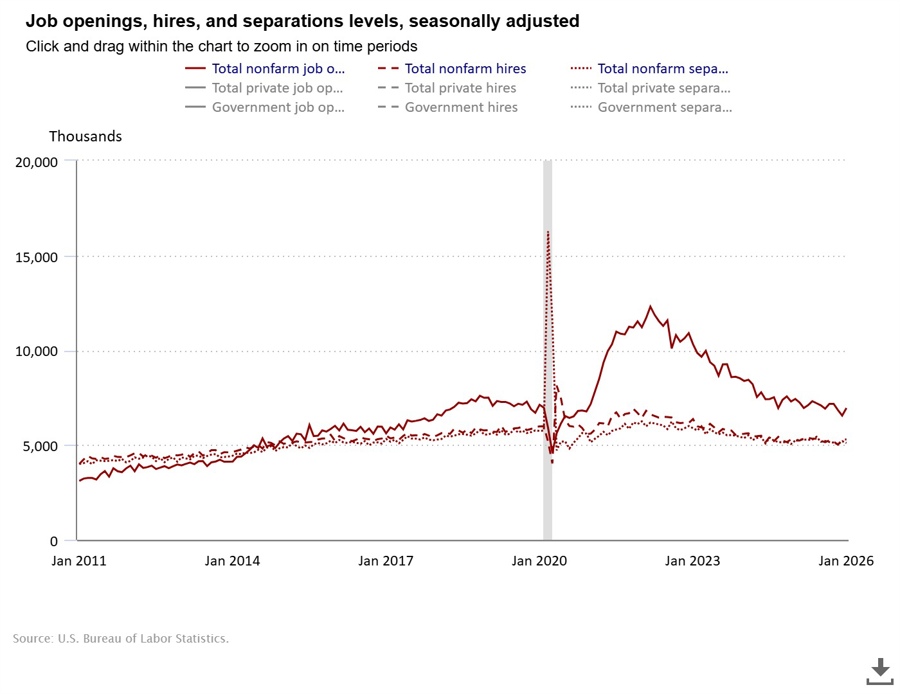
For 2025 what did the numbers do?
Job openings: Annual average 7.1 million in 2025, down 571K from 2024; openings rate 4.3% vs 4.6% in 2024.
Hires: 63.0 million in 2025, down 1.5 million from 2024; hires rate 3.3% (down from 3.4%).
Total separations: 62.8 million, down 251K from 2024; separations rate 3.3% (unchanged).
Quits: 38.0 million, down 1.3 million, accounting for 60.6% of total separations; quits rate 2.0%.
Layoffs and discharges: 21.2 million, up 1.2 million, accounting for 33.8% of separations; rate 1.1%.
Other separations: 3.5 million, down 224K, accounting for 5.6% of separations; rate 0.2%.
Economic trends from the 2025 JOLTS data
Job openings: The decline to 7.1 million (from 7.7M in 2024) suggests the labor market is cooling and demand for workers is easing. Firms appear less aggressive in posting new jobs, consistent with slower economic momentum and tighter financial conditions.
Hires: The drop in hires to 63.0 million (-1.5M YoY) indicates companies are becoming more cautious about bringing on new workers. This typically reflects moderating business expansion and a more balanced labor market after the tight conditions of the post-pandemic period.
Total separations: With separations slightly lower and the rate unchanged at 3.3%, the data suggests overall labor turnover is stabilizing. Workers are moving between jobs less frequently than during the peak of the labor market boom.
Quits: The decline in quits to 38.0 million (-1.3M) signals reduced worker confidence in finding better opportunities. Economically, the quits rate is often seen as a proxy for labor market strength, so the drop points to less worker bargaining power and slower wage pressure.
Layoffs and discharges: The increase to 21.2 million (+1.2M) indicates some normalization in layoffs after historically low levels in prior years. While not signaling a sharp deterioration, it shows firms are becoming more willing to reduce headcount as demand moderates.
Other separations: The decline to 3.5 million suggests little structural shift in retirements or other exits, reinforcing the view that most of the labor market adjustment is occurring through fewer hires and fewer voluntary quits rather than mass layoffs.
What is the JOLT Job Openings Report?
For background, the Job Openings and Labor Turnover Survey, published monthly by the U.S. Bureau of Labor Statistics, provides comprehensive data on labor market dynamics by tracking job openings, hires, and separations across approximately 16,400 nonfarm establishments nationwide. Released typically on the first Tuesday of each month at 10:00 a.m. ET, the report measures unmet labor demand and became a closely watched indicator after former Federal Reserve Chair Janet Yellen highlighted its importance in 2014. A job opening is defined as a position that is vacant on the last business day of the month, has work available, could start within 30 days, and involves active external recruiting. The survey also breaks down separations into quits, layoffs and discharges, and other separations, offering insights into worker confidence and employer demand.