- RBNZ expands media outreach after hold decision amid uncertain outlook - Breman schedule
- Reports that Iran will allow only 10-15 ships / day to pass through Strait of Hormuz
- Reserve Bank of New Zealand leaves its cash rate unchanged at 2.25%, as expected
- Bank of Korea seen holding rates on April 10 as oil shock lifts inflation risks
- PBOC sets USD/ CNY central rate at 6.8680 (vs. estimate at 6.8369)
- Israel wary of ceasefire, raising doubts over US-Iran truce durability
- Market rejoicing continues: Oil down, gold up. USD down, equities up.
- Japan real wages jump most in five years, boosting BoJ hike expectations
- Iran confirms US talks, says ceasefire hinges on finalising 10-point deal
- Anthropic warns new AI model could accelerate cyberattacks, refuses release
- Trump ceasefire announcement still to be agreed to by Iran. Markets rejoicing though.
- TRUMP HAS AGREED TO SUSPEND IRAN BOMBING FOR TWO WEEKS
- Markets expect an incoming TACO. Oil down, equities up.
- Fed’s Jefferson flags inflation risks, labour market vulnerability amid oil shock
- RBNZ to hold. Oil shock lifts inflation outlook but weak growth tempers response (preview)
- Media: “Some good news is expected from both sides soon” - citing CNN
- Iran's largest aluminium producer IRALCO has been hit in an airstrike
- RBNZ set to hold as it looks through oil shock, watches inflation persistence risks
- Iran military command say its attacks will deprive the world of the region's oil for years
- investingLive Americas market news wrap: Some optimism as we near Trump's deadline
Summary:
- Trump announces two-week pause on Iran strikes to allow negotiations
- US sees Iran’s 10-point proposal as workable framework
- Iran confirms talks via Pakistan, set for April 10 in Islamabad
- Oil drops sharply; USD weakens; equities and gold rally
- Doubts emerge over feasibility of Iran’s demands
- Unconfirmed reports suggest Hormuz transit may stay heavily restricted
- Israel signals ceasefire may not apply to Lebanon operations
- Fed’s Jefferson flags inflation risks and labour market vulnerability
- RBNZ holds, warns of inflation-growth trade-off amid oil shock
- Japan real wages surge, supporting further BoJ tightening
The key development early in the session was U.S. President Donald Trump announcing via a Truth Social post that he would pause military strikes on Iran for two weeks to allow negotiations to proceed. Trump said Washington had received a 10-point proposal from Tehran and viewed it as a workable basis for a broader agreement, adding that many major sticking points had already been resolved. The two-week window is intended to finalise and formalise a longer-term deal.
Iran subsequently confirmed it is engaging in negotiations, with state media reporting that its Supreme National Security Council had submitted the proposal via Pakistan. Talks are scheduled to begin on April 10 in Islamabad.
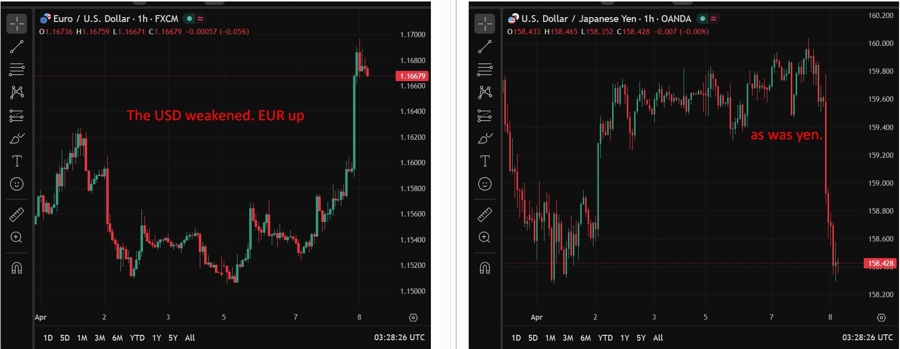
Markets reacted immediately. Oil prices fell sharply, the USD weakened, while equities and gold moved higher. Those moves extended through the session and, for now, have largely held.
That said, caution is warranted. Several elements of Iran’s reported demands appear difficult to reconcile, including the removal of all sanctions, continued support for regional proxies, and greater control over the Strait of Hormuz, including the possibility of transit fees framed as compensation.
Adding to uncertainty, unconfirmed reports later in the session suggested that Hormuz traffic could be capped at just 10–15 vessels per day during the ceasefire period. If accurate, that would represent little improvement on current flow levels and would do little to alleviate the backlog of roughly 800 vessels believed to be stuck in the Gulf. In effect, such a cap would imply that the logistical bottleneck remains largely intact despite the ceasefire.
Further complicating the picture, Israel indicated that the ceasefire does not apply to its operations in Lebanon, highlighting the risk that regional tensions could persist even as U.S.-Iran negotiations progress.
Despite these caveats, the initial market reaction has held for now, suggesting investors are leaning toward a de-escalation scenario, at least in the near term.
Away from geopolitics, central bank messaging reflected the same uncertain backdrop. Federal Reserve Vice Chair Philip Jefferson struck a cautious tone, noting rising inflation risks alongside growing downside risks to the labour market, underscoring the difficult policy trade-off ahead.
The Reserve Bank of New Zealand kept its cash rate at 2.25%, acknowledging that the Middle East conflict has materially shifted the outlook, with inflation set to rise sharply even as growth weakens. The Bank reiterated its focus on medium-term inflation and signalled it stands ready to act if needed.
In data, Japan’s February wage figures surprised to the upside, with real wages rising at their fastest pace in five years, strengthening the case for further tightening from the Bank of Japan.