- Yuan eases (just a little bit) on soft inflation despite firm PBOC guidance
- House vote failure opens door to Trump tariff repeal efforts
- ING sees yen recovery as BOJ tightening contrasts with Fed cuts
- China inflation misses forecasts as producer deflation persists
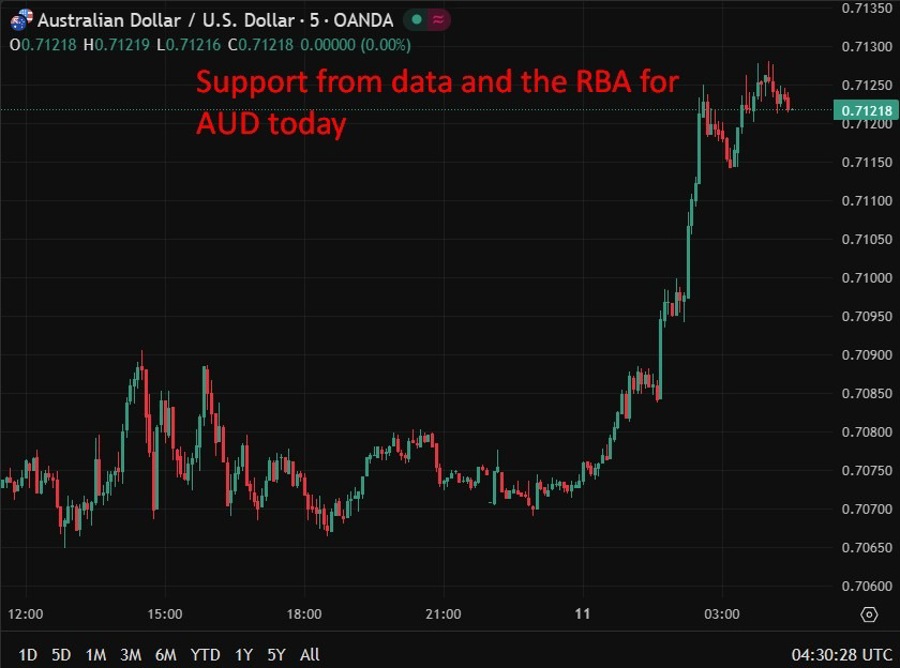
- RBA’s Hauser says inflation too high, vows action to return to target. AUD jumps.
- China January CPI 0.2% y/y (expected 0.4%)
- PBOC sets USD/ CNY mid-point today at 6.9438 (vs. estimate at 6.9109)
- Australia housing finance jumps in Q4 as markets weigh May RBA hike
- ICYMI - PBOC pledges loose policy, ample liquidity in Q4 report
- Goldman flags substantial downside risk to January jobs report
- Westpac sees RBNZ holding OCR, nudging first rate hike to December 2026
- Ford posts largest earnings miss in four years but flags 2026 rebound
- ICYMI, gold bulls galore: JPMorgan $8,000 decade-end gold scenario
- ICYMI - Fed officials signal patience as rates seen near neutral and inflation lingers
- investingLive Americas market news wrap: US retail sales disappoint
- Private survey of inventory shows huge headline crude oil build, much more than expected
At a glance:
Japan closed for holiday; yen strengthened below 153.40
China CPI undershot; PPI deflation persisted
PBOC set strongest yuan fix since May 2023
AUD hit fresh three-year highs on hawkish RBA tone
Markets pricing ~70% chance of May RBA hike
Regional equities edged higher
It was a Japanese market holiday today, with cash equities and bond trading closed. The yen nevertheless strengthened in regional trade, with USD/JPY dipping below 153.40 in Asian centres. There was no obvious fresh catalyst. Market commentary cited fading concerns about a fiscal crunch in Japan and ongoing divergence between Bank of Japan tightening and Federal Reserve easing.
I’m not entirely convinced by that narrative. On Tuesday (US time), Federal Reserve regional presidents Beth Hammack and Lorie Logan struck steady-to-hawkish tones rather than dovish ones, suggesting the Fed is in no hurry to ease further.
From China, January inflation data showed CPI rising less than expected while producer price deflation persisted. Prior to the release, the People’s Bank of China set the USD/CNY reference rate at its strongest level for the yuan since 11 May 2023. The yuan softened modestly after the data but has since recovered some ground, reinforcing the broader theme of managed stability rather than disorderly weakness.
The Australian dollar was a solid performer. AUD/USD climbed to a fresh three-year high, briefly moving above 0.7125 and marking its first sustained push above 0.71 since early 2023. The currency also gained against the euro, reaching an 11-month high, and rose to its strongest level against the New Zealand dollar in nearly 13 years.
Support came after RBA Deputy Governor Andrew Hauser reiterated that inflation remains too high and capacity constraints are evident in the economy. The RBA raised its cash rate to 3.85% last week, and markets now price roughly a 70% probability of a further hike to 4.10% at the May meeting.
Regional equities traded modestly higher, reflecting a broadly steady risk tone across Asia.
Asia-Pac stocks:
- Japan (Nikkei 225) closed for a holiday
- Hong Kong (Hang Seng) +0.43%
- Shanghai Composite +0.22%
- Australia (S&P/ASX 200) +1.64%