- Oil retraces a touch as Iran demands cast doubt on ceasefire and US boosts troop presence
- PBoC adds liquidity with CNY 500bn MLF, extends net injection streak (450bn mature)
- RBNZ’s Conway warns on purchasing power as Iran shock clouds NZ outlook, GDP 4cast slashed
- Iran distrusts Trump ceasefire peace push as US pairs diplomacy with military pressure.
- Iran proposes regional military alliance excluding US and Israel. Again.
- Iran prefers JD Vance for talks, over Witkoff or Kushner, highlighting trust issues
- PBOC sets USD/ CNY mid-point today at 6.8911 (vs. estimate at 6.8819)
- Australia February CPI cools slightly, but energy shock clouds inflation outlook
- SpaceX IPO filing imminent, report says deal could raise over $75bn
- Australian February CPI: Core (trimmed mean) 3.3% y/y (vs. expected 3.4%)
- PBOC is expected to set the USD/CNY reference rate at 6.8819 – Reuters estimate
- BoJ minutes signal gradual rate hikes as inflation nears target and oil risks rise
- Canada discusses Keystone XL revival with US amid rising energy security risks
- Fed’s Goolsbee warns energy shocks cloud rate outlook, echoing Barr stance
- Fed’s Barr says rates may stay on hold "for some time" as inflation and oil risks persist
- ICYMI: Iran allows conditional Hormuz transit as thousands of ships remain stalled
- Iran warns of mining the entire Persian Gulf if US launches ground invasion
- US to deploy 3,000 82nd Airborne troops to Gulf amid Iran war
- Israel expands conflict footprint with strike on key Russia–Iran Caspian supply route.
- Oil steady as US-Iran ceasefire talks face Israel uncertainty and broader Iran demands
- US-Iran ceasefire proposal is complex, 15 points need to be agreed. Hormuz would open.
- Oil falls on report of possible one-month ceasefire under Witkoff-Kushner plan
- Stock market rollercoaster: Tech falters, energy shines in mixed Wall Street session
There was a brief glimmer of optimism during the US session after Iran indicated that non-hostile vessels may be allowed to transit the Strait of Hormuz under coordination, raising hopes that energy flows could stabilise eventually.
That optimism strengthened after the US close when Israeli Channel 12 reported a potential one-month ceasefire framework being developed by Witkoff and Kushner. The headline prompted a modest easing in geopolitical risk premium, with oil prices falling, equities moving higher and gold also gaining.
However, markets remained cautious, with several factors quickly tempering the initial relief. The US is continuing to expand its military presence in the region, with plans to deploy around 10,000 additional troops, including elements of the 82nd Airborne Division and two Marine Expeditionary Units. This would take total US forces in the region to roughly 60,000.
The dual-track strategy has not gone unnoticed. Iranian officials and some analysts have questioned whether diplomacy is being used tactically to buy time while military positioning continues. At the same time, others argue the approach reflects a deliberate effort by President Trump to preserve optionality between negotiation and escalation. Reports suggest planning assumptions still allow for a further two to three weeks of conflict even if talks proceed.
On the ground, hostilities continued. Iran’s Revolutionary Guard said it launched missiles targeting Israel as well as Kuwait, Jordan and Bahrain, while drones struck a fuel tank at Kuwait International Airport, causing a fire. Air raid sirens were also reported across Kuwait and Bahrain, and Saudi Arabia said it intercepted additional drones.
Focus later shifted to Iran’s response to US ceasefire proposals, which included demands for the closure of US bases in the Gulf, the removal of all sanctions, an end to Israeli operations against Hezbollah, and a new framework allowing Iran to charge fees for vessels transiting the Strait of Hormuz. US officials reportedly dismissed the terms as unrealistic, highlighting the wide gap between the two sides.
As markets digested these developments, the earlier risk-on moves partially reversed, with oil prices edging higher again as traders reassessed the likelihood of a near-term de-escalation.
Separately, Federal Reserve Governor Barr said interest rates may need to remain on hold for some time, noting that inflation is still above target and warning that higher oil prices stemming from Middle East tensions could delay any move toward rate cuts, even as the labour market shows signs of stabilising. Chicago Fed President Goolsbee echoed similar sentiments.
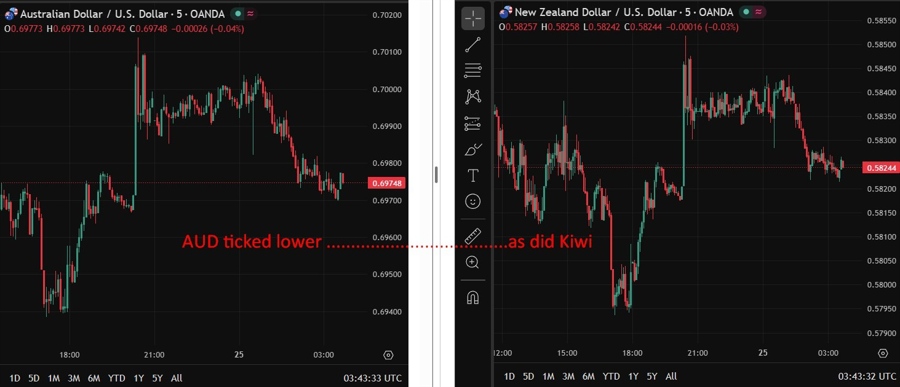
Australia’s February CPI showed modest cooling but remained above target, with the data predating the latest energy shock and leaving inflation risks skewed higher. The USD firmed, with AUD, NZD, EUR, CAD and GBP softer, while USD/JPY and USD/CHF edged up.