- Prior 50.9
- Services PMI 51.2 vs 52.5 expected
- Prior 53.5
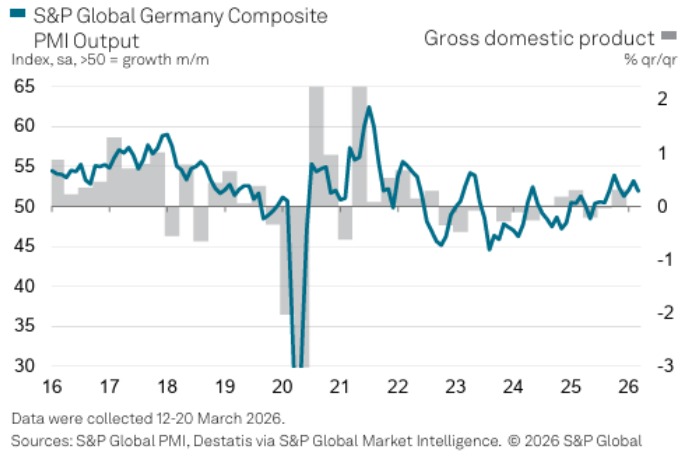
- Composite PMI 51.9 vs 52.0 expected
- Prior 53.2
I would ignore the headline figures as they don't reflect the real picture. The commentary is clearly pointing to stagflationary pressures from the US-Iran war and the longer it persists, the worse the negative impact on the economy will be.
Key Points:
- Business activity growth slows as costs spike higher in March
Comment:
Phil Smith, Economics Associate Director at S&P Global Market Intelligence:
“March's flash data show the first impacts of the war in the Middle East on growth, demand, business confidence and, perhaps most notably, prices.
"The service sector has seen an immediate negative impact. Growth in business activity has slowed sharply to its weakest since the current upturn began last September, weighed down by a drop in inflows of new work that reflects a combination of increased uncertainty and rising price pressures.
"The big surprise is perhaps the acceleration in growth in the manufacturing sector. Reports from goods producers indicate that demand has in some cases been boosted by companies reacting to the disruption and uncertainty brought on by the war in the Middle East, with some bringing forward purchases over concerns about potential supply disruption in the coming months. Output expectations have been revised down, which is a sign that the surge in factory activity will likely be short-lived.
"Supply-chain pressures have already started building, with average lead times on inputs lengthening to the greatest extent for over three-and-a-half years in March. Moreover, the manufacturing sector is at the sharp end of the surge in inflationary pressures, seeing input costs increase at a rate not seen since late-2022."