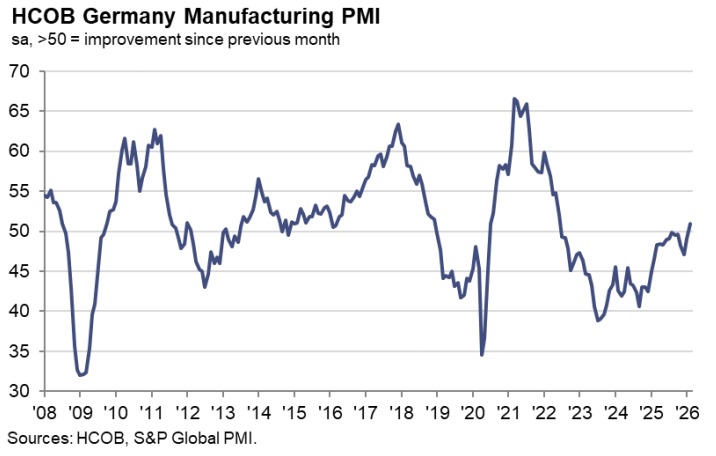
- Prior was 49.1
Key findings:
- Business expectations reach highest since February 2022
Comment:
Commenting on the PMI data, Cyrus de la Rubia, Chief Economist at Hamburg Commercial Bank, said:
“It finally looks like things are turning around for Germany’s manufacturing sector. For the first time in over three-and-a-half years, the headline PMI has climbed back above 50. That’s thanks to faster growth in output, a solid jump in new orders - helped a bit by stronger export demand - and longer delivery times, which usually signal rising demand. Most of the gains came from makers of intermediate and capital goods. For a sector that hasn’t had much to celebrate in recent years, this is already a pretty upbeat development.
“Input prices shot up in February, rising much faster than the month before. From what people in the industry are saying, costs have been rising from all kinds of directions - metals, energy, wages, electronic components, and even the newly introduced Carbon Border Adjustment Mechanism (CBAM). Companies did manage to pass some of these higher costs on to customers, but margins likely still took a hit.
“Companies kept trimming their staff, although not as sharply as in January, probably because demand has picked up a bit. With output growing for eleven of the past twelve months while employment has been cut significantly during the same period, manufacturers seem to have boosted their productivity. That could set a solid foundation for more sustainable growth in the months ahead.
“Optimism about future production has risen from an already high level. A lot of that confidence likely comes from government infrastructure stimulus and the big jump in defence spending, both of which are driving domestic demand. There really does seem to be a structural shift underway, as over the past five months total orders have consistently outpaced export orders. We expect domestic demand to be the main driver of manufacturing growth this year.”