The ANZ Business Outlook survey is a well-regarded monthly survey tracking the sentiment of hundreds of New Zealand businesses concerning the economy's future. It measures confidence, hiring, investment, and inflation expectations, with findings recently showing, for instance, a 30-year high in December 2025.
From the Reserve Bank of Australia we get its 'Bulletin'. The Reserve Bank of Australia Bulletin is published quarterly in March (or the end of February for this one today!), June, September, and December. It contains articles on the economy and financial system from teams throughout the Reserve Bank of Australia. Its unlikely to be an AUD mover much upon release.
Finally, the Japan Cabinet Office Leading Index. This is a forward-looking composite indicator aimed at signalling potential turning points in Japan’s business cycle around three to six months ahead. It draws together roughly a dozen underlying measures, such as machinery orders, inventory ratios, equity prices and consumer sentiment, to provide an early read on future economic momentum. Published monthly by the Cabinet Office as part of its broader Composite Indices of Business Conditions (which also include coincident and lagging gauges), the index is used to anticipate shifts between expansion and contraction. While the coincident index reflects current conditions, the leading index focuses on what lies ahead. Stronger-than-expected readings are typically interpreted as supportive, at the margin, for the Japanese yen, as they imply improving economic prospects.
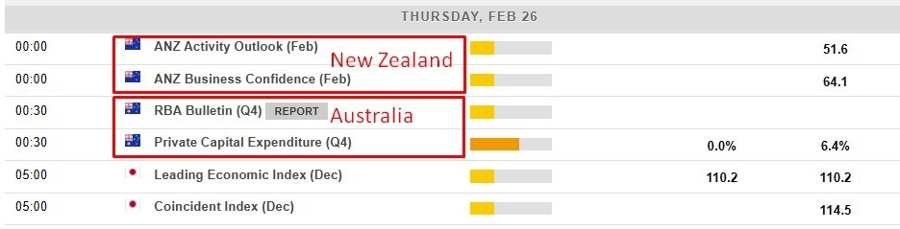
- This snapshot from the investingLive economic data calendar.
- The times in the left-most column are GMT.
- The numbers in the right-most column are the 'prior' (previous month/quarter as the case may be) result. The number in the column next to that, where there is a number, is the consensus median expected.
- I’ve noted data for New Zealand and Australia with text as the similarity of the little flags can sometimes be confusing.