Japan and South Korea warn they are ready to act against FX volatility as yen and won slide on dollar strength tied to Middle East tensions.
Summary:
Japan and South Korea voiced concern over sharp depreciation in the yen and won.
Officials said they stand ready to respond to excessive foreign-exchange volatility.
The currencies have weakened amid dollar strength driven by geopolitical tensions and rising oil prices.
The yen is nearing the 160-per-dollar level that markets see as a potential intervention trigger.
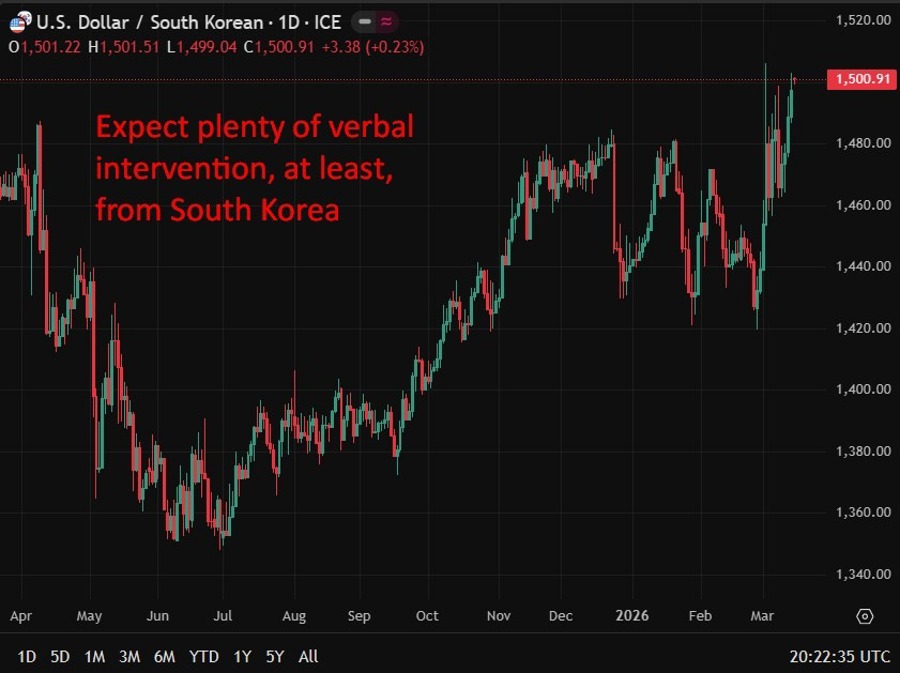
The Korean won has already breached 1,500 per dollar for the first time since 2009.
Authorities say they will monitor FX markets closely and act if disorderly moves emerge.
Some policymakers privately doubt intervention will work if geopolitical tensions continue to fuel dollar demand.
Japan and South Korea have jointly signalled their readiness to respond to excessive currency volatility after sharp declines in both the Japanese yen and the South Korean won, developments that officials say are being driven by heightened geopolitical tensions and surging energy prices.
In a statement released following their annual bilateral meeting in Tokyo on Saturday, Japan’s Finance Minister Satsuki Katayama and South Korea’s Finance Minister Koo Yun-cheol expressed “serious concern” about the recent weakness in their currencies. Both ministers said authorities were prepared to act if market volatility became excessive or disorderly.
The warning comes as global markets react to escalating tensions linked to the U.S.–Israeli war on Iran, which has driven safe-haven flows into the U.S. dollar while pushing up oil prices. The stronger dollar and rising energy costs have placed additional pressure on currencies in economies that rely heavily on imported energy, including Japan and South Korea.
The Japanese yen recently touched its weakest level in around 20 months and is approaching the psychologically important 160-per-dollar threshold, a level many market participants believe could trigger intervention from Japanese authorities. Meanwhile, the South Korean won has already crossed a key milestone, breaching 1,500 per dollar earlier this month for the first time since the global financial crisis in 2009.
Speaking after the meeting, Katayama said both governments recognised that financial markets were experiencing heightened volatility, particularly in foreign exchange. She stressed that Japan remained fully prepared to respond if currency moves threatened economic stability or placed undue strain on households already grappling with rising energy costs.
The ministers reaffirmed their commitment to closely monitor foreign-exchange markets and to take appropriate measures if needed to address excessive volatility.
Despite the public warnings, some policymakers in Tokyo privately acknowledge that direct intervention may have limited effectiveness if geopolitical tensions persist. Continued safe-haven demand for the U.S. dollar, particularly during periods of conflict, could overwhelm attempts to stabilise the yen through market operations alone.