Here is a massive number: $8 Trillion
European countries hold $8 trillion in US bonds and equities. That is almost twice as much as the rest of the world combined.
It's also what's at stake over Greenland as Europe finds out that Trump plans to conquer Greenland and will put tariffs on seven European countries until he gets his way.
Deutsche Bank makes the point that if you start existentially threatening the western alliance, why on earth would Europeans keep funding US spending? We already saw Danish pension funds repatriating cash and dumping dollars this time last year.
"We spent most of last year arguing that for all its military and economic strength, the US has one key weakness: it relies on others to pay its bills via large external deficits," writes DB.
Remember the Munich Security Conference last year? The US rhetoric scared Europe and kickstarted a massive wave of defense spending. That coincided with the German election as well.
DB argues this could be the same type of catalyst for political cohesion. Nothing unites a dysfunctional family like an outsider trying to buy the furniture. Even the euro-sceptic far-right leaders in France and Germany are bristling at this.
"The extent to which a unified European strategy arises over the next few days to address US pressure will be a key near-term signal," DB writes.
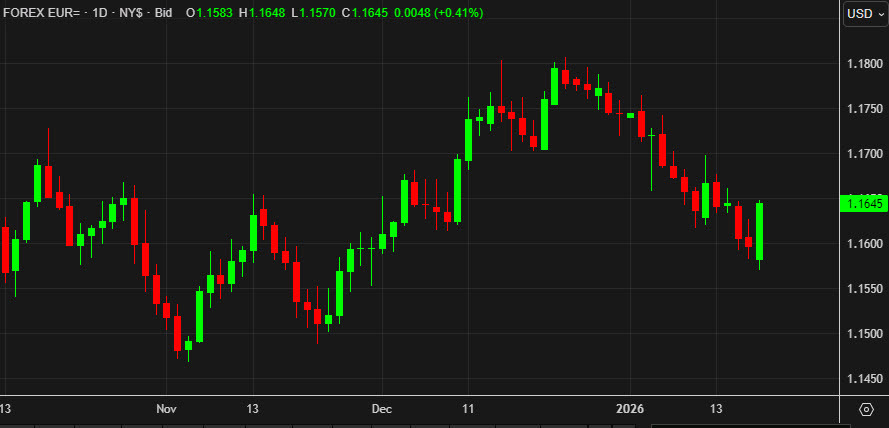
They think any dip in the euro will be a buying opportunity. So far, they've been proven right. The euro opened at a six week low today but is now up 48 pips to 1.1645.
DB notes that the EU "anti-coercion instrument" is really a capital markets too.
With the US Net International Investment Position (NIIP) at record lows (meaning the US owes the world more than ever), the interdependence is at an all-time high.
"It is a weaponization of capital rather than trade flows that would by far be the most disruptive to markets," DB writes.
Eyes will be on Treasury yields on Tuesday when US markets reopen.