Dos Bocas matters less as a global crude-supply swing factor than as a refining and fuel-security risk. In today’s market, that still matters.
Summary:
- Dos Bocas is Mexico’s flagship new refinery and a core part of Pemex’s energy self-sufficiency push.
- Nameplate capacity is about 340,000 bpd, but recent runs have been closer to roughly 205,000 bpd, or about 60% utilisation.
- That means a fire matters more for refined products and regional balances than for outright global crude supply.
- In the current backdrop of Iran-war supply anxiety and fragile refining chains, even a local disruption reinforces the broader bullish energy-risk narrative. This last point is an inference based on the refinery’s role and current underperformance.
A reported major fire at Mexico’s Dos Bocas refinery lands at an awkward time for energy markets, not because the site is big enough on its own to reshape the global crude balance, but because it adds another layer of fragility to an already tense refining and supply backdrop.
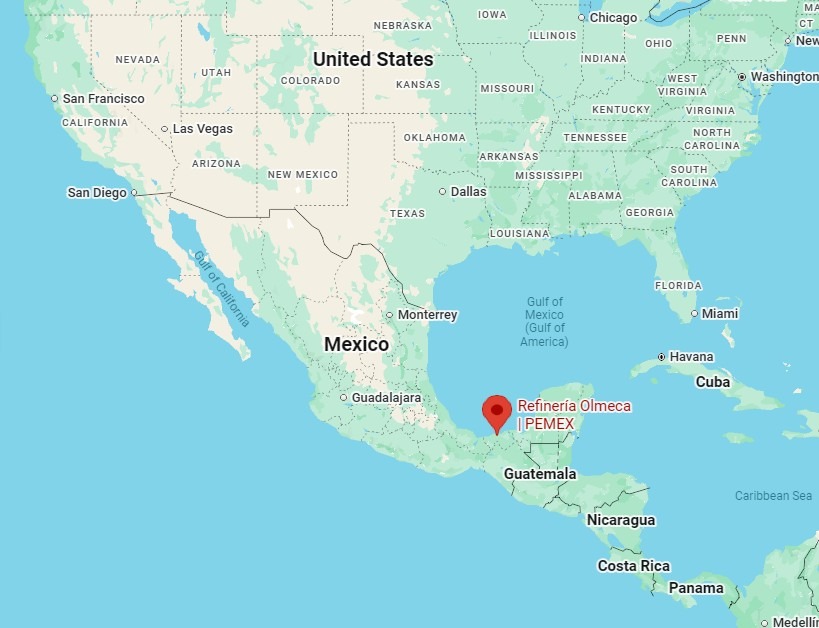
Dos Bocas, also known as the Olmeca refinery, is Pemex’s flagship downstream project in Tabasco and one of the most politically important energy assets in Mexico. The refinery was built to reduce Mexico’s dependence on imported fuels and sits at the heart of the country’s long-running push for greater fuel self-sufficiency. Its design capacity is around 340,000 barrels per day.
The problem is that the plant has struggled to run anywhere near that level. Reuters reported last month that it processed about 205,000 bpd in January, while more recent operating data cited by OPIS showed February throughput near 205,234 bpd, or roughly 60.4% of capacity, after hitting a high of 263,402 bpd in December.
That operating profile shapes how markets should think about any fire. This is not a Strait-of-Hormuz-style event. Even at full design rates, Dos Bocas is not large enough to materially change the global crude equation on its own. But it is important to Mexican fuel supply, to Pemex’s refining strategy, and to the broader story of whether Mexico can replace imported products with domestic output.
It also comes after a deadly March fire outside the refinery that killed five people, although Pemex said operations were not affected in that earlier incident.
In market terms, the bigger significance is cumulative. When geopolitical risk is already elevated and product markets are sensitive to refining outages, another disruption at an underperforming but strategically important refinery adds to the sense that the global energy system has less buffer than usual. That supports the refining-tightness narrative more than the outright crude-supply narrative. This is an inference, but it is the most sensible way to frame Dos Bocas in the current context.