The report notes that Tokyo is considering to release its national oil stockpile, even without coordinated international action.
The headline sounds convoluted but there's more nuance to it when you put things into context. Now, Japan is not an oil exporter and in fact relies heavily on oil imports - one of the biggest economies to do so. And for a better overview, over 90% of Japan's crude oil imports are drawn from the Middle East. That means almost all of it has to pass through the Strait of Hormuz, which is now in de facto closure.
So, why is Japan planning this national oil reserves release?
The whole purpose is to try and strategically lower oil prices. Or in their own words if and when the time comes, for "energy security reasons".
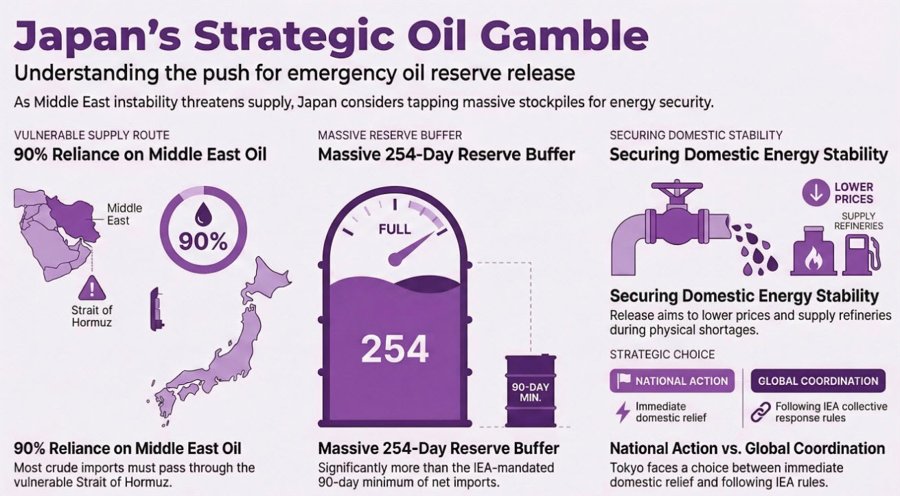
The legality of the move is questionable and in practical terms, Japan can't just outright release reserves for the sole purpose of lowering energy prices. But with the source of their imports now being stifled, there is a literal shortage of physical oil arriving at Japanese refineries.
In terms of what kind of buffer Japan has to work with, the country is estimated to hold around 254 days' worth of oil in its reserves capacity. So, the release of the reserves will at least help to calm the domestic situation before it gets more heated.
Now, Japan doesn't exactly have to seek permission per se in releasing its own oil reserves. However, they are bound by the IEA coordination rule, which requires countries to maintain a minimum of 90 days of net oil imports as emergency reserves.
And typically during a global crisis, which this arguably is one, the IEA tends to want to lean towards a more collective and coordinated response. That being by pushing for multiple countries to release oil reserves simultaneously. Hence, why it might be a bit of bad form on the part of Tokyo if they are to push forward with this idea.