
Crude oil futures opened the new week with a sharp gap higher, reflecting a renewed geopolitical risk premium following weekend developments in the Middle East. Early trade has been volatile and two‑sided, with price discovery stretching across a wide intraday range (roughly $69.20 to $75.33 on the session data shown), before settling back into the low‑$70s.
From a technical analysis perspective, the key takeaway is that the market has not simply “one‑way squeezed” higher. Instead, the gap has forced heavy two‑way trade, with multiple POC (point‑of‑control) clusters forming at prices that now matter as accept/reject zones for the rest of the day.
Ongoing tensions in the Middle East reached a critical point on March 2, 2026, when Saudi Aramco's Ras Tanura refinery was forced to shut down following a targeted drone strike. The facility, which serves as one of the world's most vital energy hubs, was hit by what reports identify as an Iranian Shahed-136 drone, leading to a small, isolated fire that was quickly brought under control. While no casualties or major structural damage were reported, the precautionary closure of the plant caused immediate ripples through the global economy, sending crude oil prices up by 8% in early Monday trading. This attack on Saudi energy infrastructure comes amid a broader regional escalation, including strikes on shipping near the Strait of Hormuz, highlighting the growing volatility affecting international trade and energy security.
Crude oil futures technical analysis: What the technical analysis is saying (4H + 1H read)
Current 4H view: The opening sequence shows very heavy participation and wide ranges: Typical of a headline gap where liquidity is thin and price is forced to auction quickly through prior value. Even where delta is not uniformly bullish, the presence of large POC clusters suggests real business being done, not just a “thin pop.”
Current 1H view: After the initial volatility, subsequent 1H bars show improving buy-side control (more positive delta and rising value/POC), consistent with a market trying to accept higher prices rather than immediately mean‑revert the gap.
The practical implication: this is still a headline-driven tape, but our technical analysis at investingLive.com suggests there is meaningful participation supporting the move, as long as key POC support levels hold.
Key levels for traders and investors
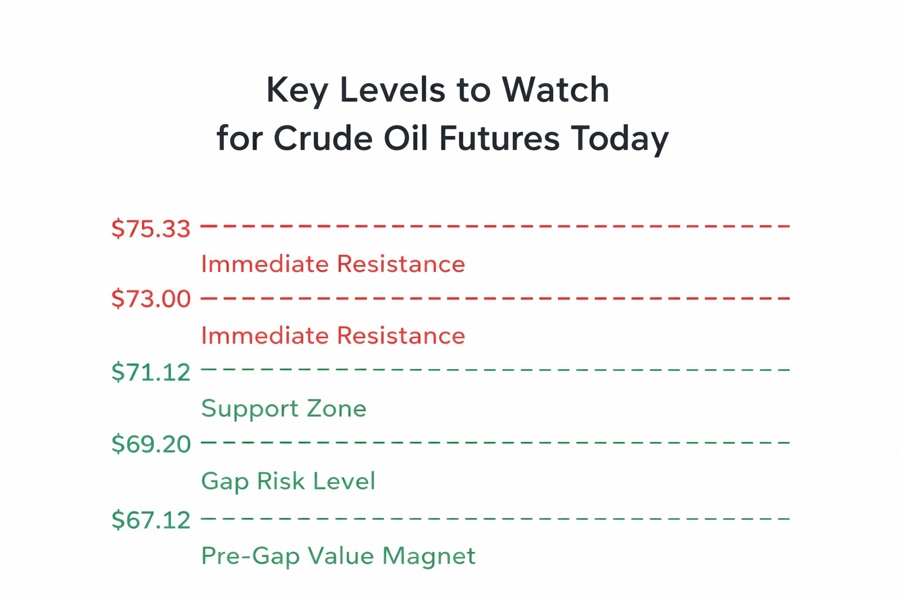
1) Immediate resistance (where momentum needs acceptance)
$73.00: A psychological and structural pivot. Acceptance above $73 (holding, not just tagging) keeps the upside pressure intact.
$75.33: The session high shown. If the market re-tests this zone, watch whether volume expands and delta stays constructive (breakout) or whether you see heavy two‑way trade and fading delta (rejection).
2) First support zone (bull case “must hold” area)
$71.12 (POC cluster): This is the most important near-term reference. If price rotates down, this is the first level where buyers need to show they can defend value.
Holding $71.12 and rebuilding positive delta = constructive consolidation.
Losing $71.12 with expanding sell imbalance = rising odds of a deeper retracement.
3) Gap-risk / mean-reversion magnets
$69.20: Session low shown. A move back into this zone would indicate the market is no longer accepting higher prices and is attempting to repair/close the gap.
$67.12 (pre-gap POC cluster): This is the key “pre‑event” anchor you referenced. If the gap fully fails, this becomes a high-probability magnet because it represents prior heavy trade/value before the weekend repricing.
Crude oil futures technical analysis scenarios to watch today (02 March, 2026)
Scenario A: Continuation / acceptance higher
Price holds above $71.12, rotates around $73, and POC migrates upward.
Traders will watch for a clean acceptance above $73.00 as a gateway to re-test the $75.33 high.
Scenario B: Volatile consolidation
Wide two‑way trade persists between roughly $71–$73.
Best read is whether we later today (or this week) see buyers absorbing pullbacks (constructive) or sellers absorbing rallies near $73 (warning sign).
Scenario C: Gap fade / retracement
A decisive breakdown below $71.12 shifts focus to $69.20, with $67.12 as the deeper “pre-gap value” magnet if the gap fully unwinds.
Bottom line: The market is repricing fast, but the technical analysis suggests key value is being established rather than purely “air‑pocket” trading. For today, $71.12 is the pivotal support, while $73.00 and $75.33 define the upside acceptance/rejection zones.
Risk note: headline-driven energy markets can move sharply in both directions; sizing and stop discipline matter more than precision levels.
