
To be fair, this is a call that many analysts were priming since the weekend already. So, UBS is very much just piling on top of that in arguing for strong upside risks to the oil market if the Middle East conflict carries on for much longer.
Of note, the firm is now raising its forecast for Brent crude oil to average about $71 in Q1 2026. That roughly implies their March forecast of around $80 for the commodity. Meanwhile, they're also raising their 2026 average to $72. That reflects a $10 premium to what they were forecasting before the US-Iran conflict.
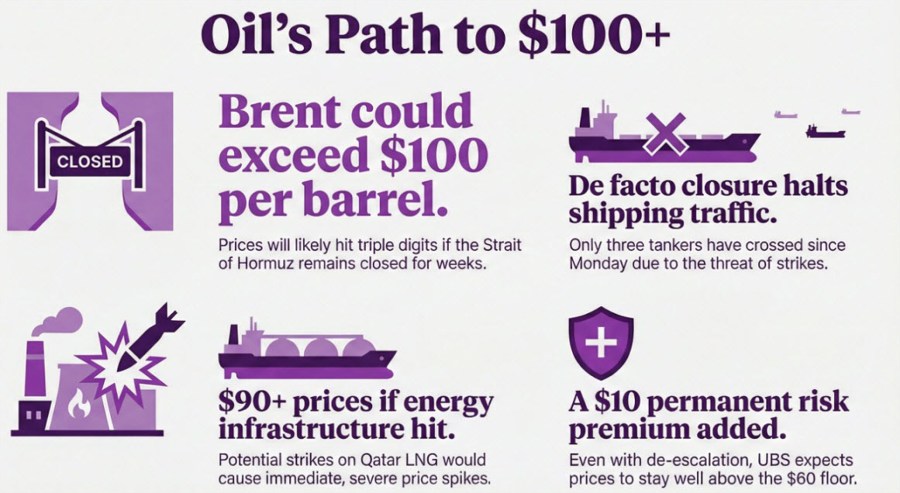
UBS argues that the risk for oil prices is to the upside "on a structurally higher risk premium". Adding that "potential strikes on energy infrastructure such as on Qatar LNG could push Brent up to $90+, depending on the severity of the strikes".
As for the case of seeing triple-digit oil prices, the firm notes that:
"If the close of the Strait of Hormuz extends beyond the next couple of weeks, Brent could see further upside of >$100."
That being said, they are warning that a de-escalation in the coming days could see that risk premium for oil prices reverse. However, it would not result in Brent prices falling all the way back down to ~$60 in their view.
As mentioned earlier, the Strait of Hormuz is not officially closed per se. However, the threat of IRGC strikes on any tankers passing through is enough to place the passage way under a de facto closure at the moment.
According to Kpler data, there has just been three oil and gas tankers that have crossed the Strait of Hormuz since Monday. There are vessels on either side of the strait but no one is willing to go through it.

