
The Bank of Canada kept rates unchanged at 2.25%.
Key points from the statement:
BoC held the policy rate at 2.25%, maintaining a steady stance as inflation remains near target and the economy continues to adjust to global trade disruptions.
Global conditions remain mixed: major economies are resilient despite US trade protectionism, with strong US consumption and AI investment, firmer-than-expected euro-area growth, and continued weakness in China’s domestic demand.
Canada’s Q3 GDP surprised to the upside at 2.6%, but this strength was driven by volatile trade flows; underlying domestic demand was flat, and overall GDP is expected to weaken in Q4.
Labour market shows tentative improvement, with employment gains over three months and unemployment falling to 6.5%, though trade-sensitive sectors remain soft and hiring intentions subdued.
Inflation remains near target, with CPI at 2.2% and core measures between 2½% and 3%; underlying inflation is assessed around 2½%, and near-term CPI will be noisy due to last year’s GST/HST holiday effects.
Policy stance deemed appropriate, with the current rate viewed as the right level to keep inflation close to 2% amid structural trade adjustments; BoC remains ready to respond if the outlook deteriorates.
The rate has moved down from 5.0% since it's first cut in June 2024. In October , the central back cut by 25 basis points to the current 2.25%. At the time the central bank concluded:
BoC cut the policy rate by 25 bps to 2.25%, citing ongoing economic weakness and inflation expected to stay near the 2% target.
US trade actions and uncertainty are significantly weighing on Canada, contributing to a 1.6% Q2 contraction, weak exports, and soft business investment.
Labour market remains soft, with job losses concentrated in trade-sensitive sectors, a 7.1% unemployment rate, and slowing wage growth.
Inflation is running slightly above expectations, with CPI at 2.4%, core measures sticky around 3%, but underlying pressures expected to ease.
GDP growth outlook remains subdued, with projections of 1.2% in 2025, 1.1% in 2026, and 1.6% in 2027, as excess capacity persists and the economy works through trade-related structural damage.
Since then, the employment situation has shown increasing signs of life, while inflation remains above and below 3%.
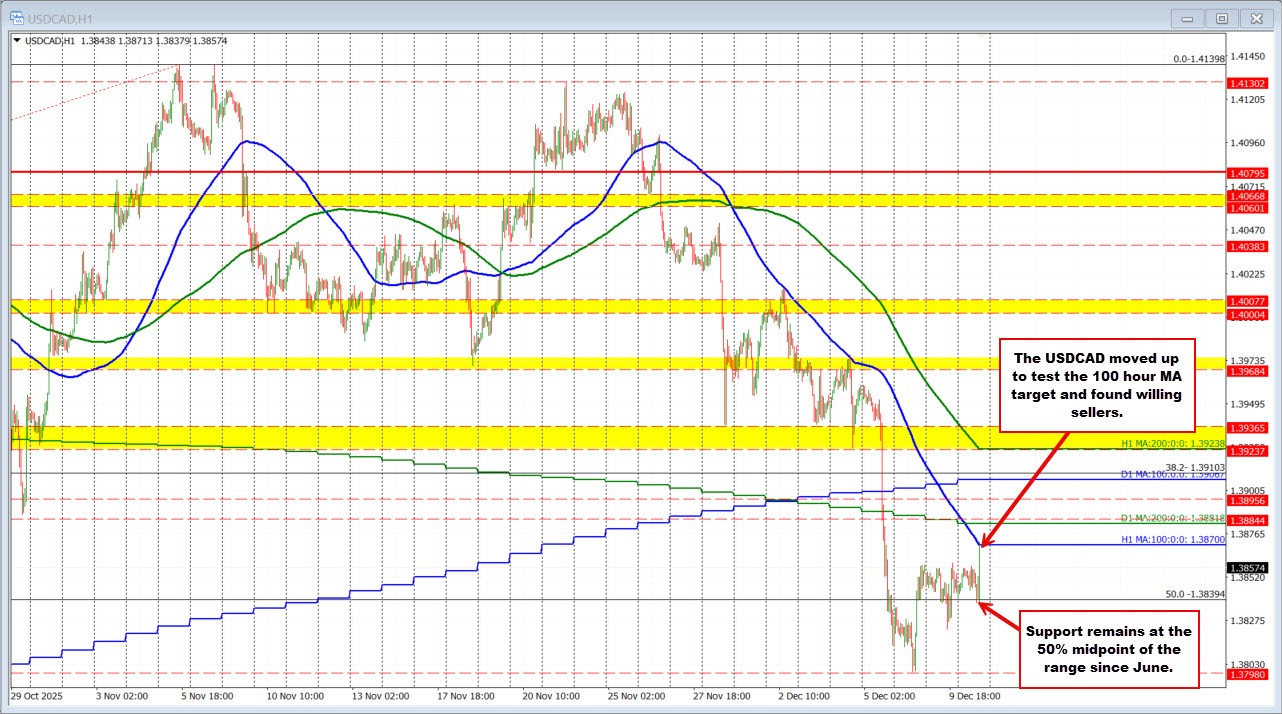
The USDCAD was trading at 1.3848 just before the decision.
The USDCAD edged higher following the Bank of Canada statement and Macklem’s comments, which were interpreted as slightly less hawkish. The pair touched a session high of 1.3871 before easing back toward 1.3855.
From a technical perspective, buyers ran into willing sellers at the first key upside target — the 100-hour moving average (blue line on the chart). A break above that level, followed by a move through the 200-day moving average at 1.3882, would shift more control to the buyers and open the door for a deeper corrective move higher.
On the downside, the 50% midpoint at 1.3839 continues to act as a key support level. Holding above that line keeps the near-term bias tilted modestly higher; a break back below it would weaken the bullish momentum and refocus traders on the earlier lows.
Macklem and Senior Deputy Gov. Carolyn Rogers will start their press conference at around 10:30 AM ET.

