White House economic advisor Kevin Hassett crossed a line today when he said the authors of a paper who said US companies were paying tariffs should be 'disciplined'.
The paper in question concluded that 90% of the tariff burden is being shouldered domestically and he called the "the worst paper I’ve ever seen in the history of the Federal Reserve system."
That paper was published Feb 12 and draws the same conclusion has a handful of other papers about the costs of tariffs.
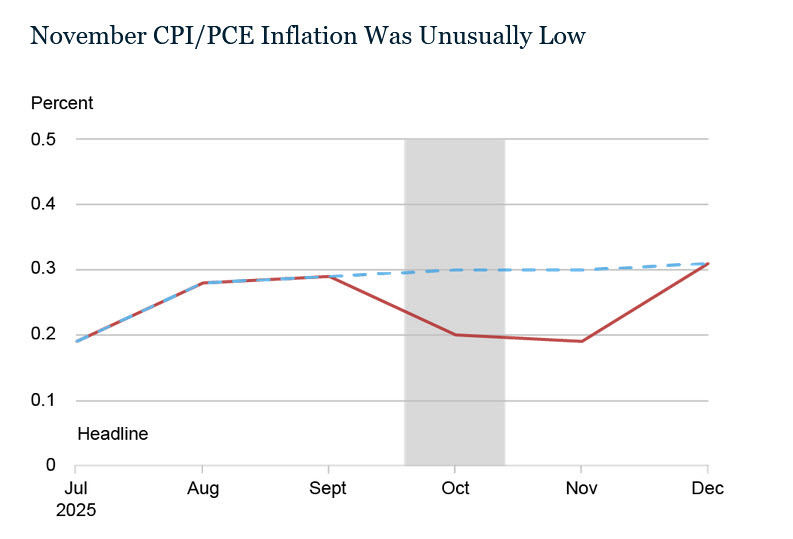
Now the NY Fed is out with another paper and he won't like it either. The report aims to look through government shutdown effects on economic data collection and said "the aggregate trend for December stands at 2.83% , an increase from 2.55% in September."
The report says:
Data releases for inflation have been scarce over the past four months due to the government shutdown. As a result, until January 22 no personal consumer expenditures (PCE) data were available beyond September and the consumer price index (CPI) had many missing entries for the one-month changes for October and November. In this post, we use an extended version of the New York Fed’s Multivariate Core Trend (MCT) inflation model to examine changes in underlying inflation over this period. The MCT model is well-suited to do so because it decomposes sectoral inflation rates into a trend (“persistent”) and a transitory component. In contrast to core (ex-food and energy) inflation, its aim is to remove all transitory factors, thus identifying the underlying trend. In addition, since the model can handle missing data—like for October—it can produce values for trend inflation for months where little or no data were released.
The report cautions Fed officials on relying on disinflationary November data as when it's aggregated with December numbers, there was a transitory effect.