Summary:
China’s FX reserves rose USD 11.5 bn in December to USD 3.36 trn
Record near-USD 1 trn trade surplus has renewed yuan valuation debate
Headline yuan strength masks deep real-exchange-rate undervaluation
Weak domestic demand and deflation underpin export competitiveness
Analysts see limited scope for yuan appreciation without policy risks
China’s foreign-exchange reserves edged higher in December, closing out a year defined by an extraordinary surge in exports and renewed debate over the true value of the yuan. Official data showed reserves rose by USD 11.5 bn from November to USD 3.358 trn at end-December, helped in part by a softer U.S. dollar. The Wall Street Journal (gated) had the report.
The increase comes against the backdrop of China recording a near-USD 1 trn trade surplus across the first eleven months of 2025 — a historic milestone that has reignited scrutiny of Beijing’s tightly managed currency regime. Despite efforts by the Trump administration to curb China’s export dominance, economists increasingly argue that currency dynamics, rather than industrial policy alone, have played a decisive role.
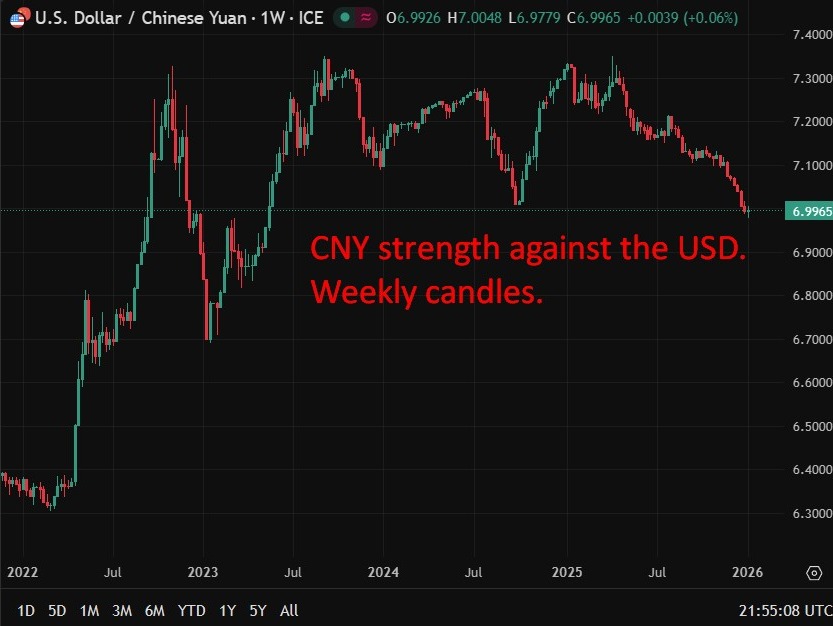
While the yuan appreciated around 3.3% against the U.S. dollar in 2025 and recently strengthened past the psychologically important 7.00 level, many analysts say this headline performance masks a far weaker underlying picture. Measures of the yuan’s real effective exchange rate, adjusted for inflation differentials, suggest the currency has fallen sharply from its 2022 peak and remains deeply undervalued relative to fundamentals.
That undervaluation has amplified China’s export competitiveness across a wide range of goods, reinforcing external surpluses even as domestic demand remains weak. Economists argue the imbalance reflects structural issues: a prolonged property downturn, subdued household spending, deflationary pressures, and an investment shift away from real estate toward green and high-tech manufacturing.
Calls for a stronger yuan, however, are met with caution. Beijing is widely seen as reluctant to allow meaningful appreciation, and analysts warn that a stronger currency could worsen deflation by lowering import prices and dampening export growth. Without a sustained recovery in consumption and the property sector, currency appreciation risks becoming counterproductive.
As policymakers signal little urgency to deploy large-scale stimulus, several research houses expect China’s real exchange rate to continue drifting lower over the coming years, leaving the trade surplus intact and currency debates unresolved.