Summary:
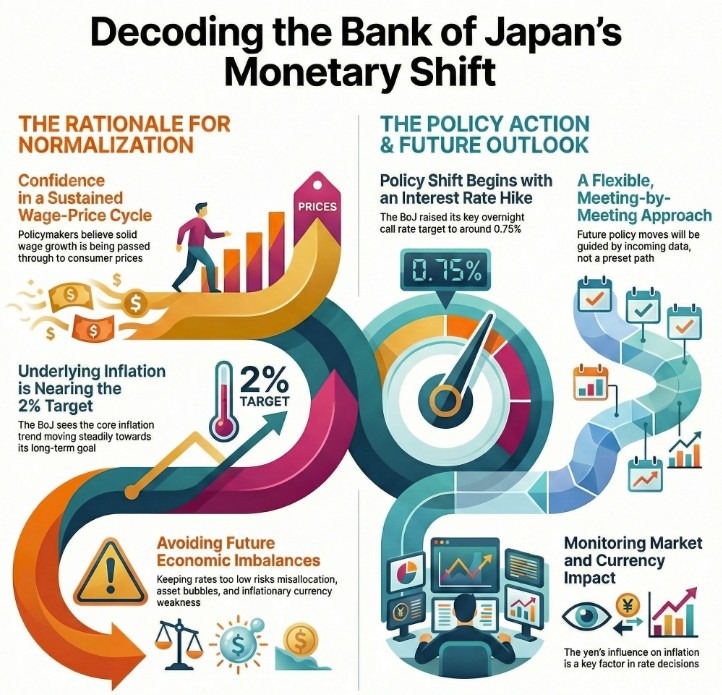
Members saw wage gains and pass-through supporting a durable wage–price cycle
Real rates still negative; credit growth and easy conditions viewed as increasingly stimulative
Neutral rate highly uncertain; preference for flexible, meeting-by-meeting adjustments
Yen weakness and long-end moves discussed via inflation channel, not as a policy target
The Bank of Japan’s December meeting minutes show policymakers becoming more confident that Japan is sustaining a moderate wage–price cycle, and using that assessment to justify another step toward less accommodative policy. The Policy Board voted unanimously to raise the operating target for the uncollateralized overnight call rate to around 0.75%, up from around 0.5%, and lifted the complementary deposit facility rate to 0.75% while raising the basic loan rate to 1.0%.
On the economy, staff judged Japan to be recovering moderately, albeit with pockets of weakness. Exports and production were described as broadly flat, with headwinds from U.S. tariff increases and a likely payback from front-loading, while domestic demand was supported by accommodative financial conditions and expected government measures. Consumption was resilient but constrained by price rises; sentiment was said to have improved as food inflation cooled and equities rose.
Inflation was still running around 3% for CPI ex-fresh food, with policymakers expecting disinflation later in fiscal 2025 as food-price effects fade and energy support measures weigh. At the same time, members increasingly emphasised the “underlying” trend: wage growth looked set to remain solid into 2026, and firms were still passing higher labour costs through to prices. Several members argued that the underlying inflation process was moving steadily toward (or already broadly consistent with) the 2% target.
That combination, improving confidence in the baseline, and concern that policy was becoming too stimulative relative to fundamentals, underpinned the decision to hike. Members noted real rates remained negative, bank lending (including to real estate) was expanding, and there were signs of front-loaded corporate bond issuance. Some warned that leaving real rates far below equilibrium risks future macro imbalances and misallocation, while others highlighted Japan’s unusually low real policy rate globally and the potential for currency weakness to feed inflation.
On sequencing, the minutes lean toward meeting-by-meeting flexibility rather than a preset path. Most members preferred to adjust policy as appropriate each meeting, guided by underlying inflation indicators, anecdotal intelligence, and the evolving response of activity and prices. Discussion of the neutral rate stressed uncertainty and “latitude,” with members favouring an iterative approach that gauges how the economy reacts at each step rather than targeting a specific neutral level.
Markets were an explicit part of the conversation. Members noted 10-year yields had risen and the yen had weakened in the intermeeting period; some interpreted break-evens as finally pricing durable 2% inflation, while others pointed to risk premia and urged close monitoring amid global fiscal and inflation uncertainty. Members also reiterated that FX is not the direct aim of policy, but the inflation consequences of yen moves can matter for rate decisions.
Full text of the minutes here:
---
From the day: